

I used to love playing video games. Sometimes, when I wanted to breeze through a difficult level, I wouldn’t grind for hours, I’d find a cheat code. This post is exactly that, but for your career. Specifically, for people who are interested in job hopping.
I ask that you please keep in mind that I am still young (28 years old) and will be sharing some hard facts about myself.
I believe that no matter what you are going through, there is always a solution to your problems, and the only person who is going to save you is you. You can't change your circumstances, but you can change yourself.
What is Job Hopping?
Job hopping is a strategy where professionals switch jobs frequently—typically every 1 to 2 years—rather than staying with one company for a long period.
In the "old game," players stayed at one company for 30 years to get a gold watch. In the modern game, job hoppers are the ones speed-running their way to higher salaries and senior titles.
The Financial Advantages of Job Hopping: Why Stay or Go?
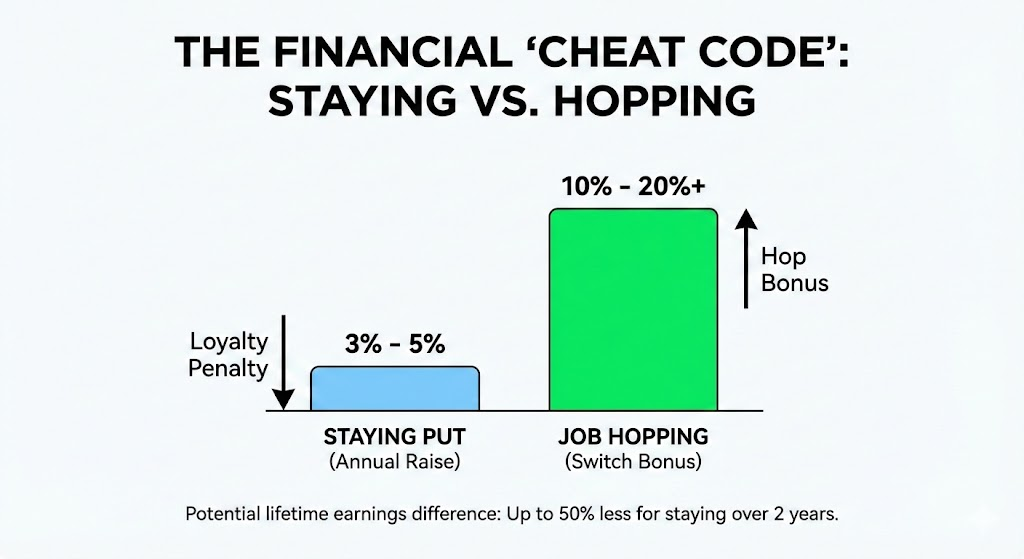
Is loyalty costing you millions? According to a Forbes article, staying employed at the same company for over two years can result in earning 50% less over your lifetime. This chart illustrates the stark contrast in potential salary growth between staying put and job hopping.
Here is the math behind the cheat code:
The "Loyalty" Penalty: High performers who stay put often receive standard annual raises of just 3% to 5% (often barely matching inflation).
The "Hop" Bonus: When you switch jobs, the average salary increase is between 10% to 20%. In exceptional cases (or if you are a savvy negotiator), this can jump to 30%.
Data from Jobvite suggests that 45% of job hoppers report receiving a pay raise of over 10% when switching, compared to the <3% average for staying put.
As I learned from a young age: "You don’t ask, you don’t get."
Leveling Up: Career Advancement & Skill Acquisition
Money isn't the only stat you boost. b hopping can also be a career accelerator. This timeline compares the slow grind of internal promotion with the "speed-run" possible through strategic job changes.
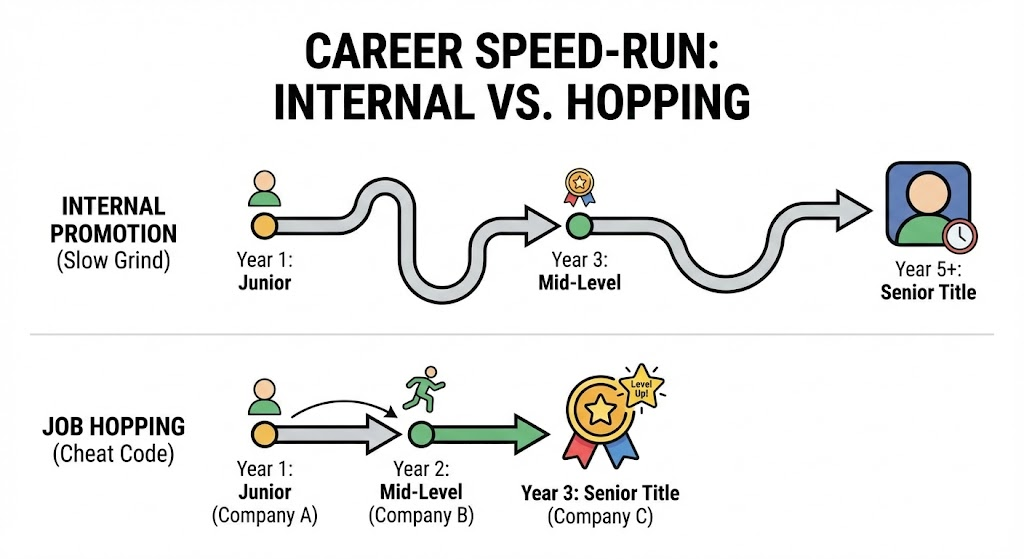
Speed-Run Promotions: Internal promotions are often slow. You might wait 3 years for a "Senior" title internally. By hopping, you can apply for that Senior role at a new company immediately.
Skill Stacking (XP): As noted by experts at Iberdrola, job hoppers often have higher "learning capacity" and "adaptability" because they are constantly learning new systems. You aren't just one cog in a machine; you’ve seen how five different machines work.
The "Boss Fight": Handling the Downsides
Every cheat code has a cooldown. It's important to weigh the advantages against the potential risks. Here's a quick balance sheet of the pros and cons of job hopping.
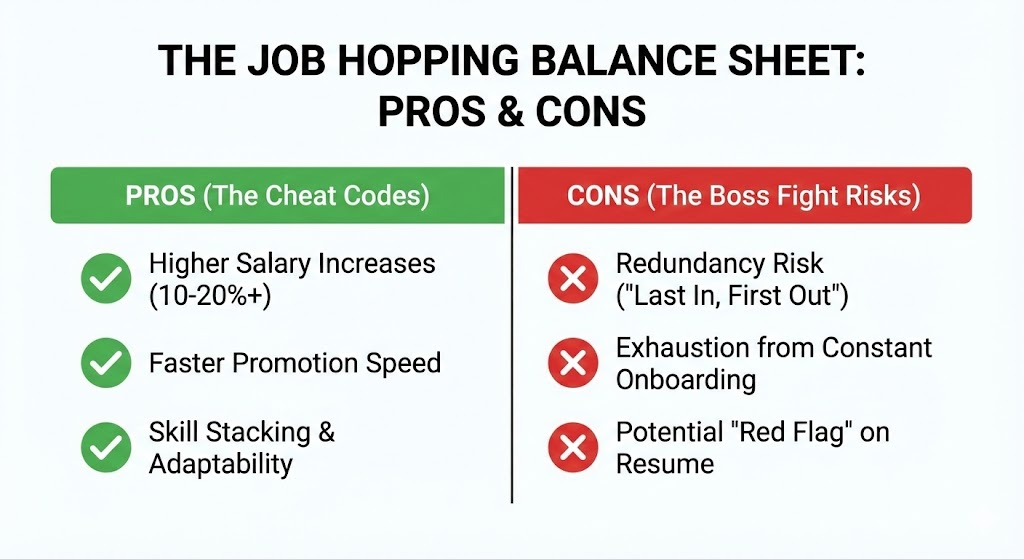
The "First Out" Risk: In times of redundancy, the 'last in, first out' theory often applies. New starters are riskier keeps than veterans.
Exhaustion (The Grind): Starting from scratch every 18 months is tiring. You have to learn new names, new politics, and new coffee machine rules constantly.
The "Red Flag" Resume: Some traditional employers view job hopping as a lack of commitment. They worry you will leave them as soon as a better offer comes along (which, let's be honest, you might).
Case Study: From Entry Level to Senior in 6 Years
A perfect example of this strategy is my wife.
She started in journalism but realized quickly that "passion doesn't pay bills."
She switched to HR at age 25, starting from scratch. She was behind her peers.
She changed 6 jobs in 6 years.
She climbed 5 positions to become a Senior HR Business Partner at a world-recognized brand, nearly[e][f] quadrupling her salary.
At one point, she even left a role after one month to join TikTok. It was a step back in salary initially, but she saw the growth potential. Within 9 months at TikTok, she was promoted to her dream role.
Takeaway: Sometimes you hop for money, sometimes you hop for the right ladder.
How to Explain Job Hopping in Interviews (The "Red Flag" Defense)
If an interviewer asks, "Why have you changed jobs so often?", do not panic. Use these tips to turn a bug into a feature:
1. Own Your Narrative
"Know your reasons for leaving each role and stand by them."
Bad Answer: "I got bored."
Good Answer: "I left because the short-term contracts impacted my job security during Covid," or "I reached a ceiling in my standalone position and needed a new challenge to keep growing."
2. Sell "Adaptability" (The Soft Skill)
Employers love "soft skills" (Blue Lynx confirms this). Tell them: "Working at both corporate giants like KPMG and fast-paced tech firms like TikTok allows me to draw from the best of both worlds. I can adapt to your culture faster than someone who has only known one way of working."
3. The "Forever Home" Pivot
"Job hopping is not forever. Early in my career, I wanted to gather diverse skills. Now, at this level of seniority, I am looking to take everything I've learned and implement it at a company long-term."
Note: If a company doesn't accept these answers, they might be looking for a cog, not a creator.
Job Hopping Strategy Guide
If you're ready to play the game, follow this four-step strategy walkthrough to make the most of your job hopping journey.
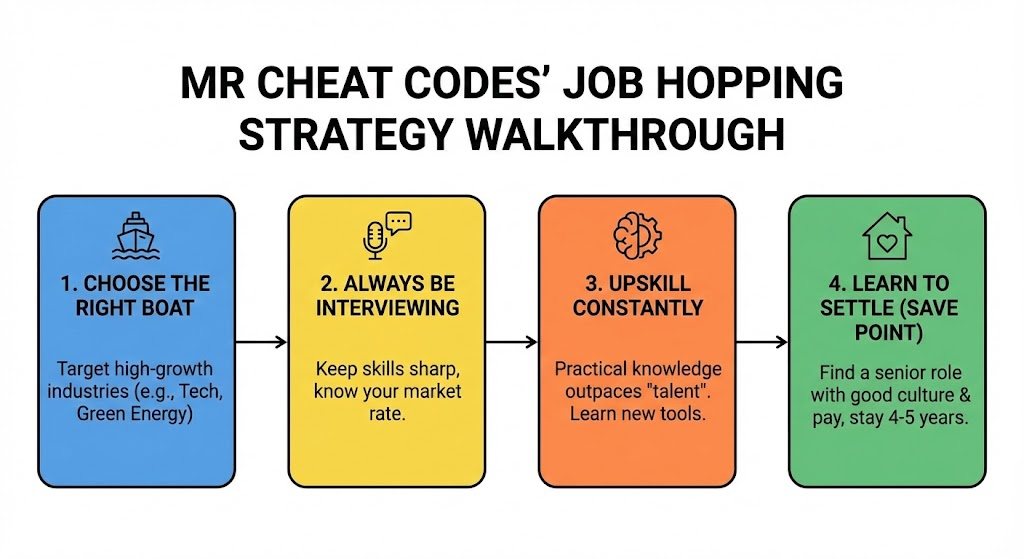
Choose the Right Boat: Find an industry with high growth potential (e.g., Tech, Green Energy). The boat you are in is more important than how hard you row.
Always Be Interviewing: Even if you are happy, apply for jobs. It keeps your interview skills sharp and tells you your current market rate.
Learn to Settle: Know when you have reached a "Save Point." Once you hit a senior role with good culture and pay, it's okay to stay for 4-5 years.
Upskill Constantly: Practical knowledge outpaces "talent." Be the person who knows the latest tools.
FAQ: Job Hopping
Is job hopping bad for my resume?
Not necessarily. It is only "bad" if you cannot explain why you moved. If you show that every move taught you a new skill or gave you more responsibility, it shows ambition, not flakiness.
How long should I stay at a job?
The general consensus is 1 to 2 years. Leaving before 12 months can look sporadic unless you have a strong reason (like a massive offer or a toxic environment).
Does job hopping really increase salary?
Yes. Data consistently shows that external hires are paid market rates, while internal employees are capped by standard 3-5% raise policies.
📚 Related Reading
- The "No Skills" Guide to Low-Effort Side Hustles (That Actually Work)
- How to Improve Company Cash Flow: 4 Proven Ways
- How to Reduce Taxes Legally: The UK Commercial Property Cheat Code
- The Drop Servicing Model: How I Closed a £120k Deal Without Doing the Work
- Property Equity Investors UK: The Hard Truth About Building Wealth Through Bricks in 2026
Stop being a landlord. Start being an investor.
Shaded Canvas introduces serious capital to vetted UK property opportunities — targeting 12–16% net returns.
Start Investing →

