

If you want to know the biggest secret to winning in business, stop looking at your product for a second and look out the window.
Understanding and spotting trends in the business environment before moving forward on an idea can be the defining factor in whether it succeeds or fails. Most people ignore this. They try to sell sand in the desert or ice in the arctic. But the real "cheat code" is understanding how environment affects business success, and positioning yourself to ride the wave rather than swimming against it.
I started noticing this when I went on holiday in Algeria back in 2018.
The Social & Cultural Factors
My cousins and I spent hours chilling at a computer (gaming) café in Algeria. I realized, it's been a while since I've even seen one of these in the UK!
In the "West," internet cafés became obsolete as personal laptops and high-speed home Wi-Fi became standard. But in the "East" (Middle East and North Africa), the environment was different.
Computers were relatively expensive compared to local salaries, keeping the café industry alive.
In many Muslim countries, it is less common for young men to hang out in family homes due to privacy norms regarding female family members. This cultural reality left a massive demographic of young men looking for a "third place" to hang out.
The specific social environment made a business model that was "dead" in the UK thrive in Algeria. If you don't analyze the culture, you miss the opportunity.
What is the "Business Environment"?
Before we go deeper, let’s define what we are talking about. To the "suits" in the corporate world, this is called Environmental Scanning. It generally breaks down into two parts:
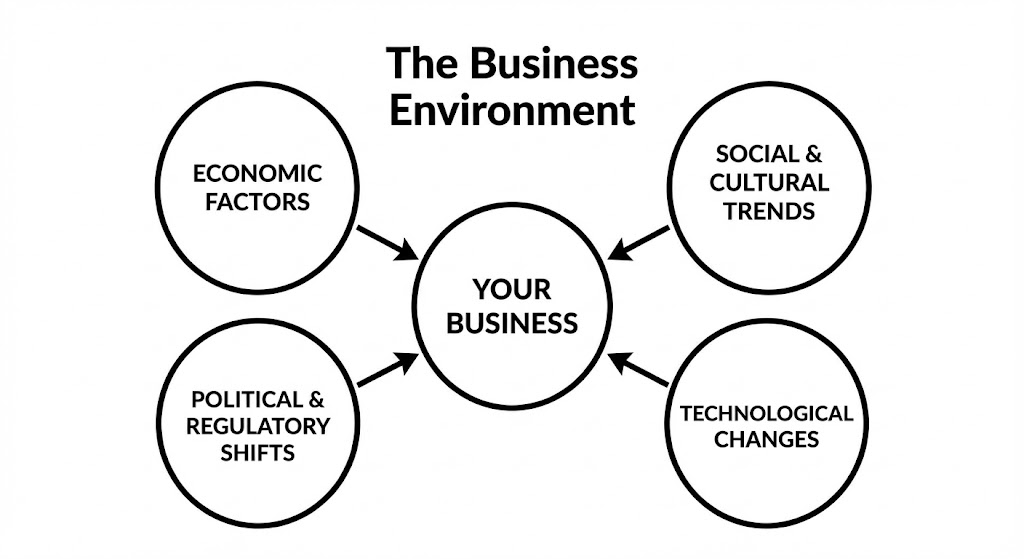
The formal framework for analyzing the external environment is called PESTLE (Political, Economic, Social, Technological, Legal, Environmental). You don't need a degree to use it; you just need to keep your eyes open.
The Economic Environment: Recessions & "The Lipstick Effect"
You often hear people panic about the economy. "The market is crashing!" But for a smart entrepreneur, chaos is a ladder.
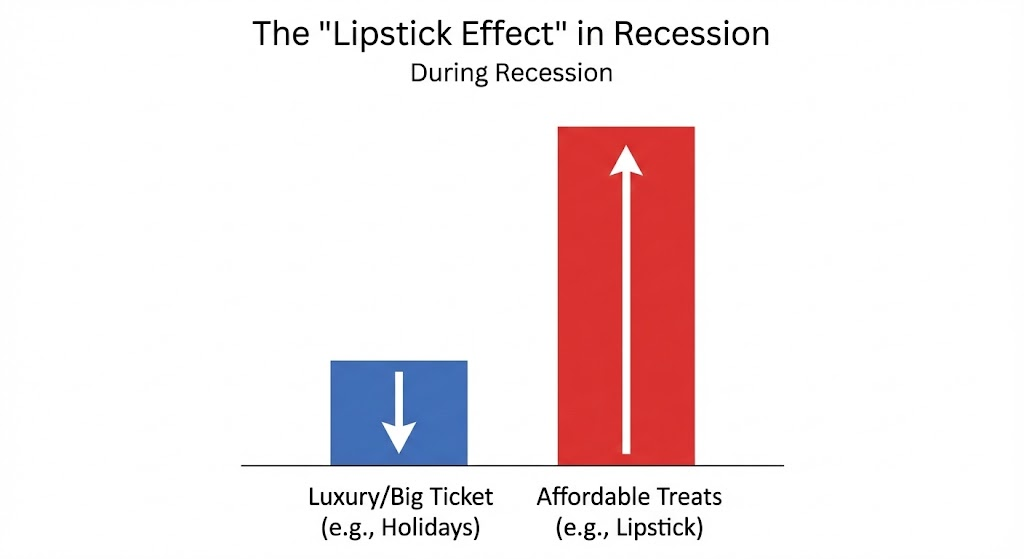
The Lipstick Effect is a fun fact I love: during a recession, lipstick sales actually go up. Why? Because when people have less disposable income, they cancel expensive holidays (luxury) but still want to treat themselves to something affordable (lipstick).
Groupon is another perfect example. It was born out of the 2008 recession. Its business model worked because the economic environment created a massive demand for discounts. It stood the test of time because it solved a problem specific to that era: saving money when it was needed most.
Timing and Momentum: The COVID-19 Shift
The best recent example of how environment affects business success is the COVID-19 pandemic.
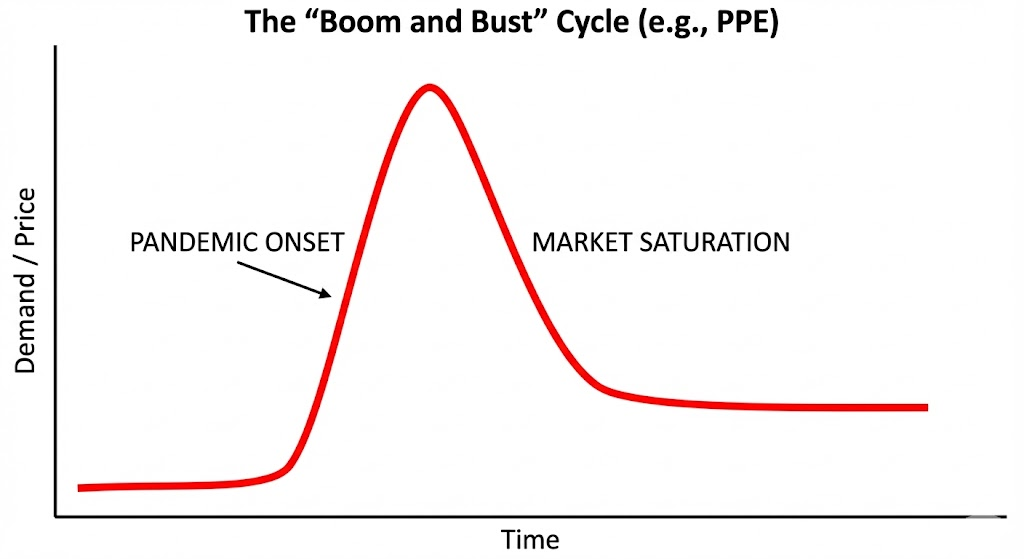
When the world came to a standstill, the environment shifted overnight. Masks and toilet paper prices went up 10x. Some people opened businesses and invested significant resources into this. But, like many trends based on a crisis, it had a short life cycle.
Momentum is tricky. Whenever there is a significant change in the market, it is usually temporary.
The PPE Trap: The PPE industry skyrocketed, but after 2 years of flooding the market, supply outweighed demand. The industry became oversaturated, prices crashed, and profits vanished.
The "Side Door" Opportunity: I prefer looking for less obvious choices with similar demand.
My brothers found one of these "side doors." During the pandemic, the DVLA (UK driver licensing) closed for nearly 2 years. When they reopened, there was an extreme backlog. You literally couldn't book a driving test.
My brothers learned the market and found ways to legally fast-track bookings. They advertised that they could save a client 3–6 months of waiting time. They weren't selling a product; they were selling a solution to a temporary environmental problem. Before long, they couldn't keep up with demand.
Don't Forget the "Green" Environment
A quick note on the literal environment: Sustainability is no longer just for hippies; it's a massive business factor. Consumers today (especially Gen Z) prefer eco-friendly businesses.
Regulatory Factors: Governments are taxing pollution.
Social Factors: Customers punish brands that waste resources.
If you are ignoring the ecological impact of your business, you are fighting the environment, not using it.
How to Analyze Opportunities (The Cheat Sheet)
So, how do you apply this? Before you start your next venture, ask yourself these questions to "scan" the environment:
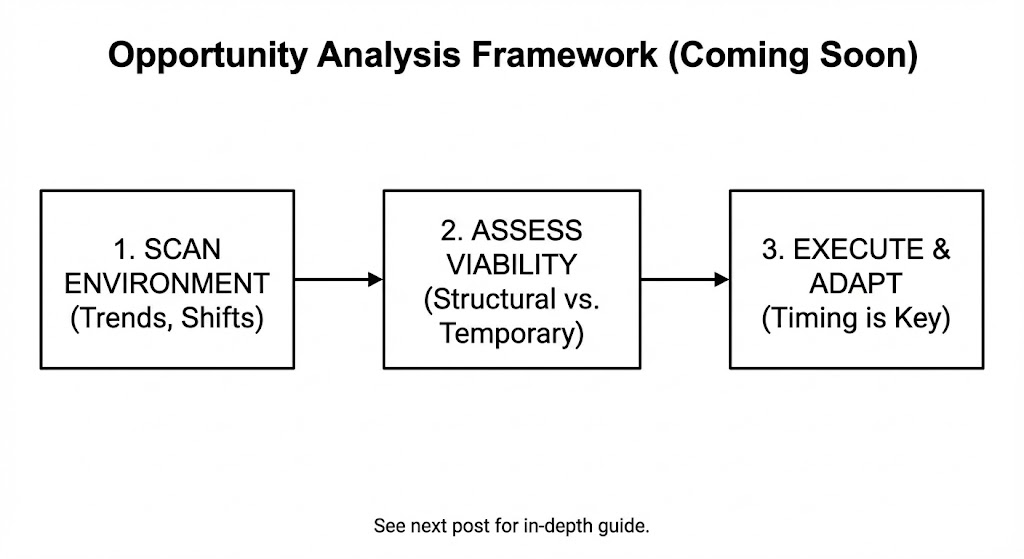
Momentum vs. Longevity
As always, take advantage of a situation when it arises. Look out for what opportunities come up, but be aware that this may just be a short-term way to bring in some cash. Always try to invest what you get out of it into something stable.
📚 Related Reading
- The "No Skills" Guide to Low-Effort Side Hustles (That Actually Work)
- How to Improve Company Cash Flow: 4 Proven Ways
- How to Reduce Taxes Legally: The UK Commercial Property Cheat Code
- The Drop Servicing Model: How I Closed a £120k Deal Without Doing the Work
- Property Equity Investors UK: The Hard Truth About Building Wealth Through Bricks in 2026
Stop being a landlord. Start being an investor.
Shaded Canvas introduces serious capital to vetted UK property opportunities — targeting 12–16% net returns.
Start Investing →

