

I used to love playing video games. Sometimes, when I wanted an easier ride, I would sit there finding cheat codes. This blog is exactly like that, but for real life.
If you find this useful, I would greatly appreciate it if you shared and subscribed.
From £33k Salary to 6-Figure Deals
A few years ago, I was earning a £33,000ish salary working 60-70 hours a week as a police officer. I wanted wealth, specifically property, but had zero idea how to get it. I started studying 40 hours a week on top of my job.
Before I knew it, I was solving problems for people who had been in business way longer than me.
Recently, I closed a deal worth over six figures. But here is the "cheat code": I didn't do the technical work myself.
I used a strategy that I later learned is called Drop Servicing.
Most people think to make money, you have to learn a hard skill (like coding) and sell your time. That’s the slow lane. Drop servicing is the fast lane. It’s about selling a solution and having an expert fulfill it, while you sit in the middle and manage the relationship. Here is a simple diagram of how the model works:
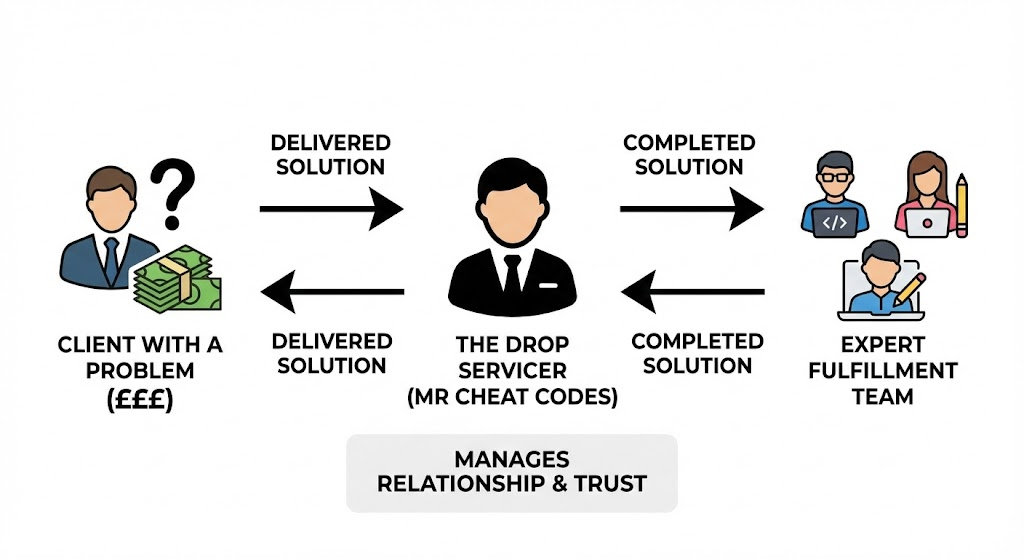
Here is exactly how I used high-ticket drop servicing to secure a £120,000 contract with just a few hours of work per week.
Phase 1: Identifying the High-Value Problem
I had just left the police. I was applying for everything, networking aggressively, and landed an interview with the CEO of a decent-sized estate agency.
I went in ready to sell my property skills—grafting from scratch. We bonded over property stories (like how I bought my first two properties on a low salary—link here).
As I shared my journey, I mentioned I had done a full-stack developer course.
The CEO’s ears perked up. He mentioned they had hired a contractor three years ago to build in-house systems. It was a disaster. Not much had been completed. They were stuck.
This was the opportunity.
He asked for my help. I agreed to look at the code, secretly thinking: Am I way out of my depth here?
Upon reviewing it, I realized the project was huge. Too big for me to code alone. A traditional freelancer would have panicked. A drop servicer sees dollar signs. I didn't need to be the coder; I just needed to control the solution.
Phase 2: Finding the "Fulfillment Partner"
In drop servicing, you need a reliable supplier.
I went to a friend who is an absolute genius in programming. He runs a team of 16 super-developers. I knew he could destroy the European market in terms of pricing, guarantee top-tier code in the latest languages, and execute efficiently.
I approached him with a proposition: I bring you a massive corporate client on a silver platter.
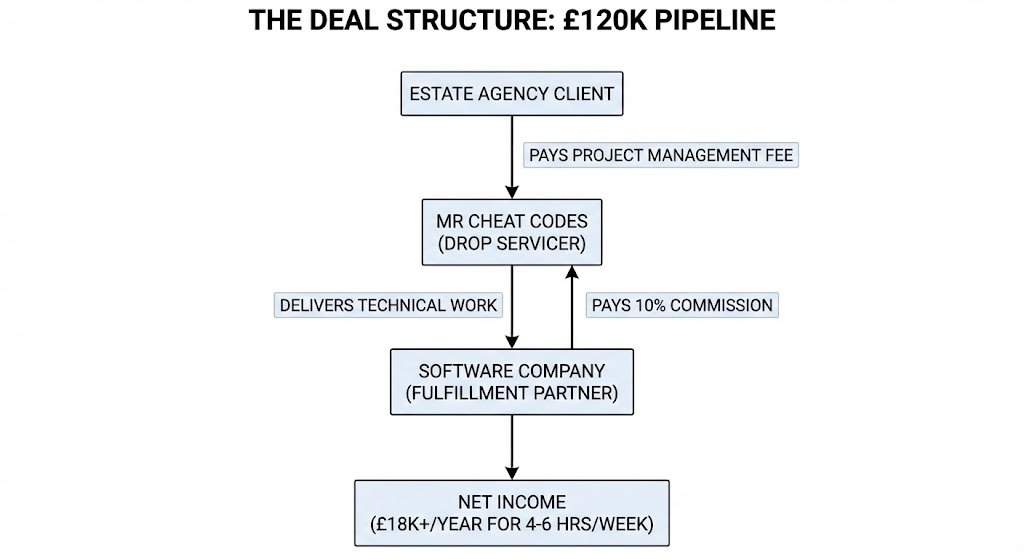
The Deal Structure: I negotiated a 10% commission from him on top of the fee I was charging the Estate Agency for managing the project.
Phase 3: The "Middleman" Hustle (Where I Earned My Money)
This is where people fail at drop servicing. They think it's passive. It isn't. You have to manage the trust.
Persistence was key. The negotiation phase between the estate agency (the client) and the software company (the fulfillment partner) was brutal. Both sides were strong-minded and had been burned by previous partners.
My job wasn't coding; my job was communication arbitrage.
They were both extremely busy. I had to save them time and make the process frictionless. I leaned heavily on the trust I had built with the CEO during that first interview.
I used a tactic from Alex Hormozi’s $100m Offers: “Make an offer so good they feel stupid saying no”.
My Grand Slam Offer to the Client:
I proposed to manage the entire headache. I would liaise with their internal team and the software company. I would check code quality in the evenings to ensure smooth running. I would handle negotiations on prices comparable to ensure they were saving money and time.
They signed.
The Results: Drop Servicing Math
The initial contract was signed for £10,500 to get started, with approximately £120,000 worth of work immediately in the pipeline.
Because I am putting in about 4–6 hours of high-level management work a week, this deal nets me an extra £18,000+ a year on the side.
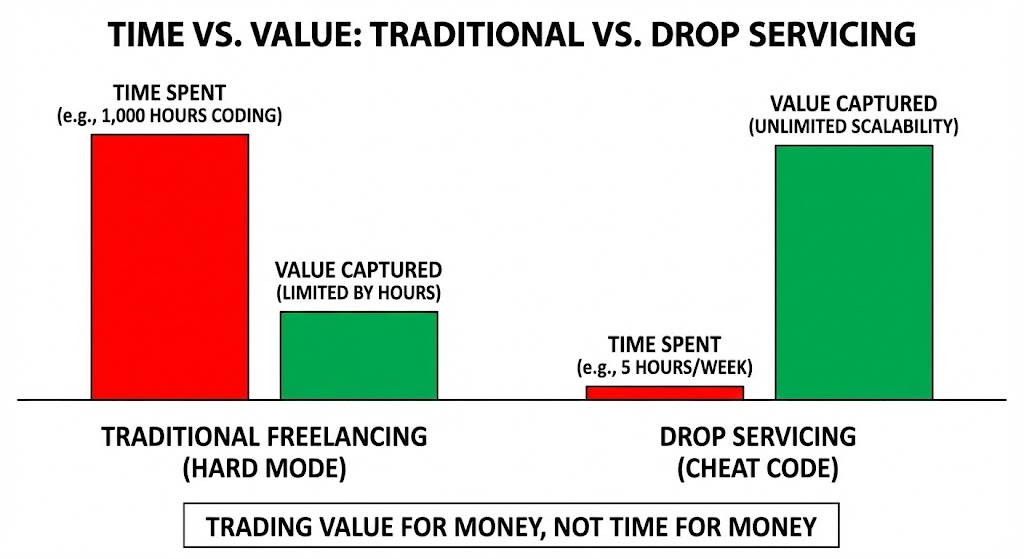
I am not trading time for money. I am trading value for money.
The Drop Servicing Blueprint (Strategy You Can Use)
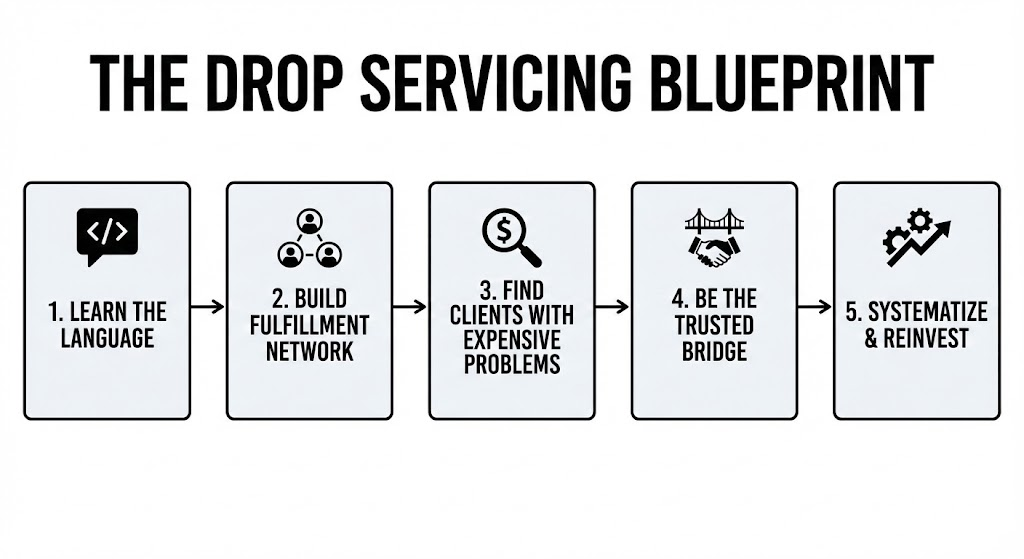
If I were starting again today, I wouldn't spend years trying to master a difficult skill like coding. I would master the art of finding problems and connecting them to solutions.
Here is the cheat code strategy:
Summary: Freelancing vs. The Cheat Code Way
Feature
Traditional Freelancing (Hard Mode)
Drop Servicing (Cheat Code)
Your Role
The Technician (Doing the work)
The Manager (Connecting the pieces)
Income Cap
Capped by how many hours you have.
Unlimited. You can scale multiple projects.
Skill Required
Mastery of a hard skill (e.g., coding).
Mastery of sales and management.
My Deal Example
I would have to code for 1,000 hours.
I manage the deal for 5 hours a week.
There is always a solution to your problems. Sometimes, the solution isn't working harder; it's finding the right cheat code.
📚 Related Reading
- Buy dirt
- How I save nearly £2,000 a Year on Groceries for a Family of 4
- How to Improve Company Cash Flow: 4 Proven Ways
- Hobbies That Make Money: Real "Cheat Codes" for Turning Your Passion Into Profit
- How Environment Affects Business Success
Stop being a landlord. Start being an investor.
Shaded Canvas introduces serious capital to vetted UK property opportunities — targeting 12–16% net returns.
Start Investing →

