

Nuveen Real Estate — the property investment management arm of TIAA (Teachers Insurance and Annuity Association) — is among the world's ten largest real estate investment managers by assets under management, overseeing approximately $150 billion in property across multiple strategies and geographies. In the UK specifically, Nuveen has built a meaningful platform spanning direct equity, real estate debt, and sector-specialist strategies. For institutional investors evaluating UK property exposure through third-party managers, Nuveen's offering merits close examination.
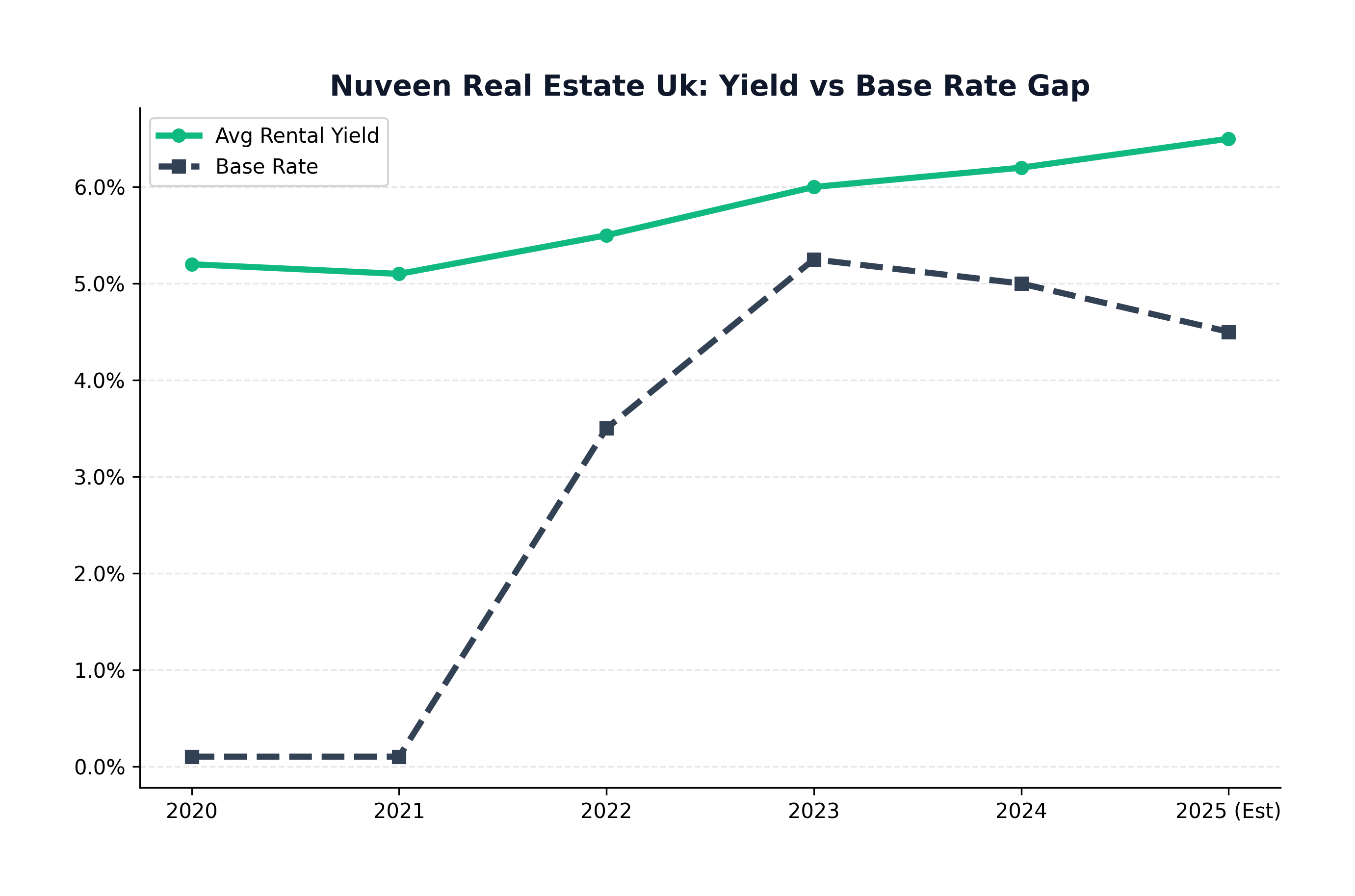 Figure: Yield vs Interest Rates
The Scale Advantage and What It Means
Managing $150 billion in real estate assets globally confers real advantages: proprietary transaction flow, the ability to underwrite large lot sizes that smaller managers cannot match, deep relationships with occupiers (and therefore superior market intelligence), and the organisational resilience to attract and retain top real estate investment talent. In a market environment where information asymmetry drives returns, scale creates competitive advantage — particularly in off-market transactions and in debt markets where relationship lending is the norm.
The flip side of scale is concentration risk management and the difficulty of deploying capital quickly in response to emerging opportunities. A $150 billion manager cannot move as nimbly as a £500 million specialist fund. Investors should understand that Nuveen's strategies are designed for institutional-scale allocations — minimum commitments in most vehicles are £10–50 million — rather than retail or high-net-worth individual access.
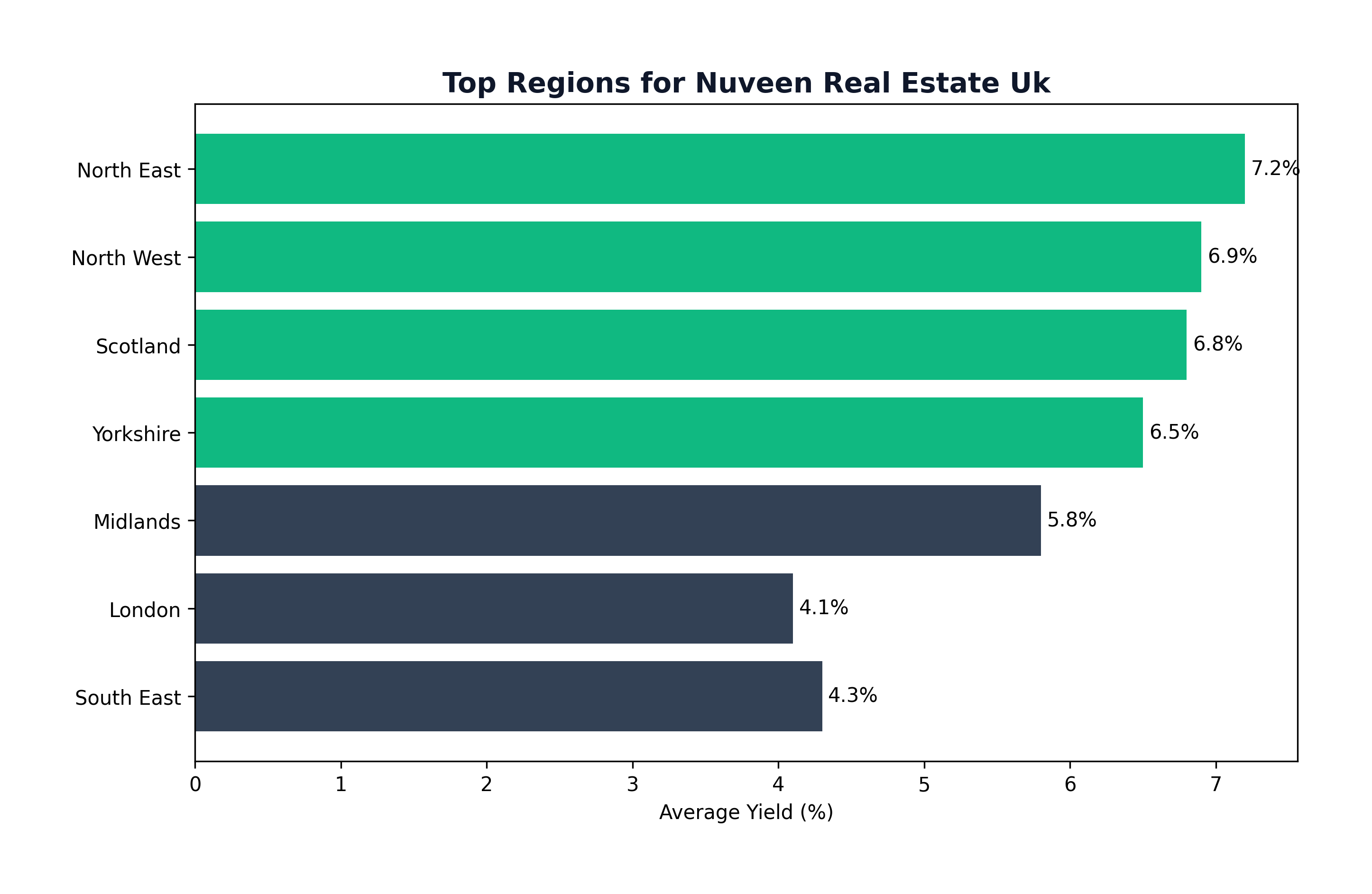 Figure: Regional Yield Heatmap
UK Strategy: The Shift Toward Debt
Nuveen's UK strategy has evolved significantly since 2020, with a deliberate increase in real estate debt allocations relative to direct equity. This shift reflects the macro environment: in a period of elevated interest rates, senior real estate debt can deliver attractive risk-adjusted returns (6–8% net in senior and whole loan strategies) with significantly lower volatility than equity and with debt's priority claim on assets in downside scenarios. For institutional investors with liability matching needs — pension funds matching fixed annuity payments, for example — real estate debt offers a compelling combination of yield, predictability, and inflation linkage.
The Global Real Estate Debt Partners series (Fund III is the most recent vintage as of 2026) targets whole loan and senior debt origination across UK and European markets, with a focus on sectors where Nuveen's equity team has deep knowledge: logistics, life sciences, and residential. The strategy lends directly to developers and asset owners at loan-to-value ratios of 55–70%, targeting net returns of 7–9% depending on market conditions.
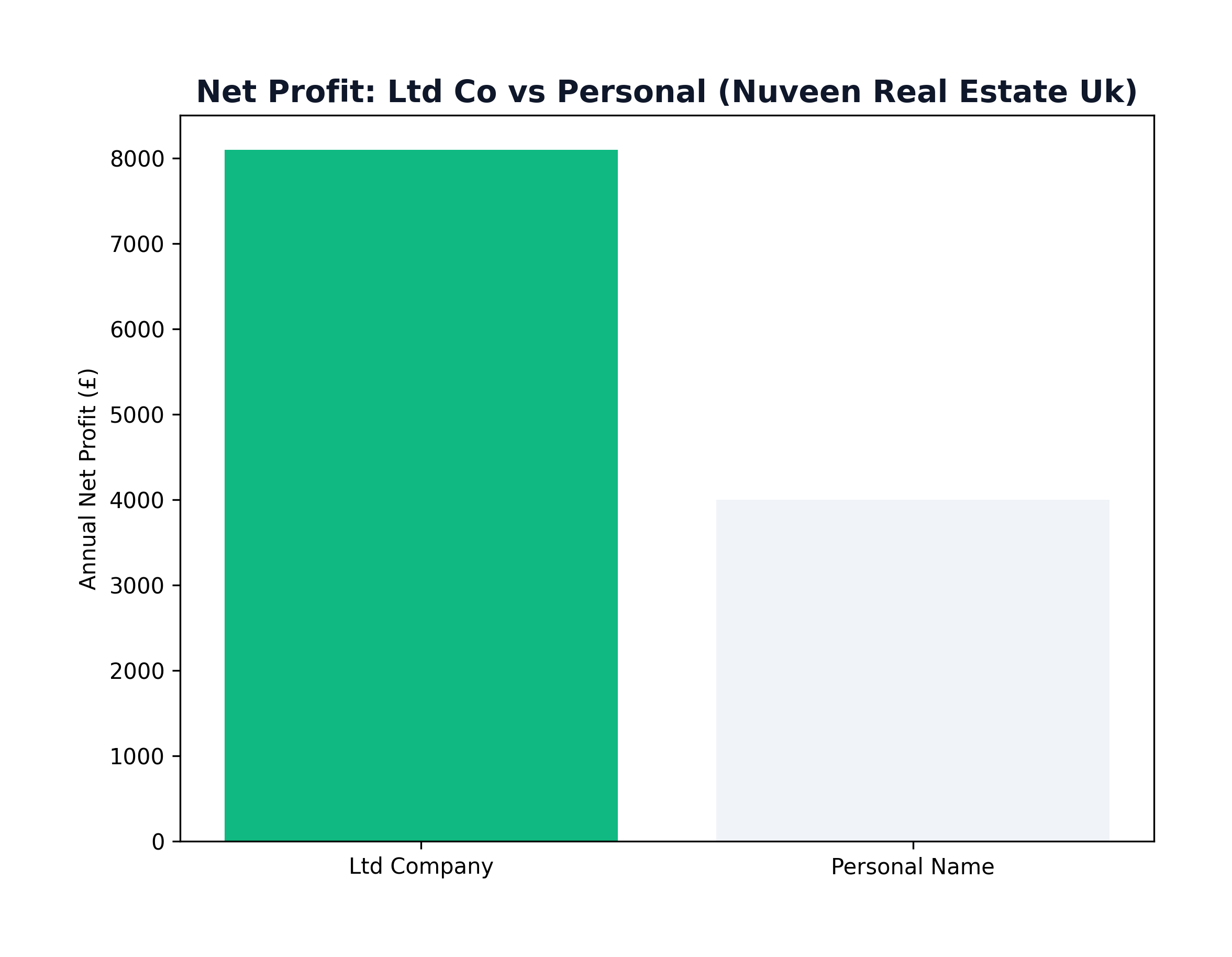 Figure: Tax Trap: Personal vs Ltd
Fund Capabilities in Detail
UK Shopping Centre Fund — The Contrarian Bet
Nuveen maintains exposure to UK retail through a specialist retail warehousing and shopping centre strategy — a genuinely contrarian position given the sector's reputation damage following high-profile retailer failures and the structural shift to online commerce. The investment thesis is valuation: UK retail assets have repriced so aggressively that yields now adequately compensate for risk, particularly in dominant regional centres with strong grocery and value-retail anchors. The Edinburgh St James development — a large-scale regeneration of Edinburgh's premier shopping district — is a case study in how patient capital and placemaking investment can restore value in repositioned retail assets.
Impact Investing: Preferred Homes (<a href="https://blog.shadedcanvas.co.uk/post/<a href="https://blog.shadedcanvas.co.uk/post/<a href="https://blog.shadedcanvas.co.uk/post/pgim-real-estate-uk" style="color:#c9a84c;text-decoration:underline;font-weight:500">pgim-real-estate-uk" style="color:#c9a84c;text-decoration:underline;font-weight:500">pgim-real-estate-uk" style="color:#c9a84c;text-decoration:underline;font-weight:500">pgim)
Nuveen's Preferred Homes strategy targets UK affordable and shared-ownership housing — a sector where structural undersupply, government policy support, and social impact credentials align with institutional investor mandates. The strategy partners with housing associations and local authorities to fund new affordable housing supply, targeting net yields of 5–6% with RPI-linked uplifts and long-term lease structures. For pension funds seeking to demonstrate ESG credentials and social impact alongside financial returns, this strategy addresses multiple objectives simultaneously.
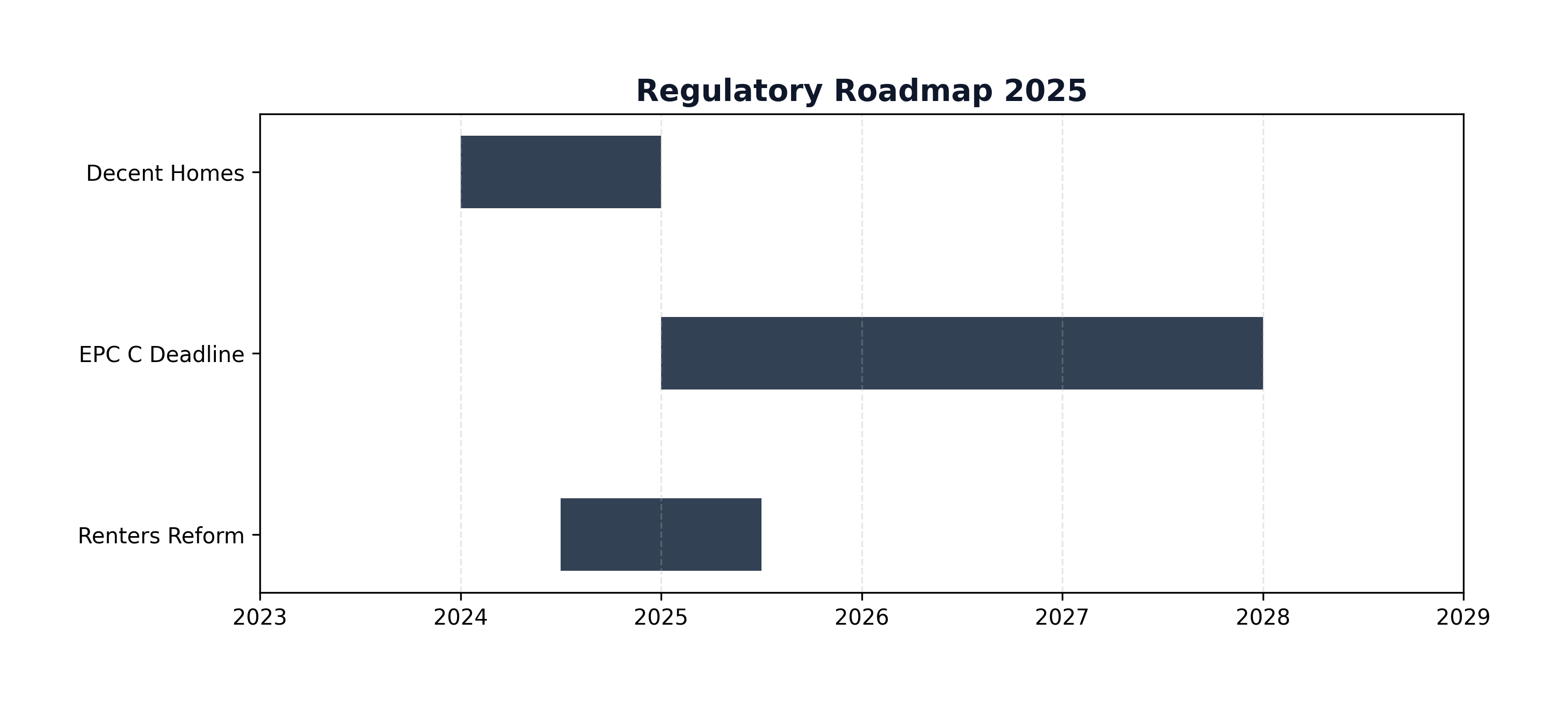 Figure: Regulatory Roadmap
The Real Estate Debt Opportunity
The case for real estate debt in the current environment is compelling from first principles. Bank lenders — constrained by Basel III capital requirements and legacy non-performing loan portfolios — have retreated from commercial real estate lending, creating a supply gap for non-bank lenders like Nuveen to fill at attractive margins. The risk-adjusted return comparison favours debt: a senior loan at 65% LTV on a logistics asset generates 6–7% net with first-loss protection of 35% before an investor loses any principal. Direct equity ownership of the same asset might generate similar current income with no such protection and additional management complexity.
Nuveen targets logistics and life sciences as priority lending sectors — areas where occupier demand is structurally supported (e-commerce and pharmaceutical/biotech research respectively) and where asset values are underpinned by strong rental growth expectations. The avoidance of secondary retail and secondary office lending reflects the team's conviction that these sectors face structural impairment rather than cyclical correction.
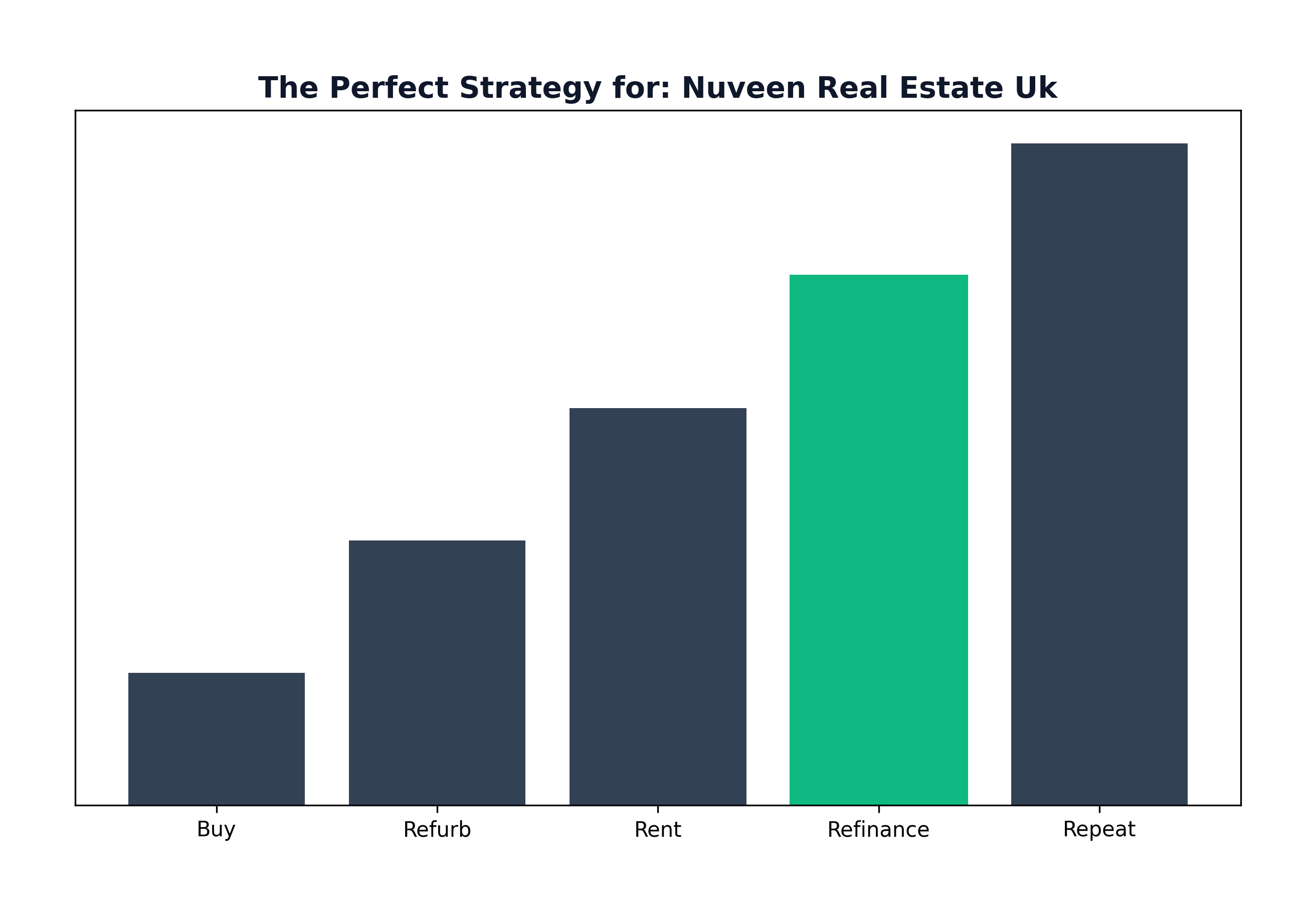 Figure: Strategy Cycle
ESG and Sustainability Commitments
Nuveen Real Estate has committed to net zero carbon across its managed portfolio by 2040, ahead of the industry's general 2050 target. This commitment is operationally meaningful: new acquisitions are subject to green building due diligence, refurbishment projects include energy efficiency capital expenditure as a core requirement, and tenant engagement on sustainability is embedded in asset management practice. The affordable housing strategy's social impact — providing homes for working families at below-market rents — contributes directly to the 'S' in ESG, which is increasingly valued by pension fund allocators whose beneficiaries are those same working families.
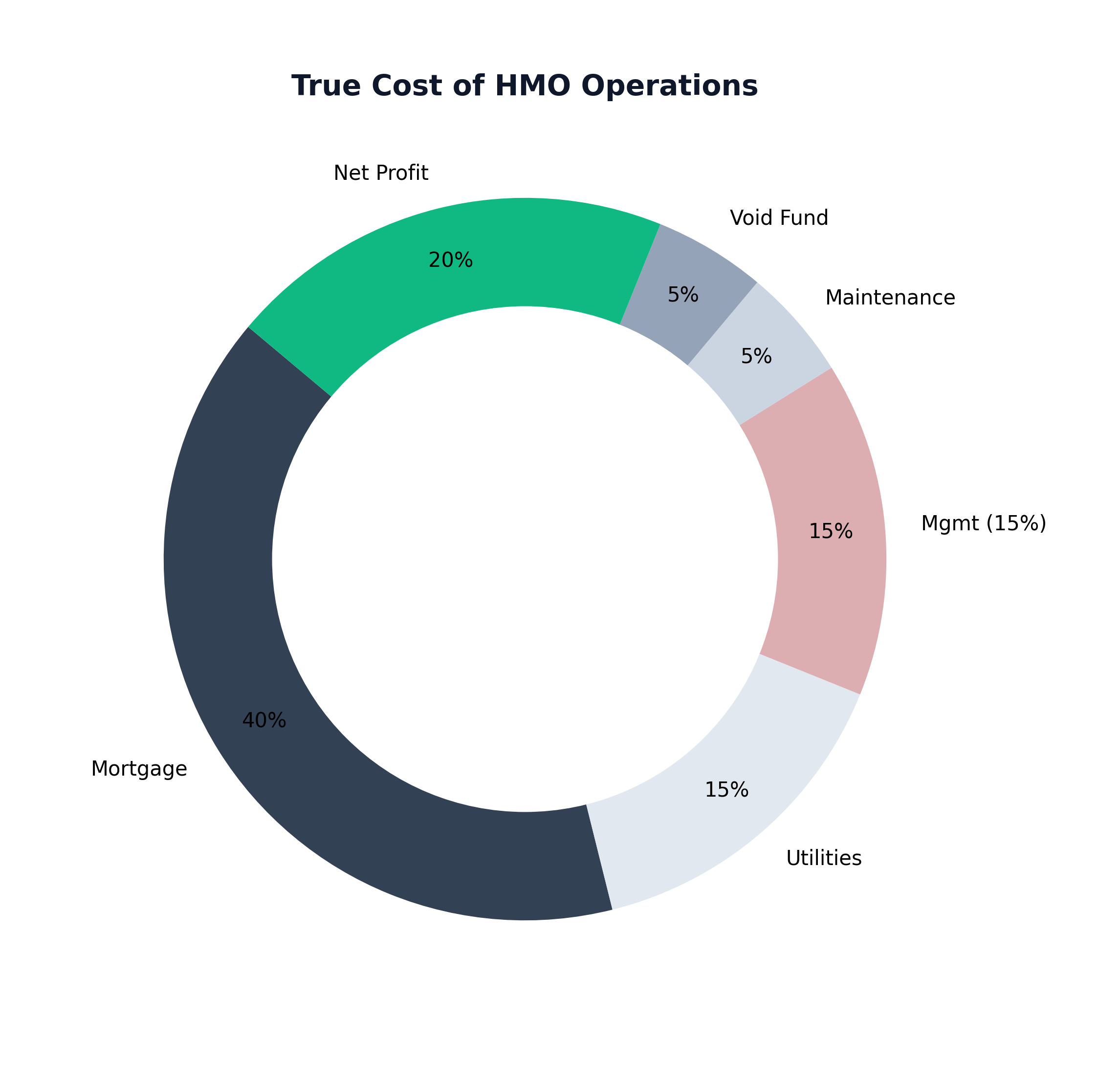 Figure: HMO Expense Breakdown
Investment Routes and Minimum Commitments
Access to Nuveen Real Estate UK strategies is exclusively through institutional channels — direct mandate, commingled fund subscription, or segregated account for larger allocations. Minimum commitments range from £10 million for the debt funds to £50 million+ for the larger equity vehicles. There is no retail access route to Nuveen's direct strategies, though the parent company TIAA's listed affiliates (including a REIT listed on global exchanges) provide partial indirect exposure. UK institutional investors — defined benefit pension schemes, insurance companies, endowments, and family offices — represent the target audience.
Stop being a landlord. Start being an investor.
Shaded Canvas introduces serious capital to vetted UK property opportunities — targeting 12–16% net returns.
Start Investing →

