

Is Stoke-on-Trent the last bastion of high-yield property investment in the UK, or a value trap?
For the last decade, Manchester and Liverpool have been the darlings of the Northern Powerhouse. But with entry prices in Manchester city centre now pushing £300,000 and yields compressing to 4-5%, investors are looking for the "next Manchester."
Enter Stoke-on-Trent.
Often overlooked, occasionally maligned, but statistically undeniable. In 2024, Stoke-on-Trent topped the charts for house price growth, recording a staggering 17.2% increase according to Halifax.
But capital growth is only half the story. The real draw here is the yield. While the rest of the UK struggles to make the numbers stack at 5% interest rates, Stoke is quietly delivering 7-8% gross yields on single lets, and 10-12% on HMOs.
This guide is not a sales pitch. It is a deep dive into the reality of investing in The Potteries—the good, the bad, and the postcodes you need to know.
The Numbers: Why Stoke Stacks Up
Let's look at the raw data compared to the national average and its nearest major rival, Manchester.
| Metric | Stoke-on-Trent | Manchester | UK Average |
|---|---|---|---|
| Average Price | £146,350 | £234,000 | £285,000 |
| Avg. Rental Yield | 6.6% - 8% | 4.5% - 5.5% | 3.7% |
| Capital Growth (2024) | +17.2% | +4.1% | +1.1% |
| Entry Point (2-Bed Terrace) | £80,000 - £100,000 | £180,000+ | N/A |
The "Why Now?" Argument
Stoke is currently in the "Regeneration Sweet Spot." It has received significant leveling-up funding (more on that below), but property prices haven't yet fully priced this in.
You can still buy a 2-bedroom Victorian terrace in Tunstall or Burslem for under £90,000. In a world of high interest rates, this low entry point is crucial—it means your mortgage payments are manageable, and your cash flow remains positive.
Area Guide: The 6 Towns (And Where to Invest)
Stoke-on-Trent is unique. It's not one big city, but a federation of six distinct towns: Tunstall, Burslem, Hanley, Stoke, Fenton, and Longton. Each has a completely different investment profile.
1. The High-Yield Play: ST6 (Tunstall & Burslem)
- Profile: Working-class residential, industrial roots.
- Entry Price: £70k - £90k for a 2-bed terrace.
- Tenant Profile: Local workers, blue-collar, LHA (Local Housing Allowance) tenants.
- The Strategy: High cash flow. You buy cheap, refurbish to a decent "robust" standard, and rent out.
- Risk: Values are lower for a reason. These areas can be rougher. Voids can be higher if the property isn't well-managed. Thorough tenant referencing is non-negotiable here.
2. The Student/Hospital Play: ST4 (Stoke & Fenton)
- Profile: The "Engine Room." Home to the Railway Station, Staffordshire University, and proximity to Royal Stoke University Hospital.
- Entry Price: £100k - £130k.
- Tenant Profile: Students, Nurses, Doctors, Commuters.
- The Strategy: HMOs (Houses in Multiple Occupation) or high-quality BTL for professionals.
- The Alpha: This is the most robust demand in the city. Doctors and students need to live here.
3. The City Centre Play: ST1 (Hanley)
- Profile: The commercial heart. Shopping centres, nightlife, new apartment blocks.
- Entry Price: £110k - £150k (Apartments).
- Tenant Profile: Young professionals, city workers.
- The Strategy: Capital Appreciation. As the "Smithfield" business quarter expands, city demand grows.
- Risk: Service charges on new-build apartments can eat your yield. Check the lease terms carefully.
4. The "Premium" Neighbor: ST5 (Newcastle-under-Lyme)
Technically a separate borough, but economically part of the Stoke conurbation.
- Profile: Leafier, more suburban, home to Keele University (Campus).
- Entry Price: £140k - £180k.
- Tenant Profile: Keele Students (affluent), Families, Senior Medical Staff.
- The Strategy: Safe, long-term growth. Lower yields than ST6, but better capital appreciation and "easier" tenants.
The "Elephant in the Room": Deprivation & Reality
Let's be honest. Stoke-on-Trent has areas of significant deprivation. If you are a remote investor used to the leafy suburbs of Surrey, a drive through some parts of Stoke might be a culture shock.
The "Working DSS" Strategy Many investors shy away from DSS (benefits) tenants. In Stoke, ignoring this demographic is a mistake. The LHA rates in Stoke are often enough to cover rent on cheaper properties, providing guaranteed income from long-term tenants who treat the property as their home. The key is guarantors and referencing.
Void Periods In the cheaper areas (cheaper ST6/ST3 streets), void periods can kill your profit. While the gross yield might be 8%, if the house sits empty for 2 months because it's in a street with a bad reputation, your net yield drops to 5%. Local knowledge is key. Do not buy a house without viewing the specific street on Google Street View and, ideally, visiting in person.
Regeneration: Beyond the Brochure Hype
Every city claims to be "up-and-coming." Stoke actually has the cranes in the sky to prove it.
1. The Ceramic Valley Enterprise Zone
This is one of the most successful Enterprise Zones in the UK. It utilizes the old industrial brownfield land (the "Potbanks") to attract modern industry. It has already attracted major employers like Amazon and enormous logistics operations, creating thousands of jobs. Jobs = Tenants.
2. The Goods Yard (ST4)
A £60m flagship project by Capital & Centric next to Stoke Station. This is a "game-changer" development bringing Manchester-style cool (apartments, workspaces, bars) to Stoke. It signals confidence.
3. Transport Connectivity
Stoke is arguably the best-connected city in the Midlands.
- Train: 90 mins to London Euston. 40 mins to Manchester. 45 mins to Birmingham.
- Road: Smack in the middle of the M6 (J15/J16), making it a logistics dream.
The HMO Warning: Article 4 Direction
This is the most critical section for investors looking at HMOs.
Stoke-on-Trent has introduced widespread Article 4 Directions.
- What this means: You have lost "Permitted Development" rights to change a C3 (family home) into a C4 (small HMO for 3-6 people).
- The Consequence: You must get full planning permission to turn a house into an HMO in many wards.
- The Trap: Many "sourcers" will try to sell you a large terrace in Shelton saying "Perfect for Students!" without telling you that you likely won't get planning permission to convert it.
Action: Before buying any potential HMO, check the Stoke Council interactive planning map. If it's in an Article 4 area, assume you cannot convert it unless it already has "Certificated Lawful Use" (C4 usage history).
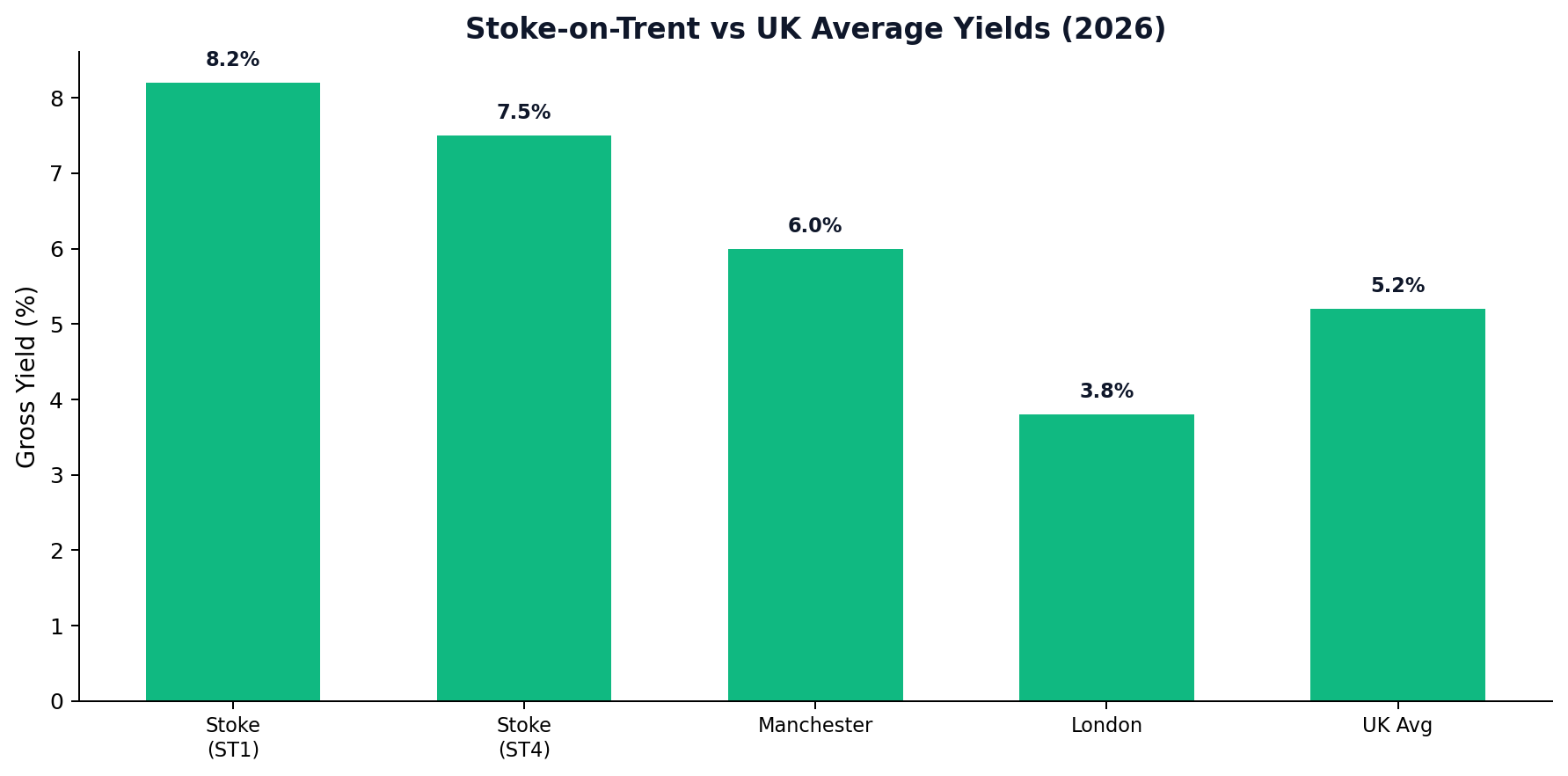 Figure: Stoke vs UK Average Yields
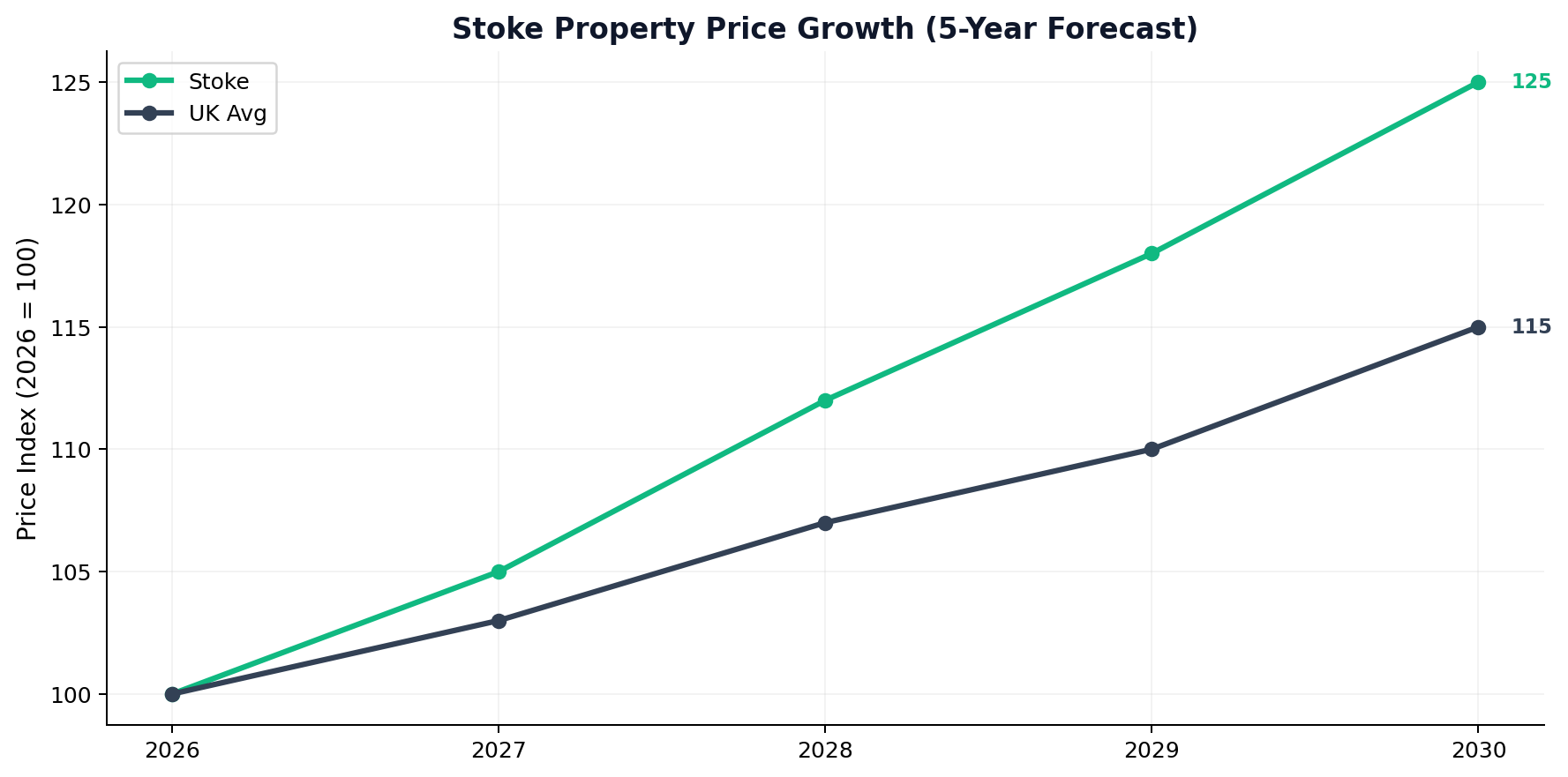 Figure: Stoke Property Price Growth Forecast
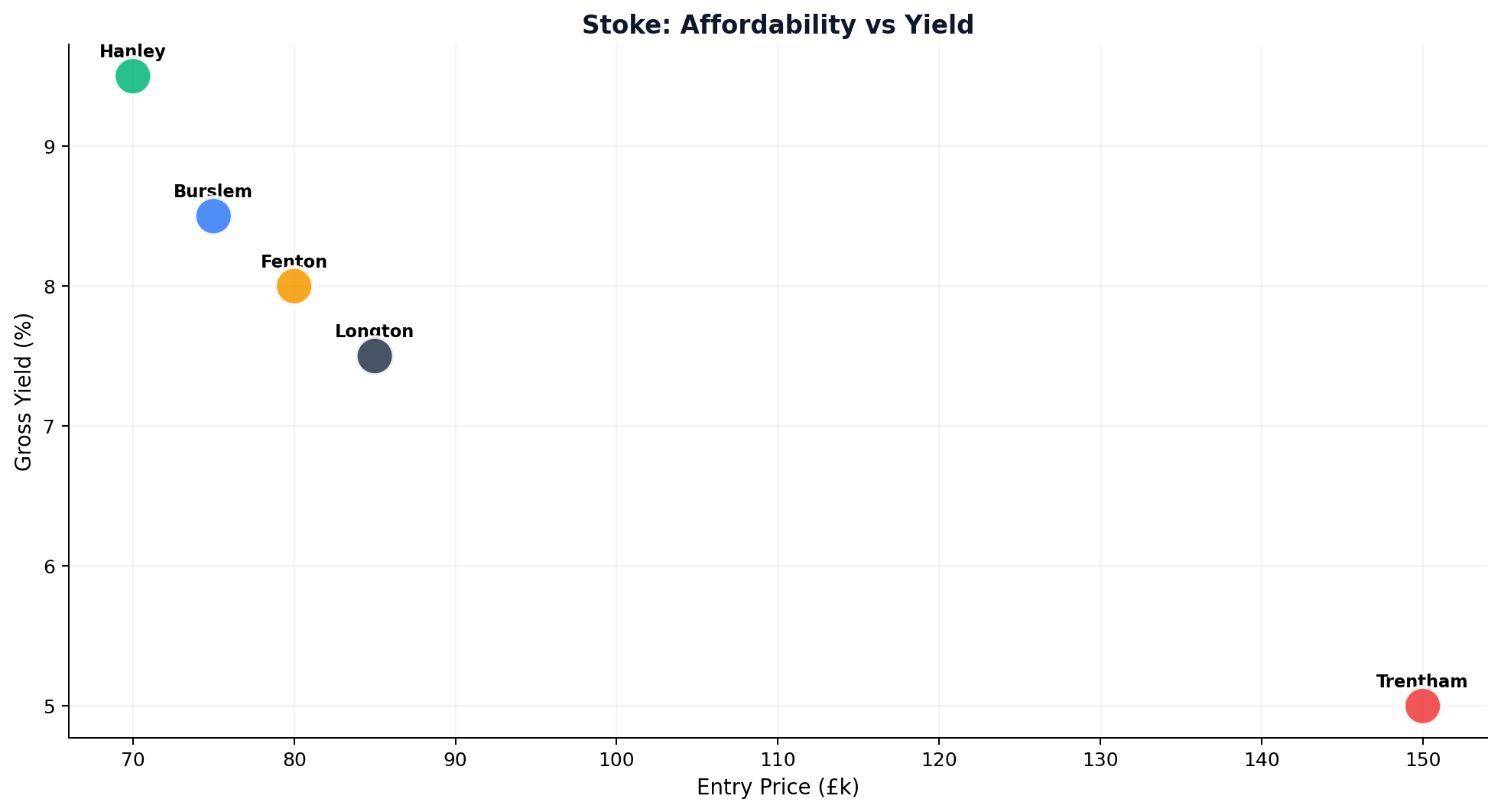 Figure: Stoke Affordability vs Yield Map
Conclusion: Is Stoke a Buy?
Yes. But you need to know what you are buying.
- Buy for Cashflow: Look at ST6 (Tunstall, Burslem). Terraced houses. 8% yields. Rugged management required.
- Buy for Stability: Look at ST4 (near Hospital) or ST5 (Newcastle). robust tenant demand from key workers. 6% yields. Good growth potential.
- Buy for Speculation: Look at City Centre Apartments. Betting on the "Goods Yard" effect to gentrify the centre.
Stoke-on-Trent is not a passive investment like a REIT. It is a working-class city that rewards investors who do their homework, manage their tenants well, and buy at the right price.
The "Golden Rule" for Stoke: Buy within 1 mile of the Station, the Hospital, or the Universities, and you will never struggle to find a tenant.
Stop being a landlord. Start being an investor.
Shaded Canvas introduces serious capital to vetted UK property opportunities — targeting 12–16% net returns.
Start Investing →