

Capital growth — the increase in your property's market value over time — is the wealth-building engine of UK property investment. Rental yield pays the bills. Capital growth makes you rich.
But here's what the "property always goes up" crowd won't tell you: capital growth is wildly uneven. Between 2019 and 2026, some UK postcodes saw 40%+ appreciation. Others barely moved. A few went backwards. Choosing the right location is the difference between building a portfolio worth £2 million and one worth £500,000 a decade from now.
This guide identifies where the strongest capital growth is forecast for 2026-2030, what's driving it, and how to position your portfolio to capture it.
The UK Capital Growth Outlook: 2026-2030
The broad consensus from major forecasters:
| Source | UK Average Price Growth (2026-2030) | Best Performing Region |
|---|---|---|
| Savills | +23.4% cumulative | North West, Yorkshire |
| JLL | +17.6% nationwide, +19.3% Manchester | North & Midlands |
| Knight Frank | +19.3% cumulative | Northern England |
| Rightmove | +2% per year (2026) | North, Scotland, Wales |
| Zoopla | +1.5-4% per year | Lower-priced regions |
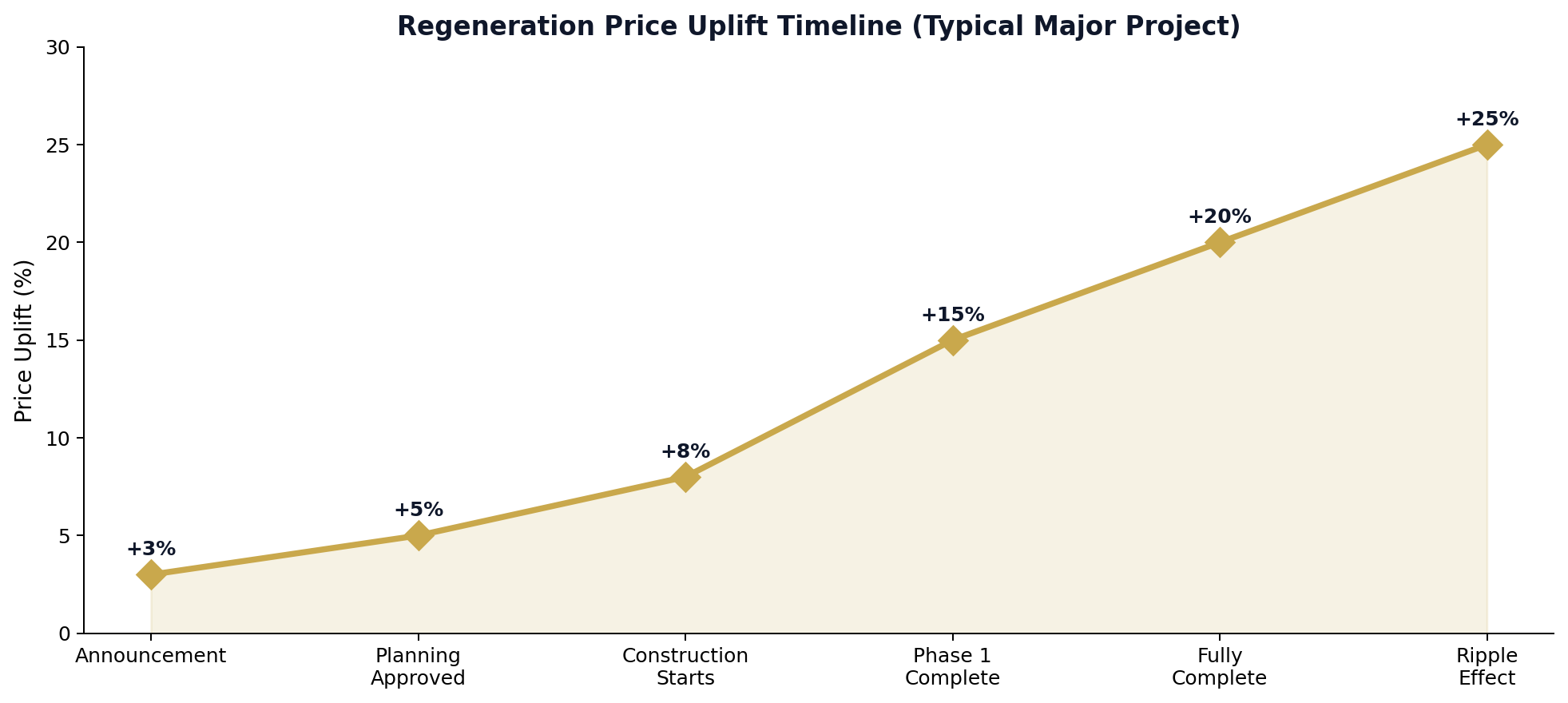
The pattern is clear: the North-South divide is inverting for growth. Cheaper regions with improving fundamentals are forecast to outperform expensive regions where affordability is already stretched.
The Capital Growth Levers: What Actually Drives Price Increases
Understanding what drives capital growth helps you evaluate individual locations rather than blindly following forecasts.
1. Affordability Headroom
Properties in areas where the average price-to-earnings ratio is low have more room to grow. London's price-to-earnings ratio exceeds 12x. Northern cities sit at 4-6x. When mortgage rates fall and wages rise, these cheaper areas absorb buyer demand fastest.
2. Regeneration Investment
Government and private sector investment in transport, housing, commercial development, and public realm creates a multiplier effect on local property prices. Every £1 billion of regeneration investment typically correlates with 5-15% property price uplift in surrounding areas over the build period.
3. Employment Growth
Jobs drive population growth, which drives housing demand, which drives prices. Cities with diversifying economies — particularly in tech, financial services, life sciences, and creative industries — sustain price growth through multiple economic cycles.
4. Supply Constraints
Areas where geography, planning restrictions, or listed building protections limit new housing supply see accelerated price growth when demand increases. Edinburgh is the textbook example — chronic undersupply in the context of strong demand.
5. Infrastructure Improvements
New transport links — rail stations, motorway junctions, Metrolink stops, bus routes — create price uplift effects. Properties within 500 metres of a new transport link typically see 5-10% premium within 2 years of opening.
The Top 10 Cities for Capital Growth: 2026-2030
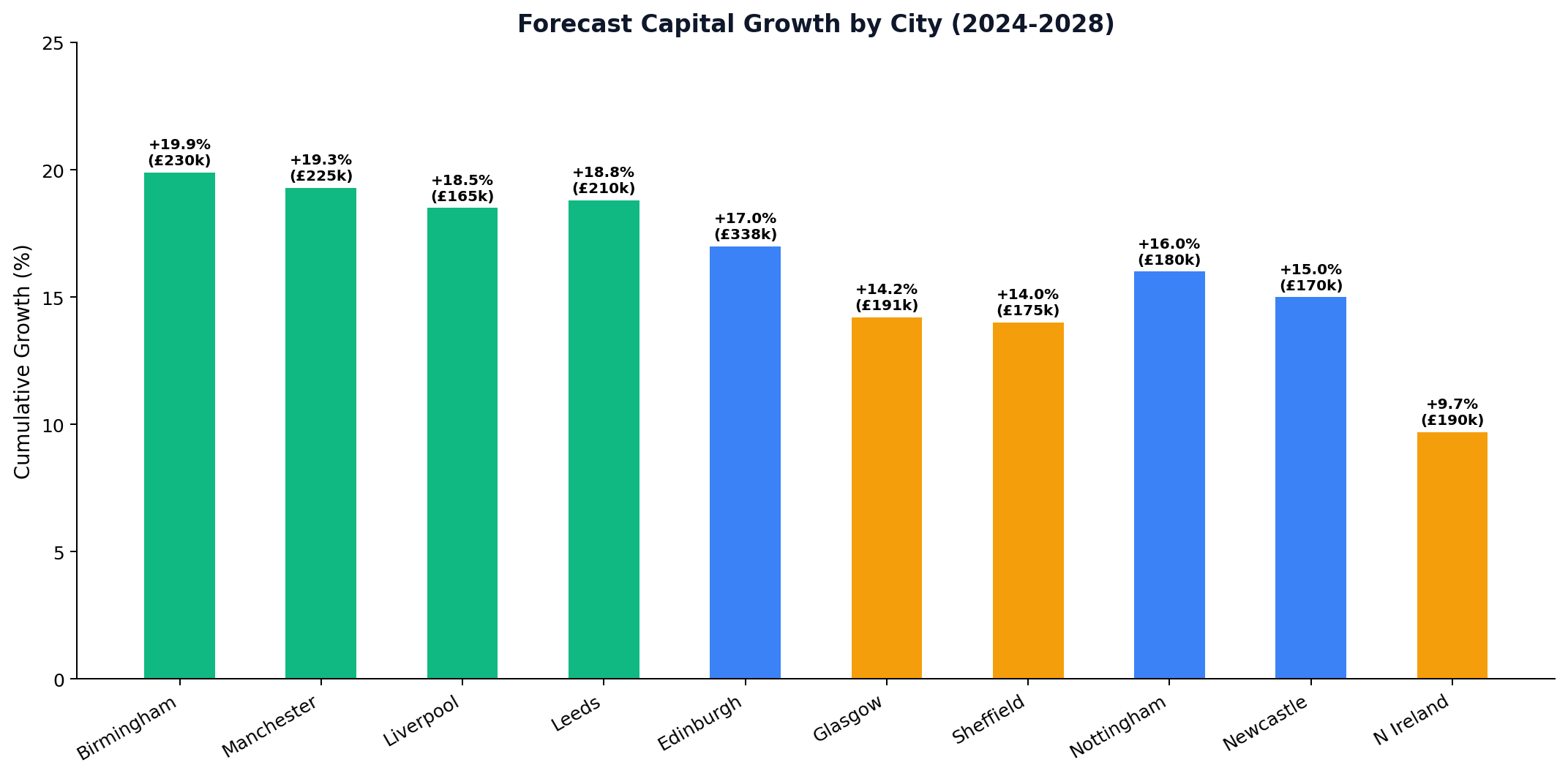
1. Manchester — Forecast Growth: +19.3% by 2028
Manchester is the consensus pick across forecasters. The combination of a young, growing population, second-fastest UK city economy, and a staggering regeneration pipeline (Victoria North, Old Trafford, MediaCityUK expansion) creates conditions for sustained appreciation.
Where to buy for growth: Victoria North corridor (M4, M40), Trafford (M16, M17), Salford Quays (M50)
2. Birmingham — Forecast Growth: +19.9% by 2028
The UK's second city is undergoing a transformation. HS2 (Manchester-London via Birmingham), the Midland Metro extension, and a booming tech sector are attracting investment and young professionals. The Commonwealth Games legacy infrastructure continues to benefit surrounding areas.
Where to buy for growth: Digbeth regeneration zone, Jewellery Quarter, Edgbaston, Eastside
3. Liverpool — Forecast Growth: +18.5% by 2028
Liverpool combines the UK's most affordable major city prices with significant regeneration investment. The £5.5 billion Liverpool Waters development, the Knowledge Quarter, and the Paddington Village project are all driving demand and appreciation.
Property prices reached £179,642 on average in May 2026 — a 49% increase over the previous decade. With entry prices still under £180,000, there's significant headroom for further growth.
Where to buy for growth: Baltic Triangle, Liverpool Waters area (L3), Toxteth (L8), Wavertree (L15)
4. Leeds — Forecast Growth: +18.8% by 2028
Leeds has quietly become one of the UK's most dynamic cities. A diverse economy spanning financial services, legal, digital, and healthcare drives consistent demand. The South Bank regeneration — the largest city centre regeneration project in Europe — will transform the area south of the River Aire.
Where to buy for growth: South Bank, Holbeck Urban Village, Kirkstall, Chapel Allerton
5. Edinburgh — Forecast Growth: +17% by 2028
Edinburgh benefits from the most severe supply constraints of any UK city. Limited development land within the city centre, combined with strong demand from students, professionals, and international buyers, creates persistent upward pressure on prices.
Where to buy for growth: Granton waterfront regeneration, Leith (EH6), Abbeyhill (EH8), BioQuarter area
6. Glasgow — Forecast Growth: +14.2% (5-year)
Glasgow is catching up. Strong price growth in 2026, affordable entry prices (£191,000 average), and ongoing regeneration make it one of the value picks. The yield premium (9.3% average) means you're being paid well while you wait for capital appreciation.
Where to buy for growth: Robroyston (G21), Dennistoun (G31), Govan regeneration area, Collegelands
7. Northern Ireland — Forecast Growth: +9.7% (2026 alone)
Northern Ireland was the UK's strongest-performing region for capital growth in 2026, with 9.7% price increases. Average prices remain sub-£200,000, and the market is being driven by simple supply-demand dynamics.
Where to buy for growth: Belfast city centre, Titanic Quarter, south Belfast
8. Nottingham — Forecast Growth: +16% by 2028
Two major universities, a growing tech sector, and one of the most affordable major city property markets in England. Prices are around £180,000 on average, with clear room for appreciation as the city's economic profile rises.
Where to buy for growth: City centre, Sneinton, Lace Market, Beeston
9. Newcastle — Forecast Growth: +15% by 2028
The North East is increasingly attractive to remote workers and those relocating from expensive southern cities. Newcastle combines affordable property, strong cultural offer, and improving infrastructure. The Quayside and Ouseburn developments are particularly promising.
Where to buy for growth: Ouseburn, Heaton, Jesmond, Quayside corridor
10. Sheffield — Forecast Growth: +14% by 2028
Sheffield benefits from two universities, growing tech and advanced manufacturing sectors, and significant regeneration in the city centre and surrounding areas. Property prices are among the lowest of any major UK city, creating exposure to outsized growth.
Where to buy for growth: Kelham Island, Neepsend, city centre, Ecclesall Road corridor
The Capital Growth Strategies
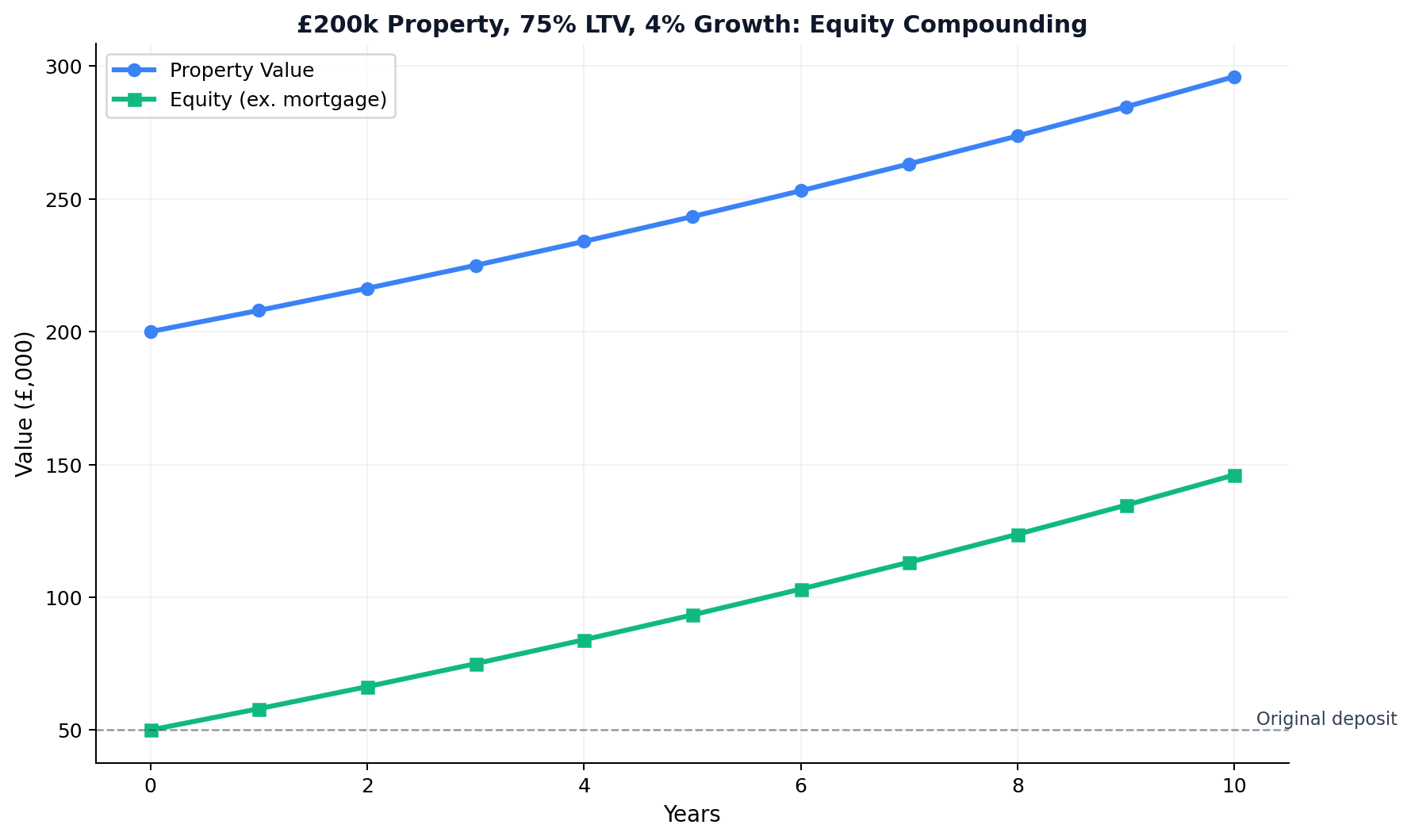
Strategy 1: Buy Ahead of Regeneration
This is the most reliable capital growth strategy. Identify areas with committed regeneration investment (not just rumoured), buy before works begin, and hold through the construction and the "ripple effect" period.
The Timeline:
- Year 0-1: Planning announced → Speculation begins, early movers enter
- Year 1-3: Construction starts → Visible change, prices begin to move
- Year 3-5: Development completes → New amenities, transport, residents arrive
- Year 5-7: Ripple effect → Surrounding streets and postcodes see uplift
The Risk: Regeneration plans can be delayed, scaled back, or cancelled entirely. Only invest where commitment is backed by signed contracts, planning approvals, and visible construction.
Strategy 2: Value-Add (Forced Appreciation)
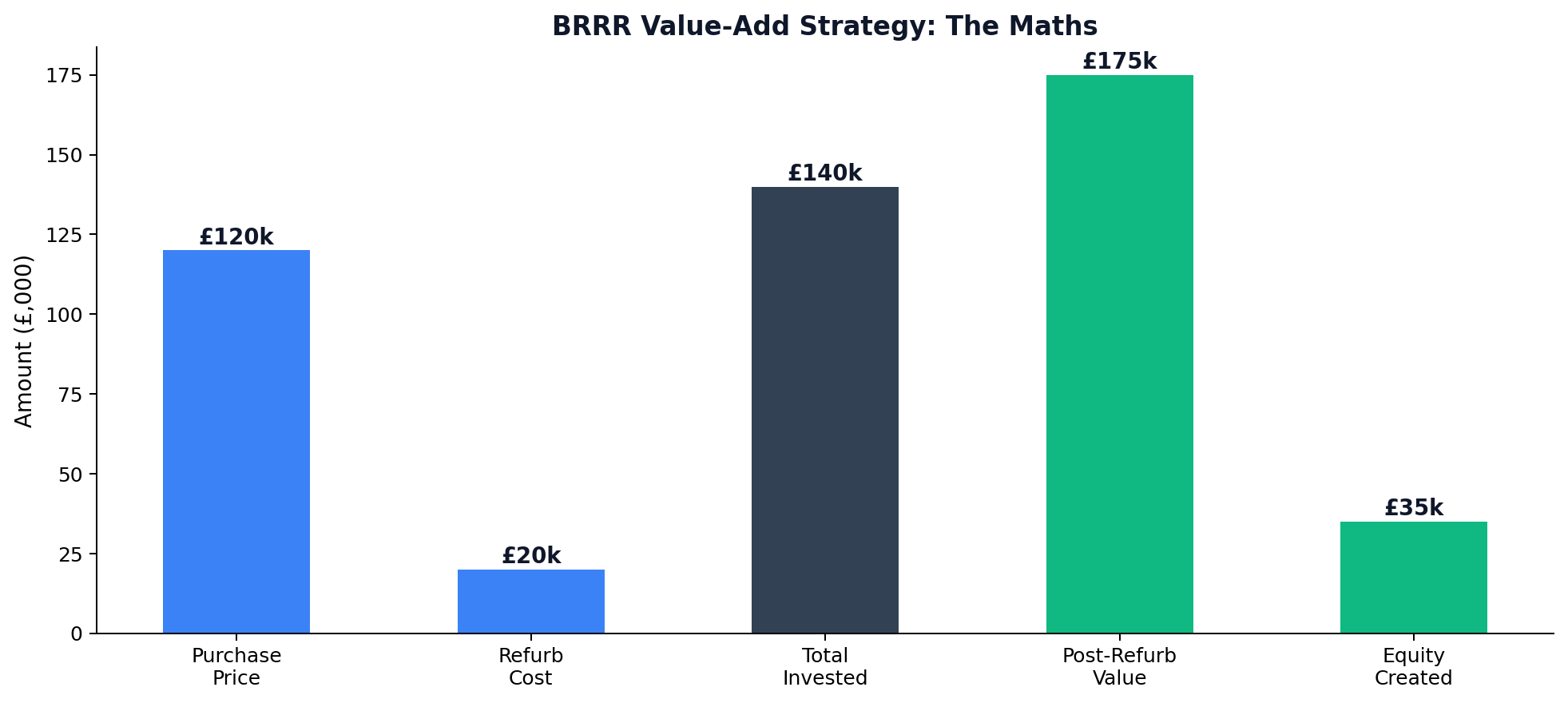
Buy below market value, add value through refurbishment, and remortgage at the higher value. This is the "BRRR" strategy (Buy, Refurbish, Refinance, Repeat).
The Maths:
- Purchase: £120,000 (20% below £150,000 market value)
- Refurbishment: £20,000
- Total invested: £140,000
- Post-refurbishment value: £175,000
- Equity created: £35,000 (25% return on capital)
You then remortgage at 75% LTV on the new £175,000 value = £131,250 mortgage, recovering most of your cash to reinvest.
Where it works best: The North and Midlands, where purchase prices are low enough that a £20,000-£30,000 refurbishment creates a meaningful percentage uplift.
Strategy 3: Infrastructure Plays
Buy near planned transport improvements — new Metrolink stops, railway stations, motorway junctions, or major road improvements. The evidence consistently shows 5-15% price uplift within 2 years of a new transport link opening.
Current Opportunities:
- Manchester Bee Network: New tram and bus routes enhancing connectivity across Greater Manchester
- HS2 Corridor: Properties near planned stations in Birmingham and Crewe
- East-West Rail: Connecting Oxford, Milton Keynes, and Cambridge
- Crossrail 2 (London): If approved, will transform property values along the route
Strategy 4: Education-Driven Growth
Areas with outstanding schools — particularly secondary schools — command premium prices. Families will pay 10-20% more for a property within the catchment area of a top school.
The Play: Identify areas where schools are improving (check Ofsted trajectory) but prices haven't yet reflected this. Buy before the market catches up.
What NOT to Do: Capital Growth Traps
The "London Will Recover" Trap
London property prices are forecast to underperform most UK regions through 2030. Affordability constraints, remote work trends, and young professional migration to northern cities all work against London's growth prospects. There are individual London postcodes that will outperform, but "London" as a blanket growth bet is no longer valid.
The Off-Plan Premium Trap
Many off-plan developments are sold at prices above current market value, sometimes with "guaranteed" rental returns that mask the premium. You've already "eaten" your capital growth before you even complete.
The Test: Would the completed property sell on the open market for more than you're paying? If no, you're paying a premium for newness, not buying into growth.
The "Next London" Trap
Every few years, a city gets labelled "the next London." It never happens. Cities grow on their own merits, at their own pace. Birmingham is becoming a better version of Birmingham, not a cheaper version of London.
Measuring Your Growth: The Numbers That Matter
| Metric | Formula | What "Good" Looks Like |
|---|---|---|
| Compound Annual Growth Rate (CAGR) | (End Value / Start Value)^(1/Years) - 1 | 4-6% for UK property |
| Price-to-Earnings Ratio | Average Price / Average Salary | Under 6x = headroom |
| Equity Multiple | Current Value / Total Capital Invested | 2x+ over 10 years |
| Total Return | (Rental Income + Capital Growth) / Capital Invested | 12-20% annually (leveraged) |
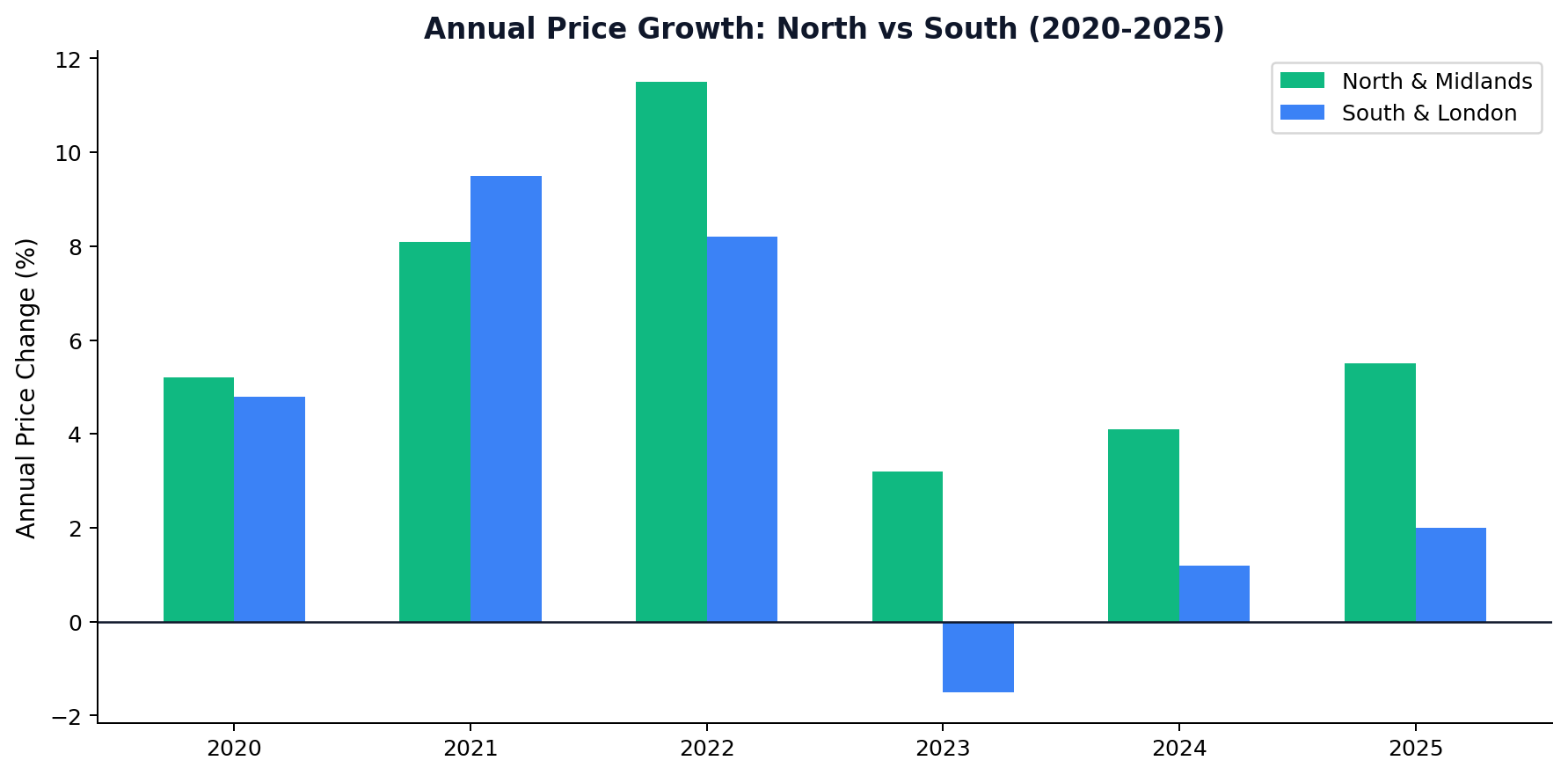
The 10-Year View: Compounding Capital Growth
The power of property capital growth becomes dramatic over longer time horizons, especially with leverage:
Scenario: £200,000 property, 75% LTV, 4% annual growth
| Year | Property Value | Equity | Return on £50K Deposit |
|---|---|---|---|
| 0 | £200,000 | £50,000 | 0% |
| 3 | £225,000 | £75,000 | 50% |
| 5 | £243,000 | £93,000 | 86% |
| 7 | £263,000 | £113,000 | 126% |
| 10 | £296,000 | £146,000 | 192% |
A £50,000 deposit turns into £146,000 of equity over 10 years at 4% growth — nearly a 3x return. That's before rental income, mortgage paydown, and any forced appreciation from refurbishment.
FAQ: Best Capital Growth Property UK
Which UK region has the best property growth forecast? The North West (led by Manchester and Liverpool) is forecast to see the strongest growth, followed by Yorkshire & Humber (Leeds, Sheffield) and the West Midlands (Birmingham). Savills projects 23.4% cumulative UK growth to 2030, with northern regions outperforming.
Is it better to invest for capital growth or rental yield? The best investments deliver both. However, if forced to choose, capital growth creates more long-term wealth. A £200,000 property appreciating 5% annually adds £10,000/year in paper wealth — often exceeding the net rental income from the same property.
Do property prices always go up? No. UK property has experienced real-terms declines during 1989-1995 and 2008-2013. However, over any 15-year rolling period in the last century, UK property has never delivered a negative return.
How do I find areas about to experience capital growth? Look for the capital growth levers: committed regeneration investment, new transport infrastructure, improving school ratings, employment growth, and affordable price-to-earnings ratios. The data is publicly available — it just requires systematic analysis.
Should I invest in London for capital growth? Not in 2026. London is forecast to underperform most UK regions through 2030. Individual postcodes (particularly East London around Crossrail stations) may outperform, but the broad London market offers weaker growth prospects than northern cities at much higher entry costs.
📚 Related Reading
- Property Equity Investors UK: The Hard Truth
- Invest During a Recession: The Smart Money Playbook
- Real Estate MASK_5
- How to Buy Dirt
- Low-Risk Investments That Actually Work
📚 Related Reading
- Passive Income Property UK: How to Build a Rental Portfolio That Actually Pays You in 2026
- Property Investments Manchester: The Definitive Investor's Guide to the UK's Most Dynamic City in 2026
- Off Plan Property for Sale UK: The 2026 Investor's Playbook
- Buy dirt
- Hobbies That Make Money: Real "Cheat Codes" for Turning Your Passion Into Profit
Stop being a landlord. Start being an investor.
Shaded Canvas introduces serious capital to vetted UK property opportunities — targeting 12–16% net returns.
Start Investing →