

Scotland's property market operates under its own rules — literally. Different tax structures, different tenancy legislation, different buyer protections, and increasingly different politics. For investors who understand these differences, Scotland offers some of the strongest fundamentals in the entire UK: high yields, affordable entry prices, and cities that consistently punch above their weight.
This guide covers everything you need to know about investing in Scottish property in 2026 — from LBTT calculations to the best postcodes in Edinburgh and Glasgow, and the regulatory shifts that will shape your returns.
Why Scotland Stands Out for Property Investors
Scotland is not just "the bit above England where property is cheaper." It's a distinct investment market with genuine structural advantages:
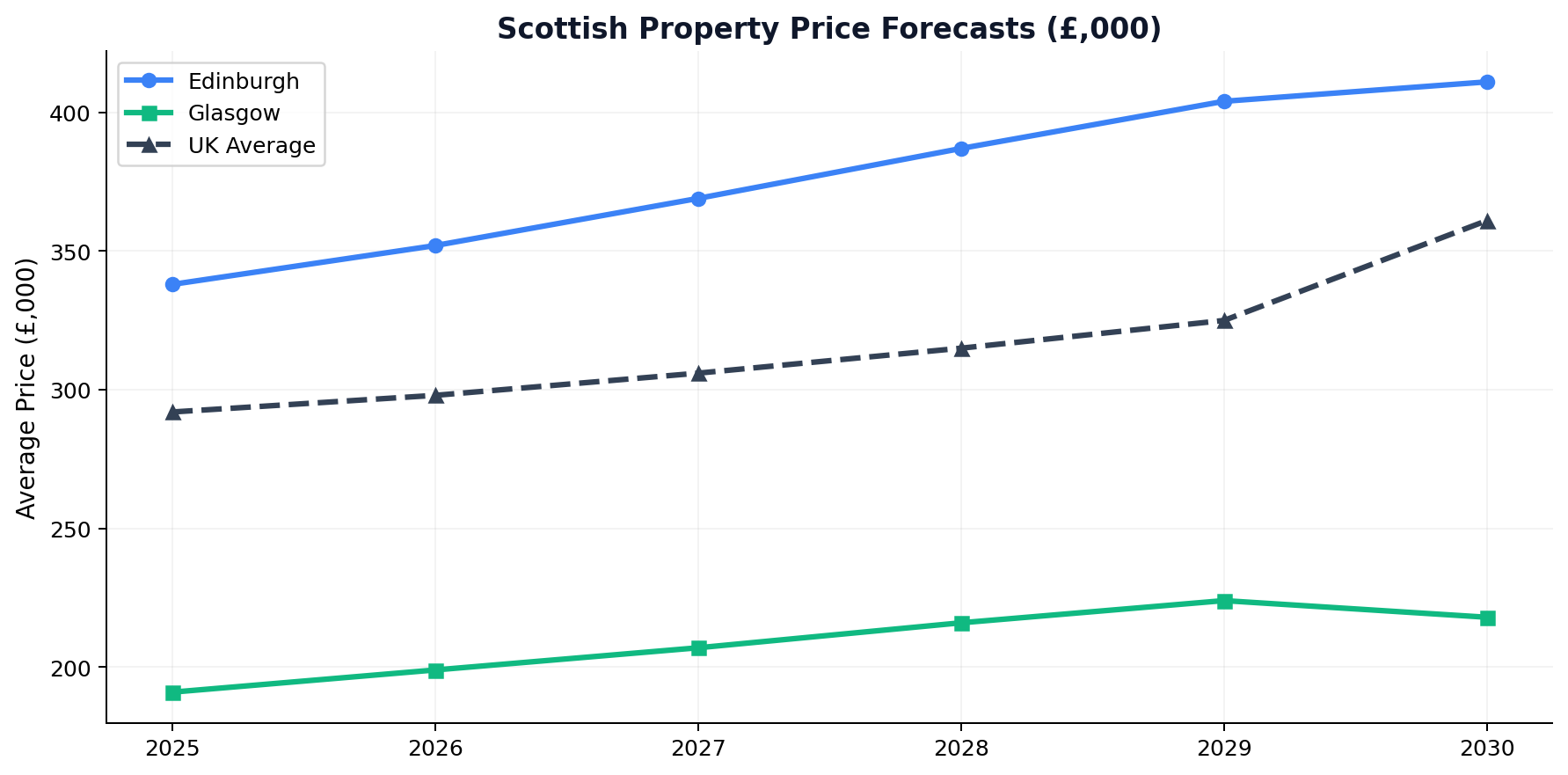
Affordable Entry Points: The average property price in Glasgow is approximately £191,000, compared to Edinburgh's £338,000. Both are significantly below the UK average of £292,000 and a fraction of London's £524,000.
Strong Yields: Glasgow delivers average gross rental yields of 9.3% — the joint highest of any major UK city. Edinburgh, while more expensive, still offers yields of 5.5-7.2% depending on postcode and property type.
Growth Trajectory: Savills projects 21.6% cumulative price growth across Scotland between 2026 and 2030. Edinburgh and Glasgow are expected to lead with 3-5% annual increases in 2026.
Robust Rental Demand: Scotland's universities, financial services sector, and tech industry drive consistent tenant demand. Edinburgh alone has over 80,000 students, while Glasgow's ten universities and colleges serve over 115,000.
Understanding LBTT: Scotland's Tax Landscape
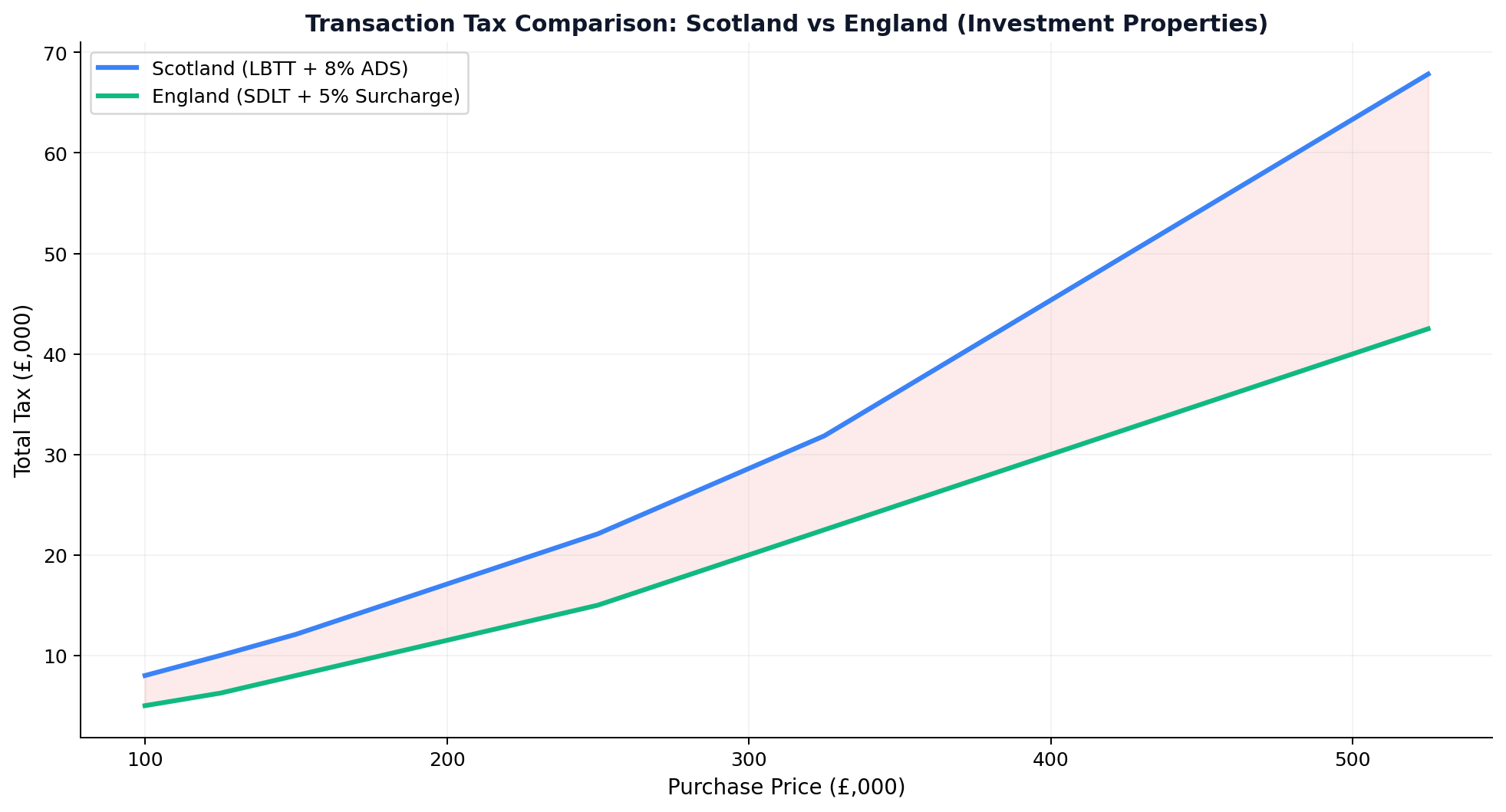
The Land and Buildings Transaction Tax (LBTT) replaced Stamp Duty in Scotland in 2015. The rates and thresholds are different, and critically, the Additional Dwelling Supplement (ADS) for second properties is different.
LBTT Rates for Residential Property (2026)
| Purchase Price Band | LBTT Rate |
|---|---|
| Up to £145,000 | 0% |
| £145,001 - £250,000 | 2% |
| £250,001 - £325,000 | 5% |
| £325,001 - £750,000 | 10% |
| Over £750,000 | 12% |
The Additional Dwelling Supplement (ADS)
If you're buying a second property (which as an investor, you almost certainly are), you'll pay an additional 8% ADS on top of the standard LBTT. This is calculated on the total purchase price, not just the portion above any threshold.
Worked Example — £200,000 Investment Property:
- Base LBTT: £1,100 (2% on £55,000 above £145,000)
- ADS: £16,000 (8% on full £200,000)
- Total Tax: £17,100
That's an important number. On a £200,000 property, the ADS alone adds £16,000 to your acquisition costs. This means your deals need to be good enough to absorb this upfront hit and still deliver acceptable returns.
The Scottish Budget for 2026 kept the ADS at 8%, providing some stability for investors who feared a further increase.
Green Freeport Relief
Scotland has designated Green Freeports that offer LBTT relief for qualifying investments. The relief is expected to remain available until September 30, 2034. If your investment strategy aligns with these zones (the Cromarty Firth and the Firth of Forth), the tax savings can be significant.
Edinburgh: The Premium Market
Edinburgh is Scotland's most expensive city and its most consistent performer. It's a market characterised by limited supply, premium rents, and a tenant pool that skews towards professionals, students, and international workers.
The Best Postcodes for Yield
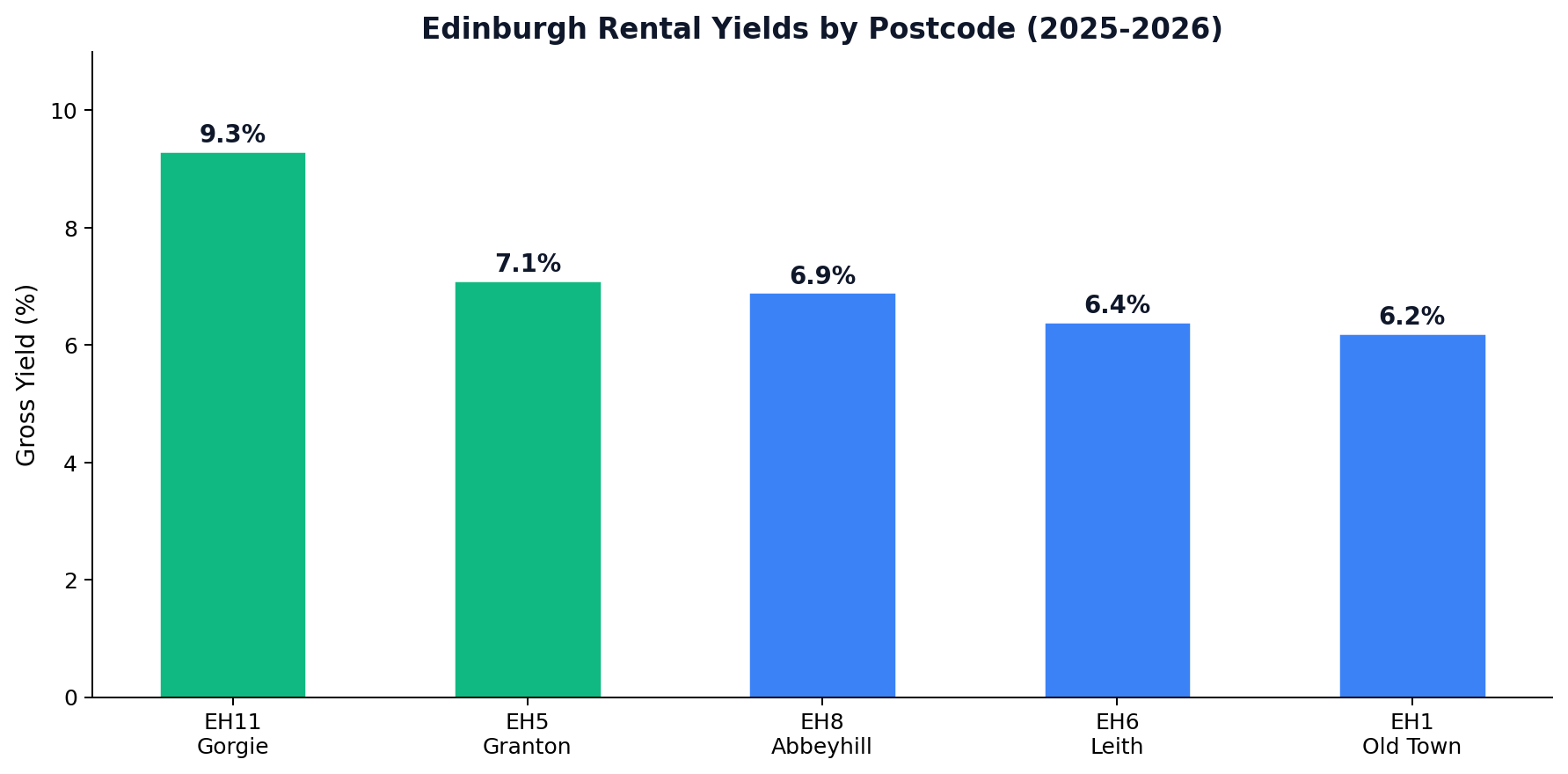
| Postcode | Area | 1-Bed Yield | 2-Bed Yield | 3-Bed Yield |
|---|---|---|---|---|
| EH5 | Granton, Trinity | 7.1% | 6.8% | — |
| EH11 | Gorgie, Dalry | — | — | 7.2-9.3% |
| EH8 | Abbeyhill, Willowbrae | — | 6.9% | — |
| EH6 | Leith, Newhaven | 6.4% | 6.4% | — |
| EH1 | Old Town, Princes St | 5.8% | 6.2% | 6.6% |
EH11 (Gorgie/Dalry) stands out as the highest-yielding area in Edinburgh. Three-bedroom properties here hit 9.3% gross yield in Q2 2026, driven by strong student and young professional demand combined with relatively affordable purchase prices.
EH5 (Granton/Trinity) offers excellent value. This area is undergoing regeneration, with new developments along the waterfront improving desirability while prices remain below the Edinburgh average.
Leith (EH6) has transformed from a rough docklands area into one of Edinburgh's most desirable neighbourhoods. Rents have increased significantly, but purchase prices haven't kept pace, creating a yield opportunity.
Edinburgh Investment Considerations
Stock Shortage: The most defining feature of Edinburgh's market in 2026 is acute stock shortage. There simply aren't enough properties for sale, which supports prices but makes finding good deals harder.
Festival Premium: Edinburgh's annual festivals (Fringe, International Festival, Hogmanay) create a short-term let premium. However, regulation of short-term lets has tightened significantly, with licensing requirements introduced in 2023 and planning control areas limiting new short-term let approvals.
New Build Pipeline: Several large developments are planned or underway, including the Granton Waterfront regeneration and continued expansion in the BioQuarter area. These will eventually add supply, but not enough to meaningfully suppress prices.
Glasgow: The Yield Powerhouse
Glasgow is Scotland's largest city and, according to Colliers, the UK's top residential investment city in 2026 — ranked first for strong yields, economic resilience, and improving fundamentals.
Why Glasgow Works for Investors
The numbers tell the story. Average gross rental yields of 9.3% across the city. Average property prices around £191,000 — accessible for investors who might be priced out of Edinburgh. A population of over 600,000 with strong net domestic migration from more expensive cities.
Glasgow has led Scottish cities in house price growth in 2026. Its ongoing regeneration — particularly in areas like the Barras, Pacific Quay, and the Clyde waterfront — is creating new residential supply while increasing the desirability of surrounding areas.
The Best Postcodes for Yield
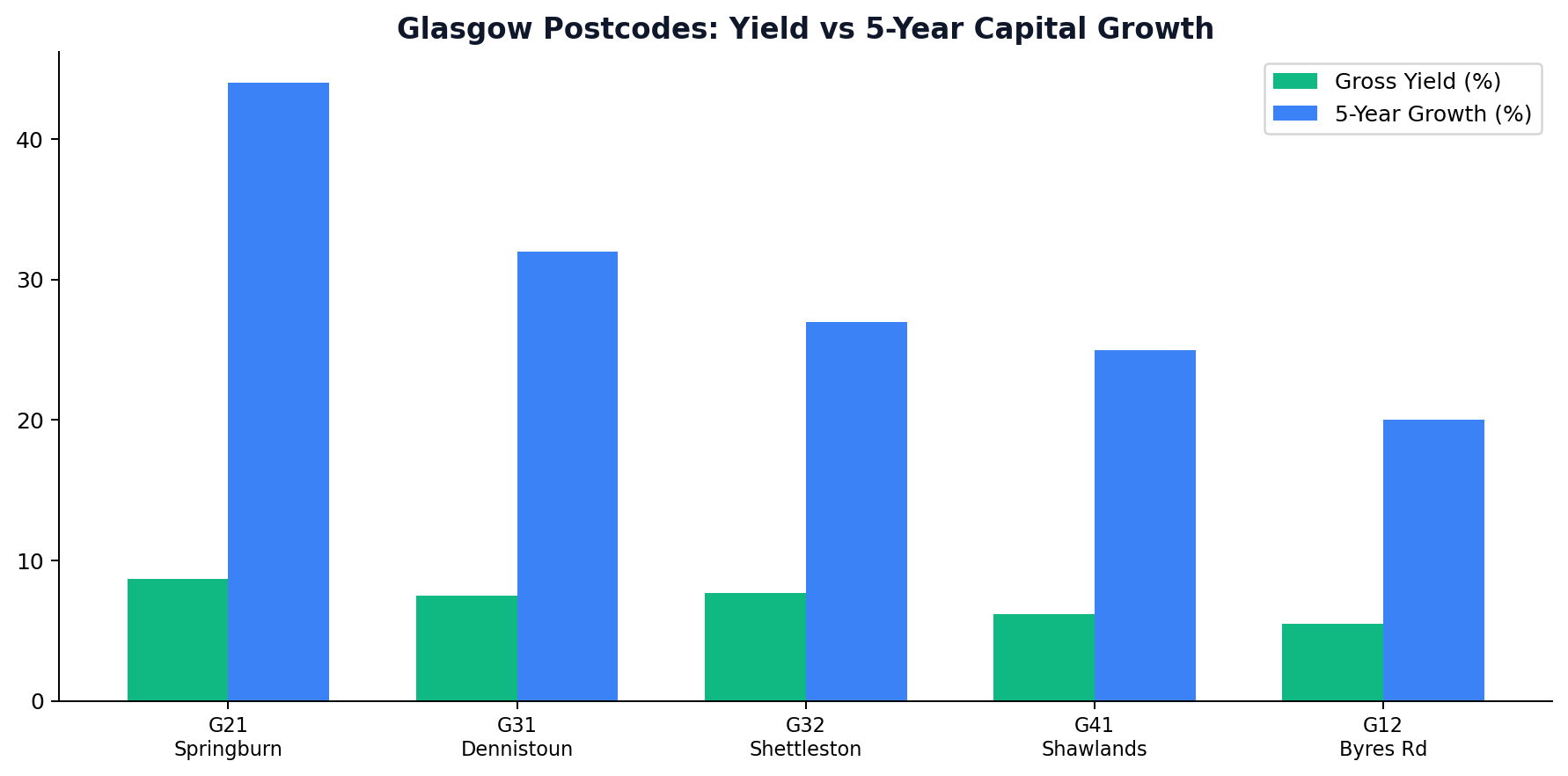
| Postcode | Area | Avg Yield | 5-Year Capital Growth |
|---|---|---|---|
| G21 | Springburn, Balornock | 8.7% | 44% |
| G32 | Shettleston, Tollcross | 7.7% | 27% |
| G31 | Dennistoun | 7.5% | 32% |
| G41 | Pollokshields, Shawlands | 6.2% | 25% |
| G12 | Byres Road, Hyndland | 5.5% | 20% |
G21 (Springburn/Balornock/Robroyston) is the standout — 8.7% rental yield combined with 44% capital growth over five years is an exceptional combination. Robroyston in particular has benefited from new-build development and improved transport links.
Dennistoun (G31) is Glasgow's equivalent of what Hackney was to London 15 years ago — a formerly overlooked area experiencing rapid gentrification, with prices still affordable enough to deliver strong yields.
Student Market
Glasgow's student population of 115,000+ across ten institutions creates massive rental demand. The University of Glasgow (West End) and University of Strathclyde (city centre) are the primary demand drivers. Purpose-built student accommodation (PBSA) cannot keep pace with demand, creating opportunities for well-located HMO-style investments.
Beyond the Central Belt
Aberdeen
Aberdeen was hammered by the 2014-2016 oil price crash, and prices have never fully recovered. This creates a potential value opportunity — but only for investors with strong conviction about the energy sector's trajectory. The city is pivoting towards renewables, but the transition is slow. Approach with caution and ensure your numbers work even without price recovery.
Dundee
Dundee is Scotland's "comeback city." The V&A museum, waterfront regeneration, and growing tech sector (Dundee has a significant gaming industry) are all positive signals. Prices are very affordable — average around £140,000 — and yields are attractive. The risk is that Dundee's economy is still heavily dependent on a small number of employers.
Stirling and Perth
Both offer affordable entry points and steady, if unspectacular, rental demand. They're university towns with stable tenant pools, but capital growth prospects are more modest than Edinburgh or Glasgow.
The Scottish Regulatory Framework
Scotland's rental legislation is distinct from England and becoming more so.
The Housing (Scotland) Bill
This landmark legislation, progressing through the Scottish Parliament, introduces:
- Rent controls: Local authorities will have powers to designate rent control areas
- Enhanced tenant protections: Building on the existing Private Residential Tenancy framework
- Landlord registration: Continued requirements for all landlords to register with local authorities
Energy Efficiency
Scotland is moving towards requiring private rented properties to achieve a fabric EPC rating of C by 2028. This is more ambitious than England's timeline and will require many older properties to undergo significant insulation and heating upgrades.
Landlord Registration
All landlords in Scotland must register with the local authority. The registration is relatively straightforward, but failure to register is a criminal offence. You must be registered before letting property.
The PRT (Private Residential Tenancy)
Since December 2017, all new private tenancies in Scotland are Private Residential Tenancies. These have no fixed end date — they're open-ended, and can only be ended by the tenant giving 28 days' notice, or by the landlord using one of 18 specified grounds for eviction with appropriate notice periods.
Scotland vs England: Key Differences for Investors
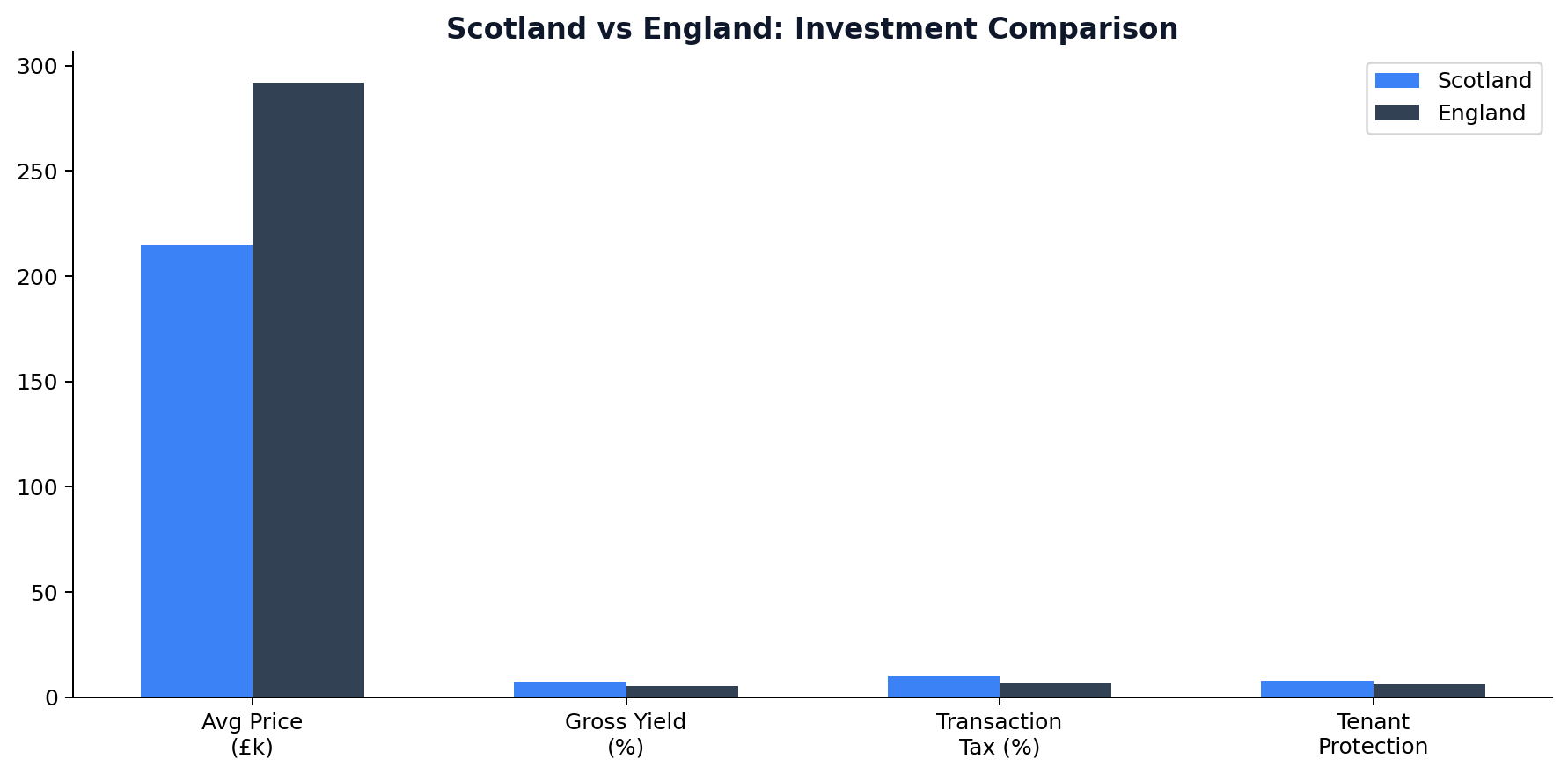
| Factor | Scotland | England |
|---|---|---|
| Transaction tax | LBTT (different bands) | SDLT |
| Second property surcharge | 8% ADS | 5% SDLT surcharge |
| Tenancy type | PRT (open-ended) | AST (fixed-term, changing under RRA) |
| Section 21 equivalent | Never existed | Abolished May 2026 |
| EPC target | Band C by 2028 | Band C proposed |
| Landlord registration | Mandatory | Not required (England) |
| Rental regulation | Moving towards rent controls | No rent controls planned |
The Investment Thesis for Scotland in 2026
Scotland's property market in 2026 comes down to a simple equation: strong yields, affordable entry, proven demand fundamentals, and clear growth trajectory — offset by higher transaction taxes (ADS), evolving regulation, and potential rent controls.
For investors who:
- Prioritise yield over capital growth: Glasgow is hard to beat
- Want a balance of yield and prestige: Edinburgh's EH5, EH6, and EH11 postcodes
- Have limited capital (under £40,000 deposit): Glasgow and Dundee offer sub-£160,000 properties
- Are looking for contrarian bets: Aberdeen at severely discounted prices
The 8% ADS is a genuine headwind. On a £200,000 property, you're paying £16,000 in additional tax that English investors don't face. Your deals need to compensate for this — either through higher yields, BMV purchasing, or a long-term hold strategy where the tax is amortised across a decade of returns.
FAQ: Investing in Scotland Property
Is Scotland a good place to invest in property? Yes — Scotland offers some of the UK's highest rental yields, particularly in Glasgow (9.3% average). Edinburgh provides stability and premium rents. The key is understanding LBTT implications and Scottish-specific tenancy legislation.
How much is the Additional Dwelling Supplement in Scotland? The ADS is 8% of the total purchase price for any additional residential property (including buy-to-let). This is higher than England's 5% SDLT surcharge.
Can I invest in Scotland if I live in England? Absolutely. There's no residency requirement. However, you must register as a landlord with the local authority where your property is located, and your tenancies will follow Scottish law (PRT), not English law.
What are the best areas in Glasgow for buy-to-let? G21 (Springburn/Robroyston) offers 8.7% yield with strong growth. Dennistoun (G31), Shettleston (G32), and the Southside (G41, G42) also deliver strong returns.
Is Edinburgh or Glasgow better for property investment? Glasgow wins on yield (9.3% vs 5.5-7%). Edinburgh wins on capital preservation and rental premium. Your choice depends on whether you're optimising for cash flow (Glasgow) or long-term growth (Edinburgh).
📚 Related Reading
- Property Equity Investors UK: The Hard Truth About Building Wealth Through Bricks in 2026
- Property Sourcing Companies UK: The Complete Investor's Guide
- Real Estate MASK_5
- Low-Risk Investments That Actually Work
- Invest During a Recession: The Smart Money Playbook
📚 Related Reading
- Best Capital Growth Property UK: Where Property Prices Are Actually Heading in 2026 and Beyond
- Passive Income Property UK: How to Build a Rental Portfolio That Actually Pays You in 2026
- Property Investments Manchester: The Definitive Investor's Guide to the UK's Most Dynamic City in 2026
- Buy dirt
- Hobbies That Make Money: Real "Cheat Codes" for Turning Your Passion Into Profit
Stop being a landlord. Start being an investor.
Shaded Canvas introduces serious capital to vetted UK property opportunities — targeting 12–16% net returns.
Start Investing →