

The UK property sourcing industry sits in an unusual position. It is simultaneously one of the most useful services available to time-poor investors and one of the most fertile grounds for outright fraud. In February 2026, an estimated 60% of new buy-to-let mortgage applications come through limited company structures, off-market deal flow has become the competitive advantage that separates profitable portfolios from mediocre ones, and sourcing agents are more in demand than ever.
But the barrier to entry is absurdly low. Anyone with a mobile phone and a Companies House registration can call themselves a property sourcer. Some deliver genuine below-market-value deals that transform portfolios. Others are repackaging Rightmove listings with a £5,000 finder's fee attached. And a vocal minority are running outright scams — taking reservation deposits and disappearing.
This guide cuts through the noise. No affiliations, no referral links, no sponsored recommendations. Just the data, the red flags, the fee structures, and the compliance framework you need to make an informed decision.
What Exactly Does a Property Sourcing Company Do?
A property sourcing company — variously called a deal sourcer, property finder, or buying agent — works exclusively for the buyer. This is the fundamental distinction from an estate agent, who represents the seller. The sourcer's job is to find investment properties that match a specific brief, negotiate the purchase price, and guide the buyer through to completion.
The service typically covers:
- Off-market deal identification through direct-to-vendor marketing, auction monitoring, estate agent relationships, and distressed seller networks
- Financial analysis including yield calculations, cash flow projections, and stress testing against rate changes
- Negotiation to secure below-market-value (BMV) pricing — typically targeting 15-25% below comparable sales
- Due diligence support covering title issues, planning risks, structural concerns, and local market dynamics
- Professional referrals to solicitors, mortgage brokers, surveyors, and property managers
The best sourcers operate as an extension of your investment team. The worst operate as intermediaries adding cost without value.
The Difference Between a Property Sourcer and a Buying Agent
This distinction matters more than most investors realise. A traditional buying agent — firms like Garrington or Prime Purchase — typically operates at the premium end, working with owner-occupiers searching for a family home in a specific area. Fees often run to 2-3% of purchase price with minimums of £10,000-£15,000.
A property sourcer, by contrast, focuses on investment-grade deals: buy-to-let flats, HMO conversions, BRRR refurbishment projects, serviced accommodation units, and commercial-to-residential conversions. The fee structures are different (typically lower), the deal volume is higher, and the emphasis is squarely on return on investment rather than lifestyle preferences.
The Fee Landscape: What Property Sourcers Actually Charge
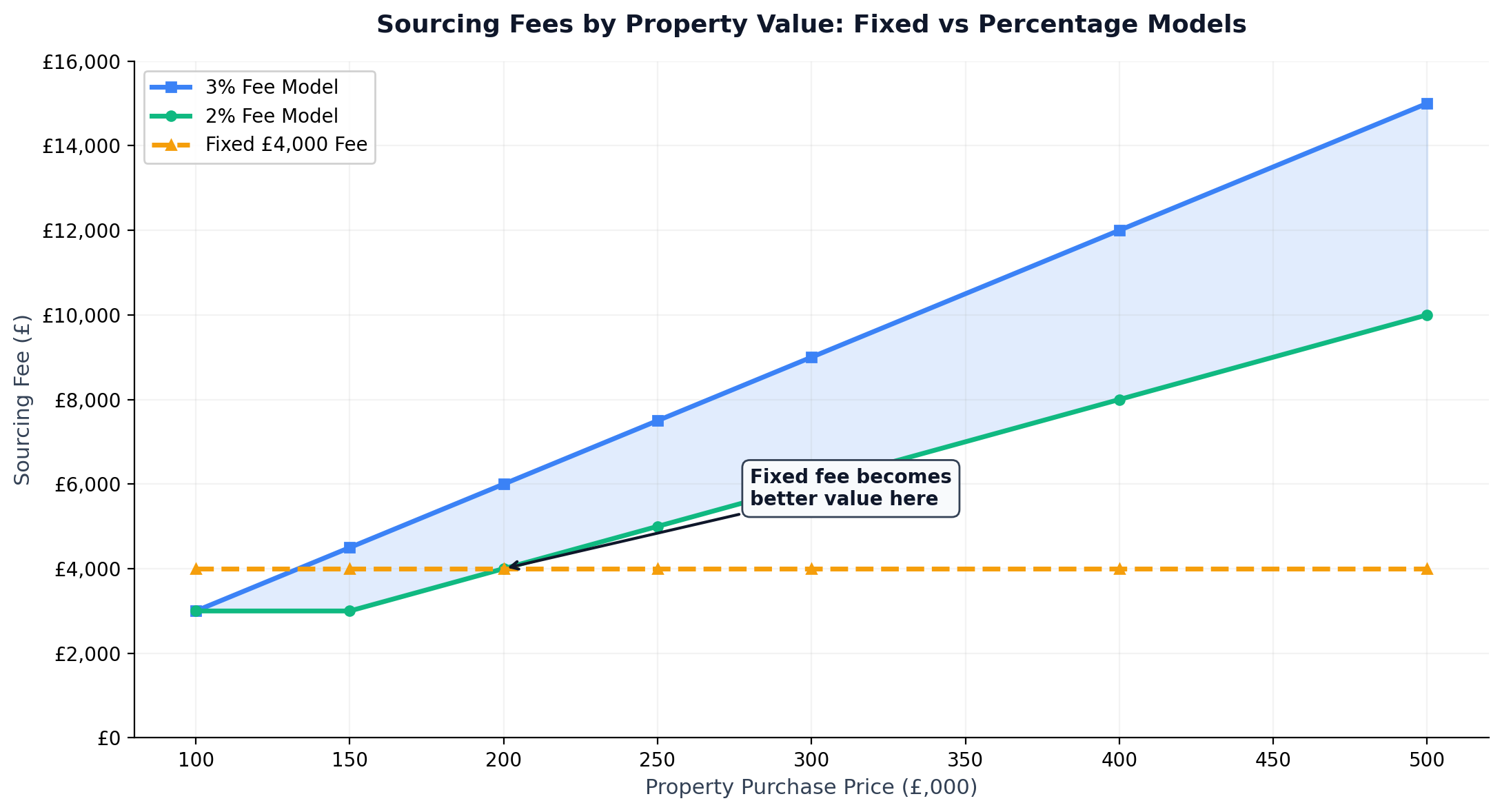
This is where the industry's opacity becomes a problem. Fees vary enormously and are often poorly disclosed until late in the process. Here is the real picture based on current market data:
Fee Structures Breakdown
| Fee Model | Typical Range | When It Works | Watch Out For |
|---|---|---|---|
| Percentage of purchase price | 1-3% | Standard for most residential deals | Verify whether it's gross or net of negotiated discount |
| Fixed fee per deal | £3,000-£6,000 | Lower-value properties where % would be too small | Some charge this PLUS a percentage |
| Upfront retainer | £500-£2,000 | Ongoing sourcing service with dedicated search | Non-refundable if no deal completes |
| Success-only fee | £3,500-£5,500 | No risk for the investor — fee only on completion | May indicate less effort per client |
The Hidden Fee Question
Here is what the headline fee does not tell you. Many sourcing companies earn additional income from:
- Developer commissions — if they steer you toward a new-build development, the developer may pay them a separate 1-3% referral fee. This creates an obvious conflict of interest
- Mortgage broker referrals — a procuration fee of £500-1,000 per referral
- Insurance and lettings management kickbacks — ongoing income per client introduced
None of this is necessarily wrong. But if a sourcer does not disclose these revenue streams, it should raise questions about whose interests they are actually serving.
What a Fair Fee Looks Like in Practice
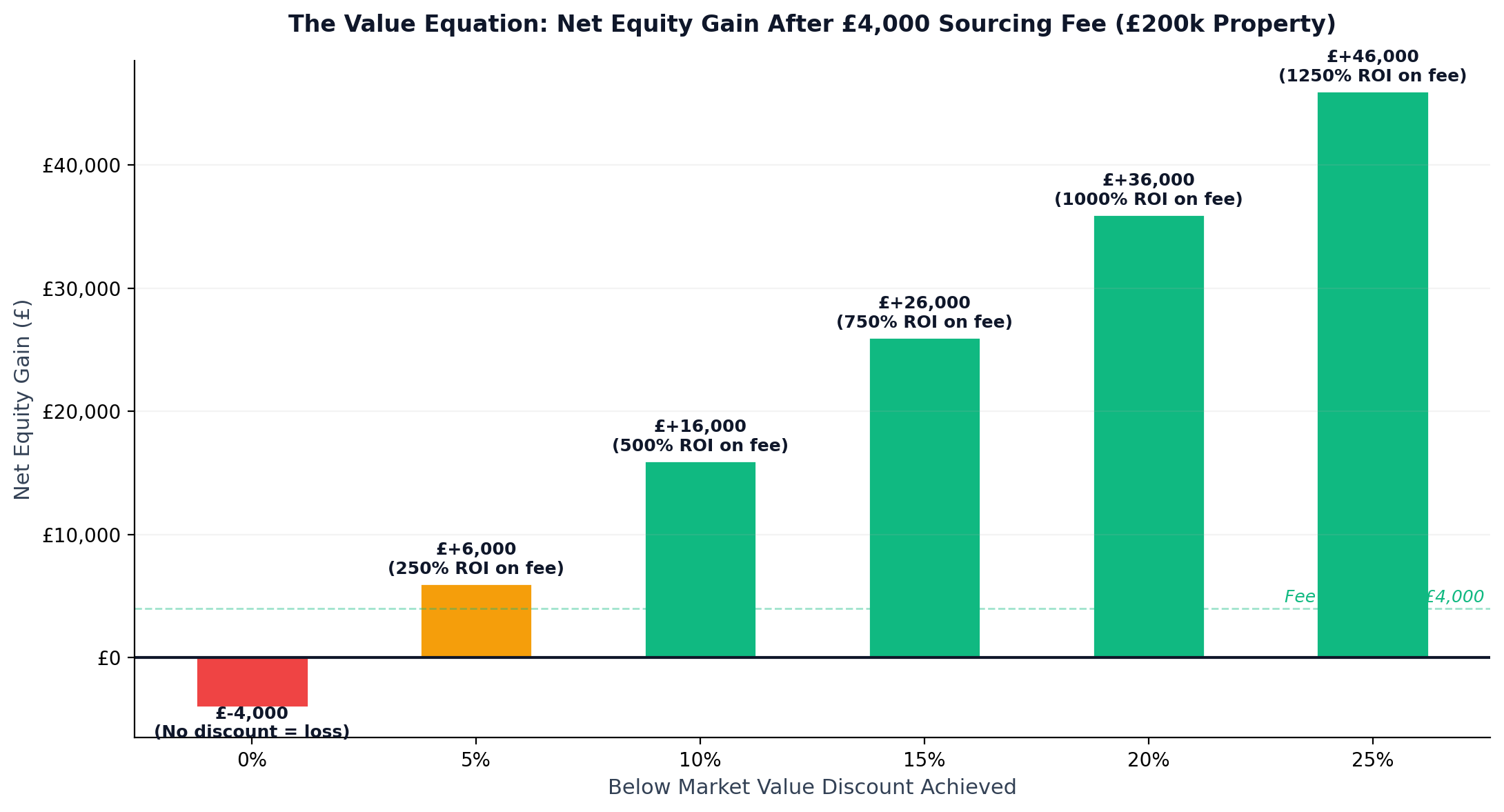
On a £200,000 buy-to-let purchased at a 20% BMV discount (£160,000 actual price), a 2% sourcing fee equals £3,200. The investor still gains £36,800 in day-one equity after the fee. That is a compelling value proposition — provided the 20% discount is genuine and verified by an independent RICS valuation, not the sourcer's own internal numbers.
The Compliance Framework: How to Verify a Legitimate Sourcer
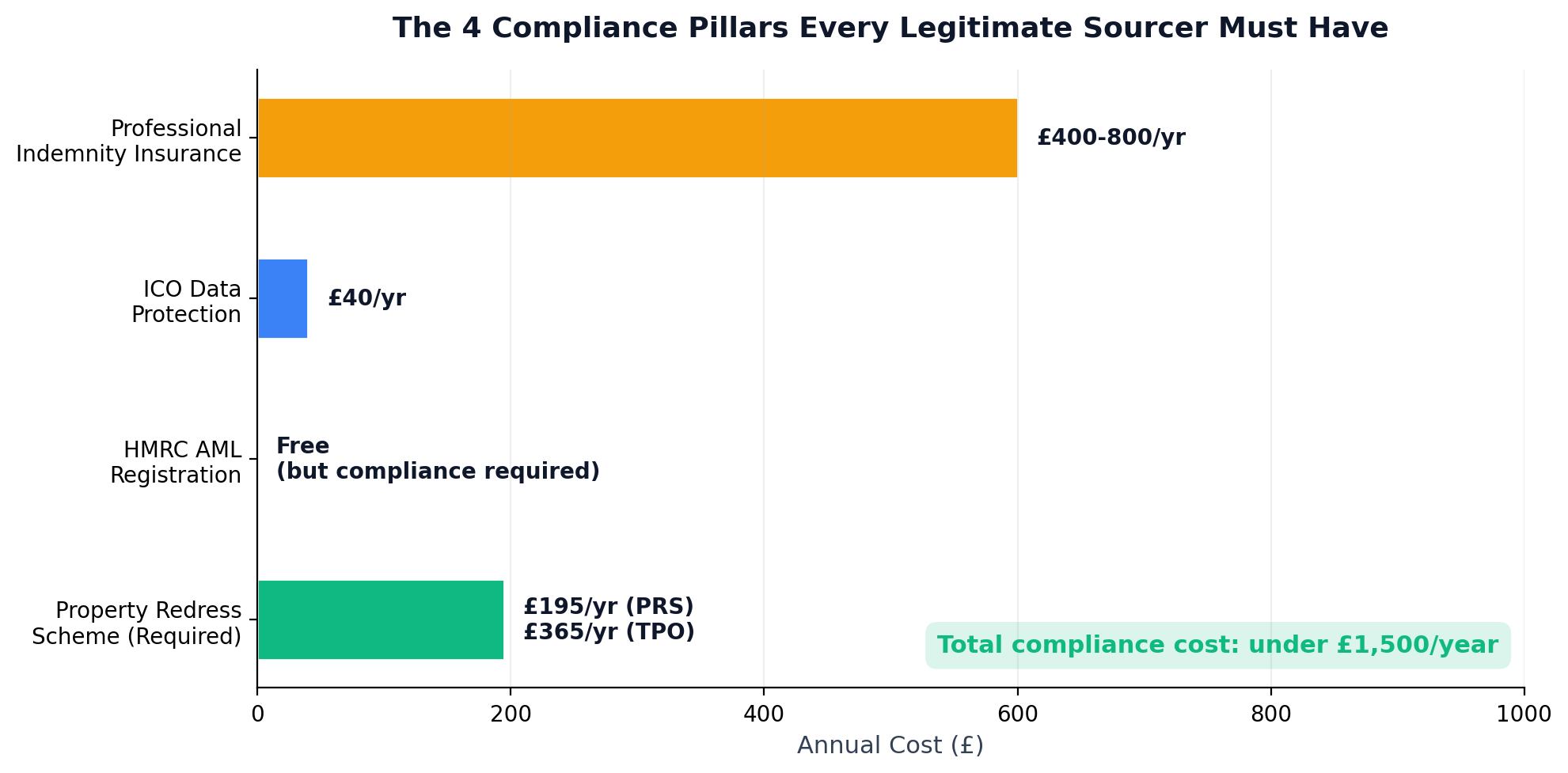
The UK property sourcing industry operates under a specific regulatory framework. A legitimate sourcer must comply with the following — and any company that cannot demonstrate all four is not worth your money or your risk.
1. Property Redress Scheme Membership (Legal Requirement)
All property sourcers in the UK are legally required to be members of either The Property Ombudsman (TPO) or the Property Redress Scheme (PRS). This is not optional. Failure to register carries a fine of up to £5,000 and potential prohibition from operating.
How to check: Search the TPO member directory at tpos.co.uk or PRS at propertyredress.co.uk. If the company does not appear, walk away.
2. HMRC Anti-Money Laundering Registration
Property sourcers are classified as estate agency businesses under the Money Laundering Regulations 2017. They must register with HMRC for Anti-Money Laundering (AML) supervision and conduct proper client identity verification.
How to check: Request their AML registration number. Legitimate firms will provide this without hesitation.
3. Information Commissioner's Office (ICO) Registration
Any business handling personal data — which property sourcers do by definition — must register with the ICO under the UK GDPR framework.
How to check: Search the ICO register at ico.org.uk/ESDWebPages/Search.
4. Professional Indemnity Insurance
While not always a legal requirement, professional indemnity (PI) insurance is the standard of care in the industry. It protects investors if a sourcer's negligence — such as failing to identify a structural problem or legal issue — causes financial loss.
What to ask for: A copy of their PI insurance certificate and confirmation it covers the value of deals they source.
The Companies House Check
Beyond regulatory compliance, run the company and its directors through Companies House. Look for:
- Dormant filings or strike-off actions — a red flag that the company may be a shell
- Director history — have they been directors of previously dissolved companies?
- Financial accounts — do they show actual trading activity or just minimal filings?
- Company age — how long have they been operating under this name?
The Red Flags: How to Spot a Bad Sourcer (Before You Lose Money)
The property investor forums — particularly Reddit's r/HousingUK, r/UKProperty, and r/UKPersonalFinance — are filled with cautionary tales. Here are the patterns that emerge repeatedly:
Guaranteed Returns or "Risk-Free" Language
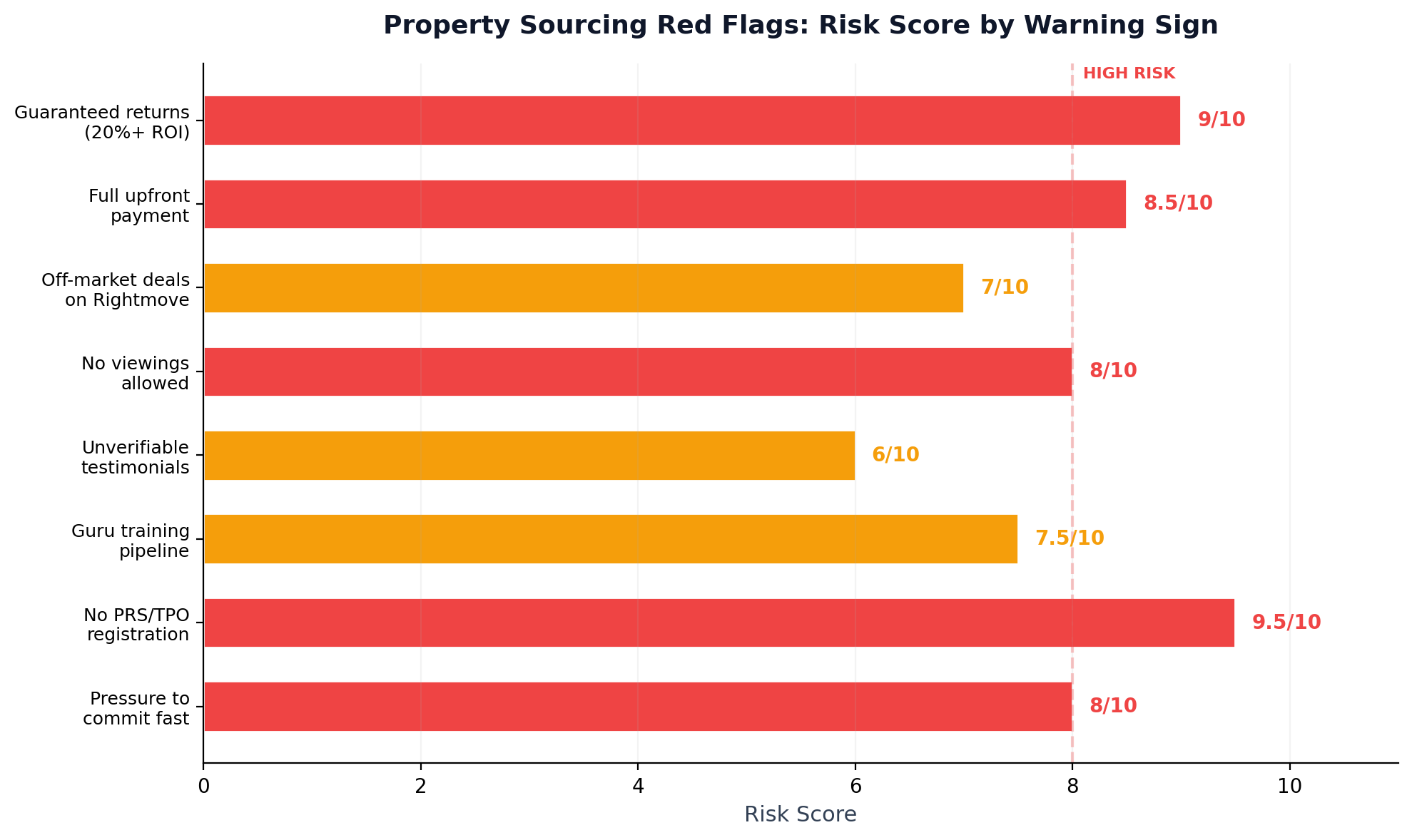
No property investment is risk-free. Any sourcer promising guaranteed returns — particularly above 8% net yield — is either lying or does not understand the market. If a deal genuinely offered risk-free 15% returns, institutional capital would have taken it long before a sourcing company offered it to retail investors.
Full Upfront Payment Before Property Identification
Reputable sourcers either work on a success-only basis or charge a modest retainer with the main fee payable on completion. Any company demanding the full sourcing fee upfront — particularly if they call it a "reservation fee" — presents an unacceptable risk. Multiple Reddit posts document companies that collected these fees and became unresponsive.
"Off-Market" Deals That Are Actually on Rightmove
This is remarkably common. Some sourcing companies simply monitor Rightmove and Zoopla, identify properties that have been listed for extended periods, and present them to investors as "exclusive off-market opportunities" with a £5,000 fee attached. A five-minute search would reveal the property has been publicly listed for months.
How to verify: Before paying any fee, search the property address on Rightmove, Zoopla, and OnTheMarket. Check the listing history using tools like PropertyData or the Land Registry price paid data.
Pressure to Complete Without Independent Advice
A legitimate sourcer will encourage you to instruct your own solicitor, obtain your own mortgage advice, and commission your own survey. If a sourcer insists you use their recommended professionals exclusively — particularly their solicitor — this creates a closed loop where independent due diligence becomes impossible.
No Track Record or Unverifiable Testimonials
Ask for direct contact with previous clients. Not curated testimonials on a website — actual contact details for investors who have completed deals through them. A sourcer with a genuine track record will facilitate this. One that refuses is hiding something.
The "Property Guru" Pipeline
Be deeply sceptical of sourcing companies that emerged from paid training course ecosystems. The business model for many property educators is: sell a £5,000-£20,000 course, then funnel graduates into a sourcing company that earns additional fees on every deal. The incentive structure is misaligned — the revenue is in selling courses and sourcing fees, not in the quality of the underlying deals.
How Property Sourcing Actually Works: The Process Step by Step
For investors who have never used a sourcer, here is what a legitimate engagement looks like from initial contact to completion:
Step 1: Initial Consultation and Investment Brief
The sourcer should spend significant time understanding your:
- Available capital (deposit size, refurbishment budget, cash reserves)
- Investment strategy (buy-to-let, HMO, BRRR, serviced accommodation, commercial conversion)
- Target geography (specific cities, regions, or nationwide)
- Risk tolerance (leveraged vs unleveraged, single-lets vs multi-lets)
- Exit timeline (5-year flip, 10-year hold, indefinite portfolio building)
A good sourcer will tell you what does NOT work for your specific situation. A bad one will tell you everything works.
Step 2: Deal Identification and Packaging
Using their network — estate agent relationships, direct-to-vendor marketing, auction monitoring, and trade contacts — the sourcer identifies properties matching your brief. Each deal should be packaged with:
- RICS comparable evidence supporting the claimed market value
- Cash flow projections at current interest rates plus 2% stress-tested
- Refurbishment cost estimates from a quantity surveyor or itemised builder quote
- Rental comparables from Rightmove, SpareRoom, or local letting agent data
- Area analysis covering tenant demand, employment, transport links, and regeneration plans
Step 3: Viewing and Decision
You should always view the property personally or send a trusted representative. Any sourcer that discourages viewings or pressures you to commit without seeing the property is a non-starter.
Step 4: Offer and Negotiation
The sourcer handles negotiation with the seller or estate agent. Their fee should be disclosed at this stage at the latest, and the terms confirmed in writing before any commitment.
Step 5: Due Diligence and Legal Process
Once an offer is accepted, the standard conveyancing process begins. You instruct your own solicitor (not theirs), commission a survey, and arrange mortgage financing. The sourcer should assist with coordinating timelines and resolving any issues that arise — but they should never control the professional appointments.
Step 6: Completion and Fee Payment
The sourcing fee is typically payable on completion — when the property legally transfers to you. Some sourcers charge on exchange of contracts (which is earlier and carries marginally more risk for the investor, as exchange is usually binding).
The Sourcer vs DIY Question: When Does It Actually Make Sense?
Property sourcing is not for everyone. Here is an honest assessment of when it makes sense and when you are better off doing it yourself:
When a Sourcer Adds Genuine Value
- You are investing remotely — if you live in London but investing in the North West, a sourcer with boots on the ground can access deals, attend viewings, and assess properties you cannot easily reach
- You lack time but have capital — a BRRR project requires 20-30 hours of deal sourcing per acquisition. If your professional income exceeds what you would save in sourcing fees, outsourcing is rational
- You need volume — scaling from 1 to 10 properties requires consistent deal flow that most individual investors cannot sustain alone
- You want genuine off-market access — some sourcers have relationships with solicitors handling probate sales, receivers managing repossessed stock, and housing associations disposing of assets. This deal flow is genuinely unavailable to the public
When You Are Paying an "IQ Tax"
- You are buying a standard buy-to-let listed on Rightmove — you do not need a sourcer for this. You need a Rightmove account and basic due diligence skills
- The sourcer cannot explain their unique deal advantage — if their "edge" is monitoring the same portals you have access to, the fee is pure loss
- You are buying in your own local area — the information advantage a sourcer provides is directly proportional to your distance from the investment location
The Best Property Sourcing Companies: What to Look For
Rather than naming specific companies — whose quality can change with staff turnover and market conditions — here are the characteristics that distinguish elite sourcers from the rest:
Hallmarks of a Top-Tier Sourcer
- Regulatory compliance across all four pillars — PRS/TPO, HMRC AML, ICO, and PI insurance
- Transparent fee structure disclosed in writing before any commitment
- RICS-backed comparable evidence for every deal (not internal estimates)
- Willing to connect you directly with previous clients — not just website testimonials
- Specialism in a defined geography or strategy — generalists rarely outperform specialists
- Stress-tested financial models showing scenarios at current rates, +2%, and +4%
- No developer commissions or undisclosed referral income — or full transparency about them
- Professional contracts with clear terms on refunds if a deal falls through
How to Evaluate a Sourcer in 30 Minutes
- Search their company and directors on Companies House
- Verify their membership on the TPO or PRS register
- Request their AML registration number and PI insurance certificate
- Ask for three client references and contact them independently
- Request a sample deal pack from a recent completed transaction
- Ask what percentage of their deal flow is genuinely off-market vs publicly listed
If they cannot satisfy all six checks, there are better options available.
Regional Sourcing: Where the Deals Are in 2026
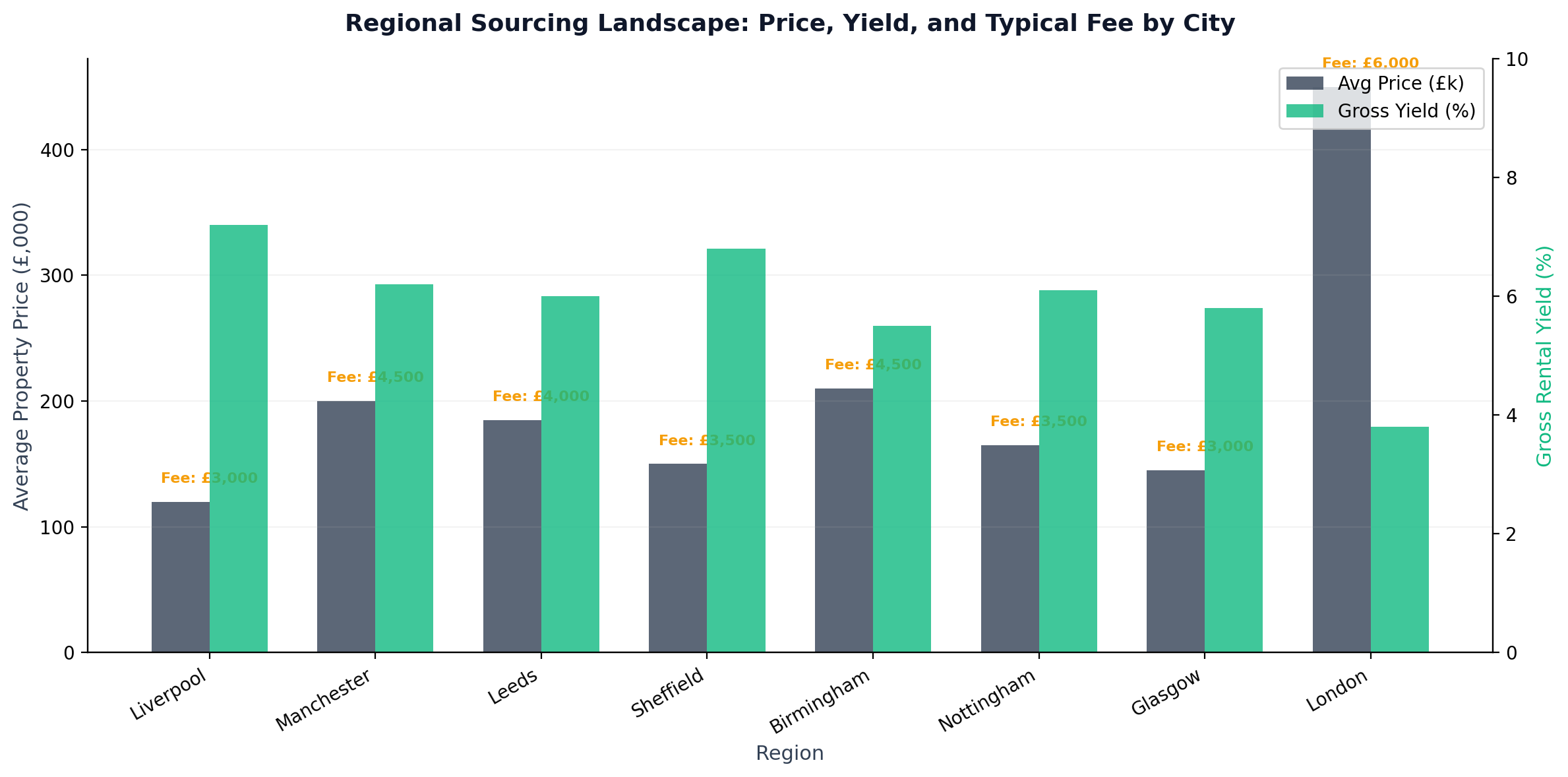
The economics of property sourcing vary dramatically by region. Here is where sourcers are currently delivering the strongest deal flow:
The Northern Powerhouse
Manchester, Liverpool, Leeds, and Sheffield dominate sourcer activity because the yield mathematics work at scale. A £150,000-£200,000 purchase price with 6-8% gross yields and genuine BRRR opportunity creates the sweet spot that sourcers need to justify their fees.
Liverpool remains the entry-level favourite — properties available from £80,000 in L4/L5/L6 postcodes still achieving £550-650 PCM rents. Sourcers operating here typically charge £3,000-4,000 fixed fees.
Manchester has moved upmarket — average sourced deal prices now sit around £180,000-£250,000. The fee competition is intense, with multiple established firms operating in the region.
The Midlands Corridor
Birmingham and Nottingham offer a middle ground between northern yields and southern capital growth. The HS2 effect (though delayed) continues to drive speculative interest in Birmingham city centre and suburban regeneration zones.
Scotland
Edinburgh and Glasgow present unique opportunities because Scottish property law operates differently — creating information asymmetries that good sourcers can exploit. The Scottish Home Report system means more data is publicly available, but local knowledge of specific schemes and tenant demographics remains the sourcer's edge.
The Legal Landscape: What Changed in 2026-2026
Several regulatory changes affect both sourcers and their clients:
The Renters Reform Bill
Now the Renters' Rights Bill, this legislation abolishes Section 21 "no-fault" evictions. For sourced investment properties, this changes the risk profile — you need stronger tenant vetting and cannot easily exit a bad tenancy. Good sourcers should factor this into their deal analysis and property investment strategies in the UK.
Energy Performance Certificate (EPC) Requirements
The trajectory toward minimum EPC C for rental properties by 2028 means any sourced property with a low EPC rating carries a hidden cost — the refurbishment needed to bring it to compliance. Sourcers should be including EPC upgrade costs in their deal analysis. Properties with EPC ratings of D or below require careful cost modelling before commitment.
Making Tax Digital
From April 2026, landlords with qualifying income over £50,000 must submit quarterly digital tax returns. This adds administrative complexity that many investors underestimate. Your sourcer should understand how this affects your overall strategy for reducing taxes legally in the UK.
Property Sourcing as a Career: The Other Side of the Equation
A significant proportion of people searching for "property sourcing companies UK" are actually looking to start their own sourcing business. Here is the reality:
What You Need to Start
- Property Redress Scheme membership — £195/year (PRS) or £365/year (TPO)
- HMRC AML registration — free but requires compliance procedures
- ICO registration — £40/year for small businesses
- Professional Indemnity Insurance — approximately £400-800/year for starting out
- Companies House registration — £12 for online incorporation
- A CRM system — to manage leads, contacts, and deal pipeline
Total startup cost: under £1,500. Which is exactly why the barrier to entry is so low and the quality range so wide.
The Revenue Model
A sourcer completing 2 deals per month at £4,000 per deal generates £96,000 in annual revenue. The operational costs are modest — no premises needed, minimal stock, and low overhead. The challenge is deal flow: finding genuine BMV properties consistently requires deep networks that take years to build.
Why Most New Sourcers Fail
The failure rate is high because the business is relationship-dependent. You need estate agents who trust you enough to call you before listing a property. You need solicitors who will refer probate cases. You need a reputation that makes vendors comfortable selling to your clients. None of this comes from a training course — it comes from years of consistent, professional operation in a specific area.
FAQ: Property Sourcing Companies UK
How much do property sourcing companies charge?
Fees typically range from £3,000 to £6,000 per deal as a fixed fee, or 1-3% of the purchase price. Some companies also charge upfront retainers of £500-£2,000. Always confirm the total fee in writing before committing, and ask about any additional referral income the sourcer receives.
Are property sourcing companies regulated in the UK?
Property sourcers must be members of an approved redress scheme (TPO or PRS), registered with HMRC for Anti-Money Laundering purposes, and registered with the ICO for data protection. Beyond these requirements, the industry is not regulated by the FCA, which is why due diligence on your part is essential.
How do I check if a property sourcing company is legitimate?
Search their company on Companies House, verify their TPO/PRS membership on the relevant register, request their AML registration number, and ask for direct contact with previous clients. A legitimate company will satisfy all four checks without hesitation.
Can I become a property sourcer with no experience?
Legally, yes — the barrier to entry is under £1,500 in registration costs. Practically, success requires deep local market knowledge, established networks with estate agents and solicitors, and a track record of finding genuine BMV deals. Most new sourcers without property industry experience fail within 18 months.
What is the difference between a property sourcer and an estate agent?
An estate agent works for the seller and earns a commission on the sale price. A property sourcer works exclusively for the buyer, earning a fee for finding investment-grade properties that meet the buyer's specific criteria. The interests are directionally different — the estate agent wants the highest price, the sourcer wants the best deal for their client.
Is property sourcing worth it for buy-to-let investors?
It depends on your time, location, and expertise. If you are investing in an area you know well and have time to source deals yourself, a sourcer adds cost without proportional value. If you are investing remotely, scaling a portfolio, or lack the time to manage the sourcing process, a good sourcer earning £4,000 per deal can deliver 10x that in genuine equity uplift.
📚 Related Reading
- Buy dirt
- How I save nearly £2,000 a Year on Groceries for a Family of 4
- How to Improve Company Cash Flow: 4 Proven Ways
- Hobbies That Make Money: Real "Cheat Codes" for Turning Your Passion Into Profit
- How Environment Affects Business Success
Stop being a landlord. Start being an investor.
Shaded Canvas introduces serious capital to vetted UK property opportunities — targeting 12–16% net returns.
Start Investing →

