

Airbnb was once the golden ticket of UK property investment — buy a flat, list it, watch the money roll in. In 2026, that story has fundamentally changed. The Furnished Holiday Let tax regime is dead. London's 90-day rule is enforced. A mandatory national registration scheme is rolling out. And operating costs have eaten into margins that once looked effortless.
So is short-term rental investment still worth it? The answer is nuanced: yes, if you treat it as a business; no, if you treat it as passive income. This guide uses real data to show you exactly where the numbers work, where they don't, and how the regulatory landscape has shifted the game entirely.
Last Updated: May 2026 | Data: AirDNA, ONS, HMRC, Airbnb Host Reports
What Changed: The 2025–2026 Regulatory Shift
The FHL Tax Abolition (April 2025)
The single biggest change in short-term rental economics in a decade:
| Feature | Before April 2025 (FHL) | After April 2025 |
|---|---|---|
| Mortgage interest | Full deduction against income | 20% basic-rate credit only |
| Capital allowances | Furniture, fixtures — fully deductible | No longer available |
| Business Asset Disposal Relief | Available (10% CGT) | No longer available |
| Pension contributions | Counted as relevant earnings | No longer counts |
| Loss offset | Against other income | Against property income only |
For higher-rate taxpayers, this single change can reduce net profit by £3,000–£8,000 per property annually. The playing field with long-term buy-to-let is now completely level on tax.
The 90-Day Rule (London)
| Rule | Detail |
|---|---|
| Applies to | Entire-home listings in Greater London |
| Limit | 90 nights per calendar year |
| Exceeding it | Requires planning permission (change of use to C5/Sui Generis) |
| Enforcement | Active — councils using Airbnb data sharing |
| Penalty | Up to £20,000 per breach + enforcement notice |
National Registration Scheme (2026)
| Status | Detail |
|---|---|
| Timeline | Phased rollout during 2026 |
| Requirement | All short-term let operators must register |
| Display | Unique registration number on all listings |
| Purpose | Safety compliance, data collection, enforcement |
Planning Permission Tightening
Local authorities are increasingly using Article 4 Directions to require planning permission for change of use from C3 (dwellinghouse) to short-term let. Cities implementing or considering restrictions include:
- Edinburgh — mandatory STL licensing since 2022
- Bath — Article 4 Direction active
- Cornwall — multiple council restrictions
- York — considering controls
- London — 90-day rule + borough-level enforcement
The Numbers: Is Airbnb Actually More Profitable?
Revenue Comparison: Short-Term vs Long-Term Let
| Metric | Airbnb (Short-Term) | Traditional BTL (Long-Term) |
|---|---|---|
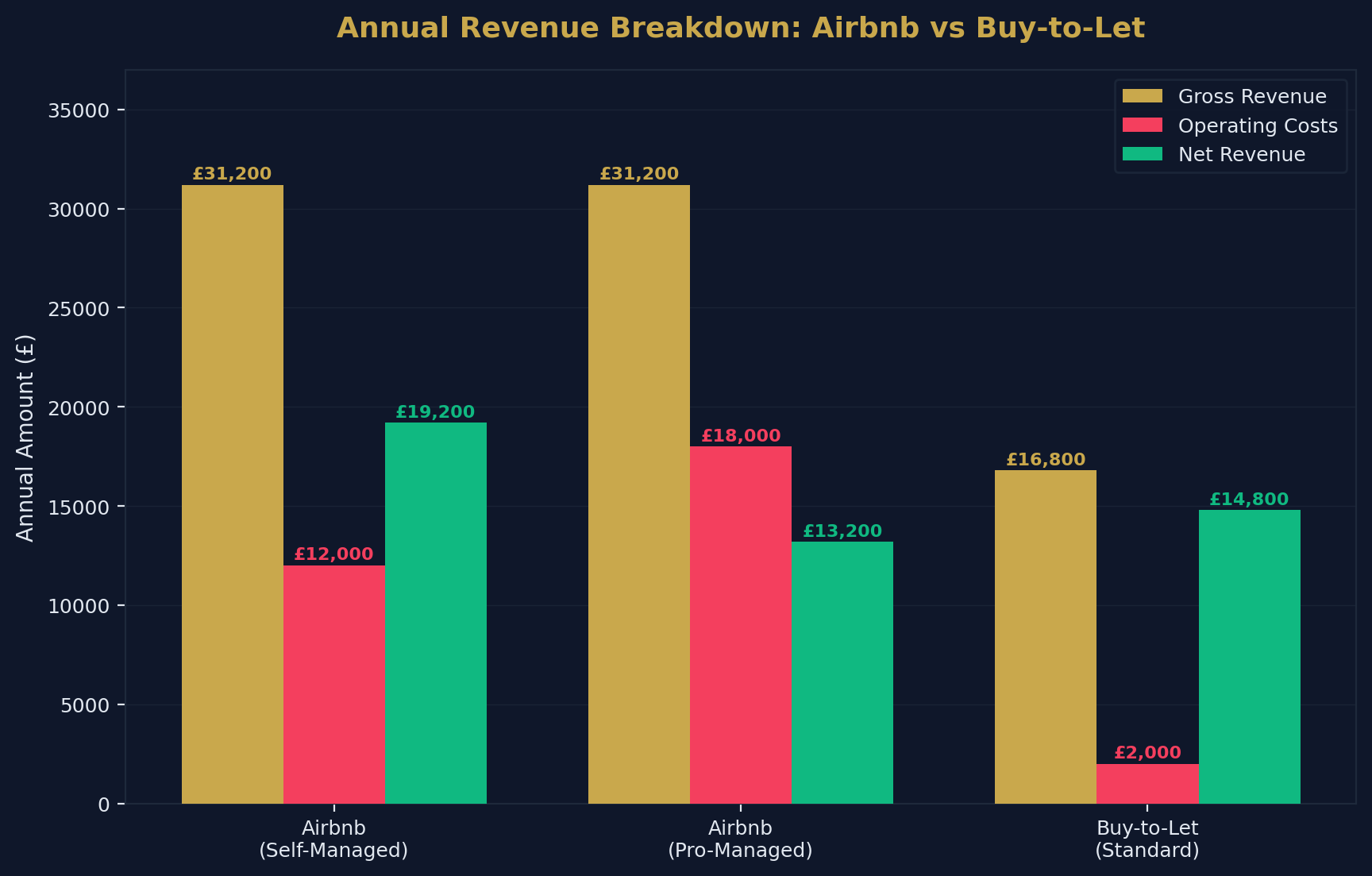
| Average monthly gross revenue | £2,600 | £1,400 |
| Annual gross revenue | £31,200 | £16,800 |
| Operating costs (% of gross) | 30–50% | 10–15% |
| Annual operating costs | £9,400–£15,600 | £1,700–£2,500 |
| Annual net revenue | £15,600–£21,800 | £14,300–£15,100 |
| Management intensity | High (daily) | Low (monthly) |
| Void risk | Higher (seasonal) | Lower (12-month tenancy) |
The surprise: After operating costs, the net revenue gap between Airbnb and traditional buy-to-let is often only £1,000–£7,000 per year — far less than the gross figures suggest.
The Operating Cost Reality
| Cost Category | Monthly | Annual |
|---|---|---|
| Cleaning (between guests) | £400–£800 | £4,800–£9,600 |
| Utilities (host-paid) | £150–£250 | £1,800–£3,000 |
| Airbnb platform fee (3%) | £80–£120 | £960–£1,440 |
| Linen & consumables | £50–£100 | £600–£1,200 |
| Professional management (15–25%) | £390–£650 | £4,680–£7,800 |
| Insurance (specialist STL) | £40–£80 | £480–£960 |
| Maintenance & repairs | £100–£200 | £1,200–£2,400 |
| Total (self-managed) | £820–£1,550 | £9,840–£18,600 |
| Total (professionally managed) | £1,210–£2,200 | £14,520–£26,400 |
City-by-City Performance
| City | Avg Occupancy | Avg Nightly Rate | Est. Monthly Revenue | Key Constraint |
|---|---|---|---|---|
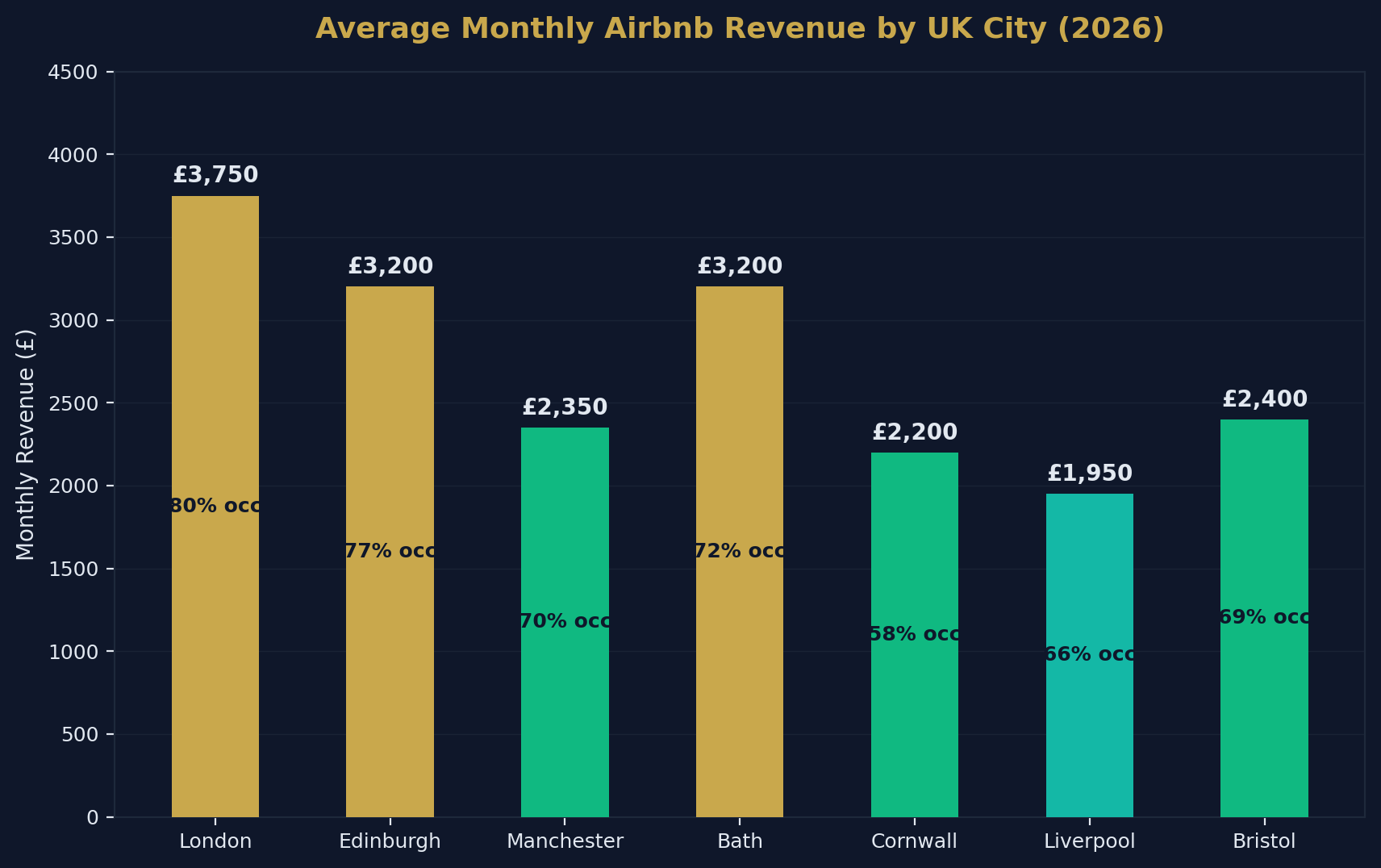
| London | 75–85% | £130–£180 | £3,000–£4,500 | 90-day cap |
| Edinburgh | 70–84% | £110–£160 | £2,400–£4,000 | STL licence required |
| Manchester | 61–78% | £90–£130 | £1,700–£3,000 | None currently |
| Bath | 65–78% | £120–£170 | £2,400–£4,000 | Article 4 Direction |
| Cornwall | 55–60% | £100–£150 | £1,700–£2,700 | Seasonal (summer-heavy) |
| Liverpool | 60–72% | £80–£110 | £1,500–£2,400 | Strong value market |
| Bristol | 62–75% | £95–£135 | £1,800–£3,000 | Growing regulation |
When Airbnb Investment IS Worth It
Scenario 1: High-Demand Tourist Locations
Properties in areas with year-round tourism demand — Edinburgh, Bath, Central London, Cotswolds — can significantly outperform traditional lets. The key is consistent 70%+ occupancy across all seasons, not just summer peaks.
Scenario 2: Unique or Premium Properties
| Property Type | Premium Potential |
|---|---|
| Period character properties | +30–50% vs standard |
| Properties with hot tubs/gardens | +20–40% vs standard |
| Eco/unusual stays (shepherds huts, treehouses) | +50–100% vs standard |
| Properties near event venues | Premium during events |
Standard flats in city centres — the most common Airbnb investment — are precisely where margins are thinnest due to competition.
Scenario 3: The Hybrid Approach
The smartest operators are using a mid-term let strategy:
| Strategy | Booking Length | Target Market | Benefit |
|---|---|---|---|
| Short-term | 1–3 nights | Tourists, weekenders | Highest nightly rate |
| Mid-term | 1–6 months | Corporate relocations, contractors | Lower costs, steady income |
| Long-term | 6+ months | Traditional tenants | Lowest risk, most stable |
A hybrid model — mid-term lets for the baseline, short-term during peak periods — often delivers the best risk-adjusted return.
When Airbnb Investment Is NOT Worth It
Red Flags
| Scenario | Why It Fails |
|---|---|
| London without planning permission | 90-day cap limits revenue to £12,000–£16,000/year |
| Seasonal-only locations | 5–6 months of income must cover 12 months of costs |
| High-mortgage properties | 30-50% operating costs + mortgage payments = negative cash flow in low season |
| Properties requiring management company | 15–25% management fee + other costs eliminate the premium over BTL |
| Leasehold with STL restrictions | Many leases prohibit short lets — breach = forfeiture risk |
The "Time Tax"
What no revenue calculator accounts for:
| Task | Time Required |
|---|---|
| Guest communication | 30–60 min/day |
| Cleaning coordination | 2–3 hours/week |
| Pricing management | 1–2 hours/week |
| Review management | 30 min/day |
| Maintenance coordination | 2–4 hours/week |
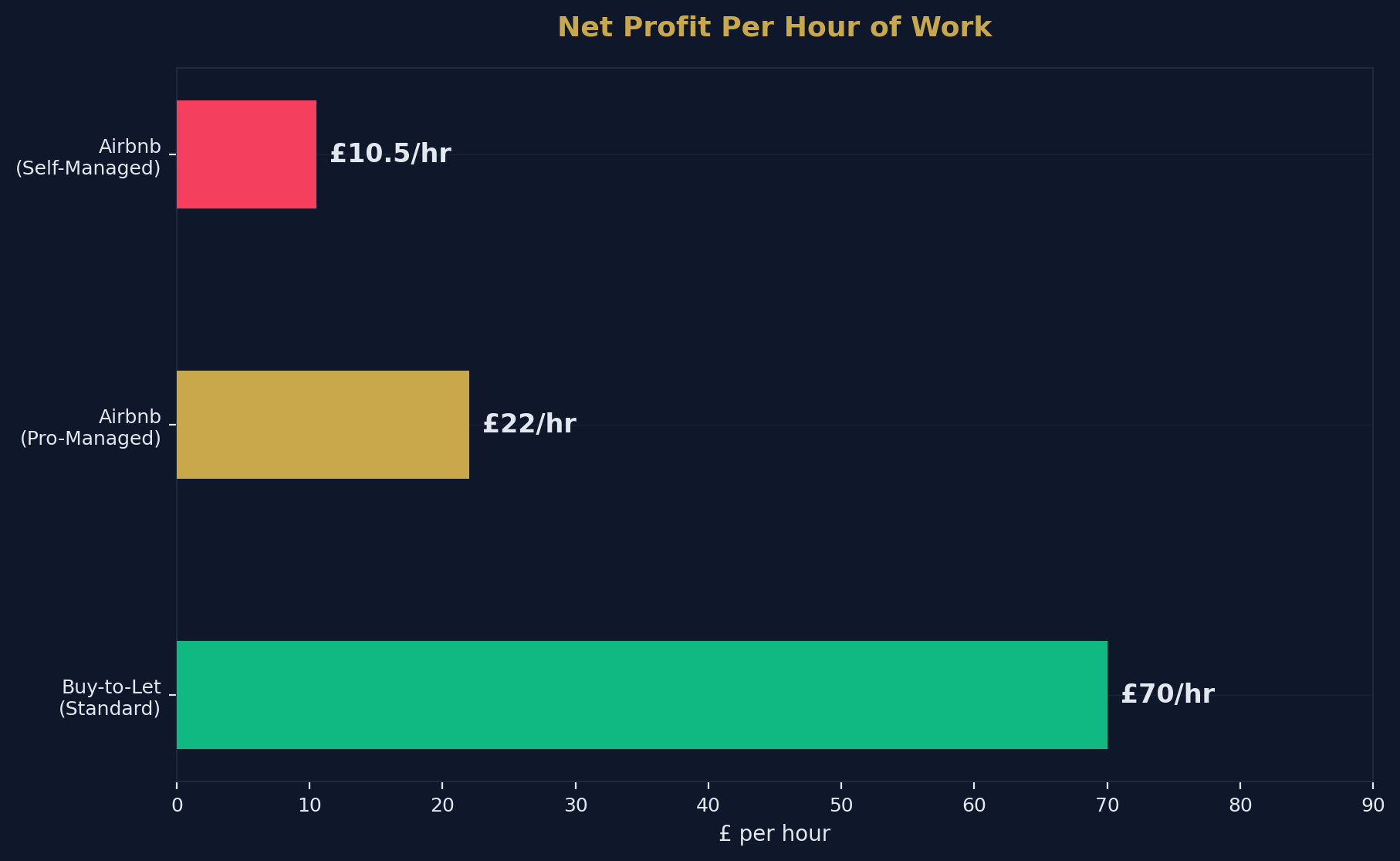
| Total weekly time commitment | 12–20 hours |
At a £30/hour opportunity cost, that's £18,000–£31,000/year in unpaid labour. Unless you enjoy hosting, this is the hidden cost that makes Airbnb a job, not an investment.
The Tax Reality Post-FHL
Tax Comparison: Airbnb vs Buy-to-Let (Higher-Rate Taxpayer)
| Metric | Airbnb (Post-FHL) | Traditional BTL |
|---|---|---|
| Gross rental income | £31,200 | £16,800 |
| Operating costs | -£12,000 | -£2,000 |
| Mortgage interest (£150k @ 5.5%) | -£8,250 | -£8,250 |
| Taxable profit | £10,950 | £6,550 |
| Tax at 40% | £4,380 | £2,620 |
| Mortgage interest tax credit (20%) | £1,650 | £1,650 |
| Tax payable | £2,730 | £970 |
| Net profit after tax | £8,220 | £5,580 |
| Net profit per hour of work | £8–£13/hr | £46–£93/hr |
When you account for time, buy-to-let pays you 5–10x more per hour than self-managed Airbnb. The only way Airbnb wins is at scale with professional management — and even then, margins are thin.
For limited company structures, the arithmetic changes — corporation tax at 19–25% is more favourable, but the FHL abolition means the same treatment applies to both strategies.
What Smart Investors Are Doing Instead
| Strategy | Detail |
|---|---|
| Serviced accommodation (SA) companies | Professional STL operators running 10+ units with economies of scale |
| Rent-to-SA | Renting properties from landlords, subletting on Airbnb (requires explicit permission) |
| Mid-term corporate lets | 1–6 month furnished lets to corporate relocations — lower costs, higher stability |
| Hybrid portfolios | Mix of long-term BTL for stability + 1–2 STL properties in prime locations |
| Northern city BTL | 6–8% yields with minimal management, outperforming STL on a net basis |
Decision Framework: Should You Invest in Airbnb?
| Question | If Yes | If No |
|---|---|---|
| Do you have a property in a year-round tourist area? | STL could work | Standard BTL is safer |
| Can you commit 15+ hours/week? | Self-manage for max returns | The numbers probably don't work |
| Do you have planning permission (London)? | Proceed carefully | Do not exceed 90 days |
| Is your property unique/premium? | STL premium justifies costs | Competition will erode margins |
| Are you a higher-rate taxpayer? | Consider Ltd company structure | Personal ownership is viable |
| Is this your only investment property? | Standard BTL is lower risk | Diversify your approach |
Frequently Asked Questions
Do I need a licence to run an Airbnb in the UK?
In Scotland, yes — a mandatory STL licence is required. In England, a national registration scheme is rolling out in 2026. Check your local council for additional requirements. In London, you need planning permission if exceeding 90 nights.
Can I get a mortgage on an Airbnb property?
Standard buy-to-let mortgages typically prohibit short-term letting. You need a holiday let mortgage or a commercial mortgage, which usually carry higher rates (typically 1–2% above standard BTL) and require larger deposits (30–40%).
How much does it cost to start an Airbnb in the UK?
Beyond the property purchase, budget £3,000–£8,000 for furnishing, professional photography, initial supplies, insurance setup, and registration/licensing fees. Ongoing monthly costs run £800–£2,200 depending on management approach.
Is Airbnb passive income?
No. Self-managed Airbnb requires 12–20 hours/week. Even with professional management (15–25% of revenue), you still handle strategy, pricing oversight, and compliance decisions. For genuinely passive property income, traditional BTL with a managed agent is far closer to the definition.
How to Cite This Page
Is Airbnb Investment Worth It in the UK? The Honest 2026 Analysis. Shaded Canvas. Published May 2026. Available at: https://blog.shadedcanvas.co.uk/post/is-airbnb-investment-worth-it-uk
Stop being a landlord. Start being an investor.
Shaded Canvas introduces serious capital to vetted UK property opportunities — targeting 12–16% net returns.
Start Investing →

