

Making Tax Digital for Income Tax Self Assessment (MTD for ITSA) is now live. From 6 April 2026, landlords with gross property income over £50,000 must keep digital records and submit quarterly updates to HMRC. This is the biggest change to how rental income is reported since Self Assessment was introduced in 1997 — and it affects an estimated 750,000 landlords in the first wave alone.
This guide explains exactly who is affected, what you need to do, when your deadlines are, which software to use, and how to avoid the new points-based penalty system. If you own investment property in your personal name, this applies to you.
Effective: 6 April 2026 | Applies to: England, Wales, Scotland, Northern Ireland
Who Is Affected?
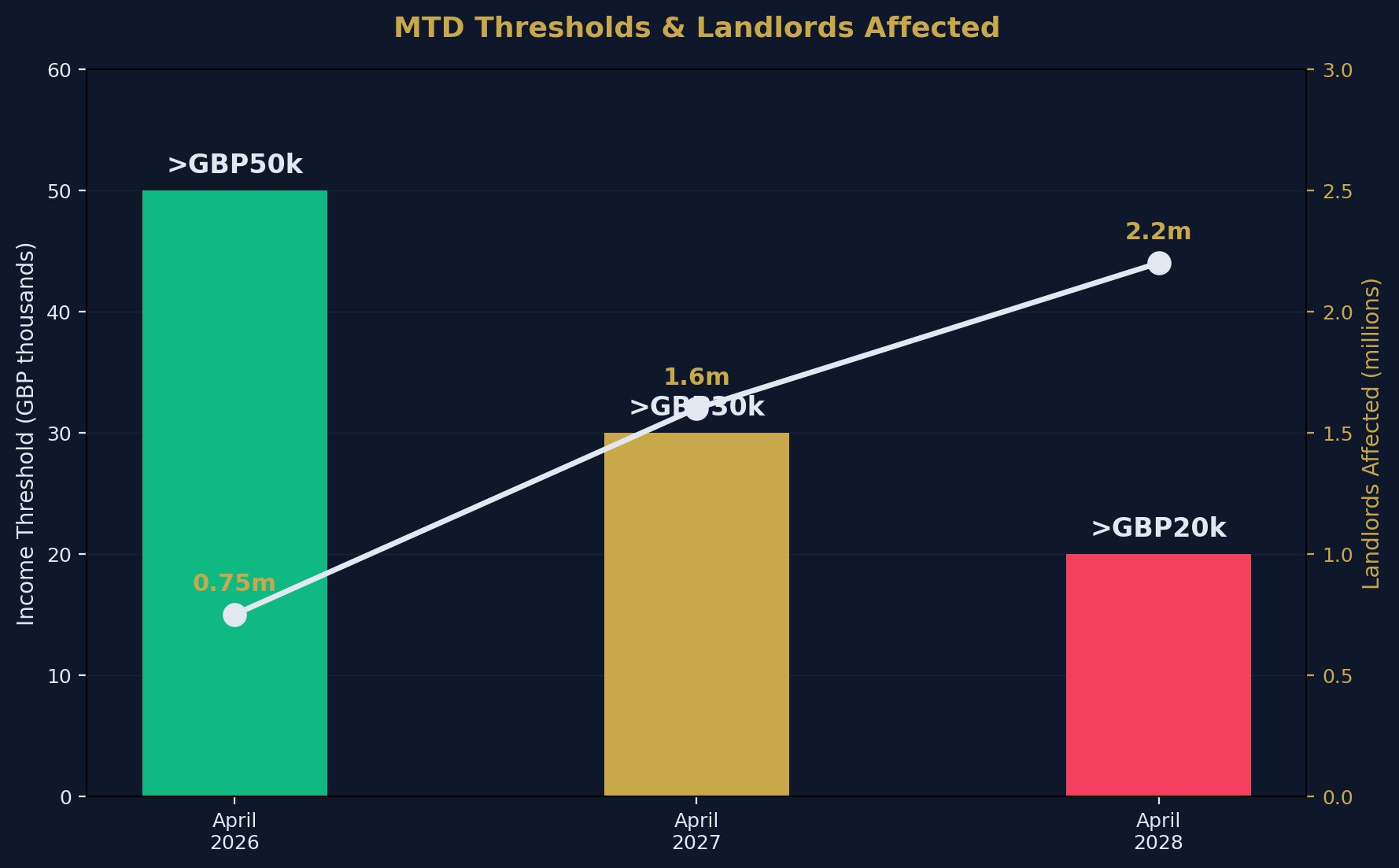
Threshold Timeline
| Date | Gross Income Threshold | Estimated Landlords Affected |
|---|---|---|
| 6 April 2026 | Over £50,000 | ~750,000 |
| 6 April 2027 | Over £30,000 | ~1.6 million |
| 6 April 2028 | Over £20,000 (planned) | ~2.2 million |
Key Rules
- Gross income = total rental income before expenses are deducted
- Includes all UK property income combined (if you own 5 properties each generating £12,000, your gross income is £60,000 — you are in scope)
- Self-employment income is added to property income for the threshold calculation
- Limited companies are EXEMPT — they follow Corporation Tax rules instead
Am I In Scope? Quick Check
| Your Situation | In Scope from April 2026? |
|---|---|
| Personal landlord, >£50k gross rental income | ✅ Yes |
| Personal landlord, £30k–£50k gross rental income | ❌ No (until April 2027) |
| Personal landlord, <£30k gross rental income | ❌ No (until April 2028) |
| Ltd company landlord (any income) | ❌ No (exempt) |
| Partnership landlord, >£50k share | ✅ Yes |
| Non-resident landlord, >£50k UK property income | ✅ Yes |
What Changes
Old System vs MTD
| Feature | Old (Self Assessment) | New (MTD for ITSA) |
|---|---|---|
| Record keeping | Paper or digital | Digital only (HMRC-compatible software) |
| Reporting frequency | Once per year | Quarterly updates + final declaration |
| Submission method | HMRC online portal | Via approved software (API connection) |
| Deadline | 31 January following tax year | Quarterly deadlines + 31 January final |
| Penalty system | Fixed fines | Points-based (like driving licence) |
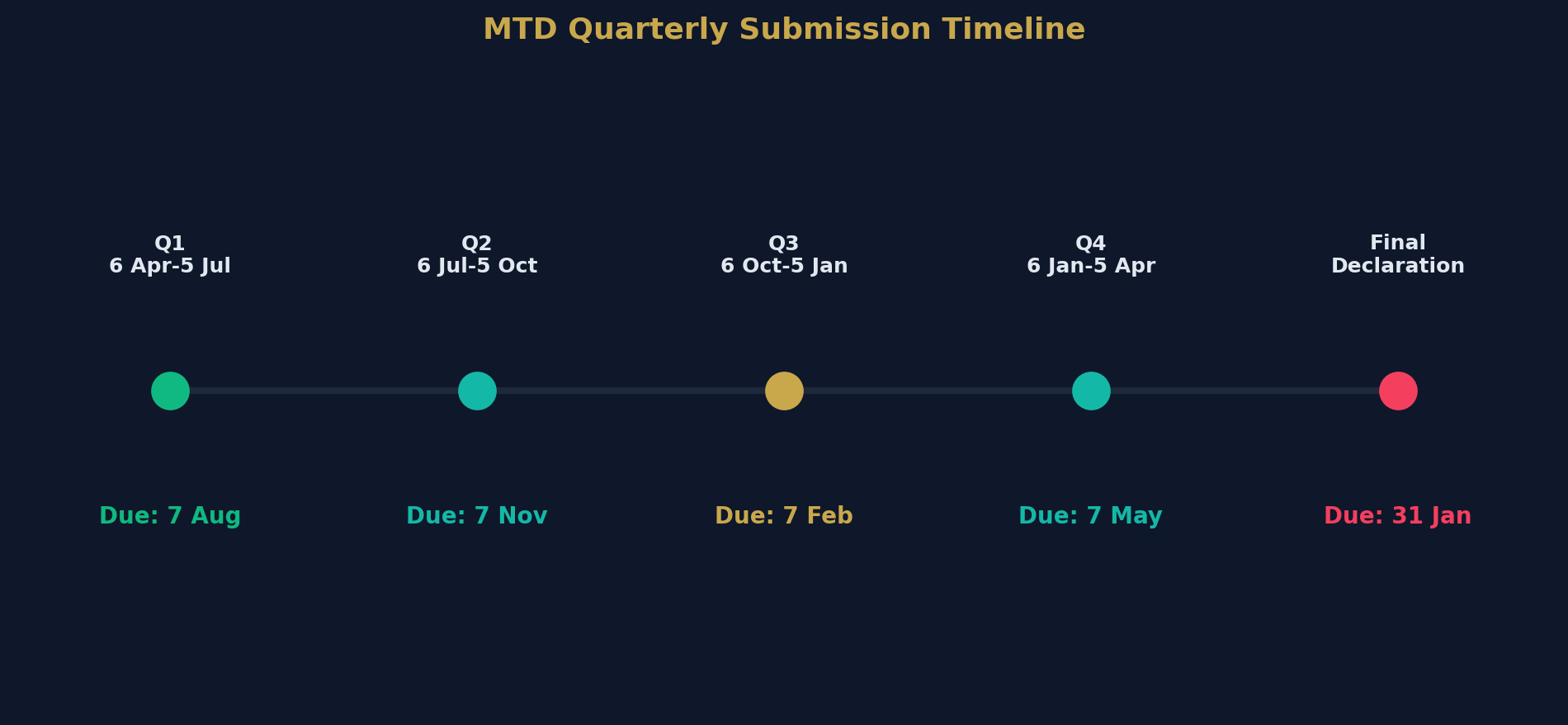
The Quarterly Cycle
You must submit a summary of income and expenses every quarter:
| Quarter | Period | Submission Deadline |
|---|---|---|
| Q1 | 6 April – 5 July | 7 August |
| Q2 | 6 July – 5 October | 7 November |
| Q3 | 6 October – 5 January | 7 February |
| Q4 | 6 January – 5 April | 7 May |
| Final Declaration | Full tax year | 31 January (following year) |
The Final Declaration replaces your traditional annual Self Assessment tax return.
What Records You Must Keep Digitally
Mandatory Digital Records
| Record Type | Examples |
|---|---|
| Income | Rent received, service charges, insurance recharges |
| Expenses | Mortgage interest, repairs, insurance, management fees, ground rent |
| Capital expenditure | Improvements, replacements (Replacement Domestic Items Relief) |
| Tenant details | Names, tenancy dates, deposit amounts |
| Property details | Address, ownership structure, EPC rating |
Supporting Evidence (Retain 5+ Years)
| Document | Why |
|---|---|
| Bank statements | Prove income and expenses |
| Letting agent statements | Monthly breakdowns |
| Receipts and invoices | Repair and maintenance costs |
| Mortgage statements | Interest amounts for tax relief |
| Insurance policies | Deductible expenses |
| EPC certificates | Compliance evidence |
| Tenancy agreements | Rental terms and periods |
Software Options
What You Need
HMRC does not provide free MTD software. You must use a commercial, HMRC-recognised product that can:
- Store digital records of income and expenses
- Connect to HMRC's API to submit quarterly updates
- Submit the final declaration
Software Comparison
| Software | Price (Annual) | Best For | Key Features |
|---|---|---|---|
| Landlord Studio | Free–£99 | Landlords specifically | Receipt scanning, bank feeds, MTD-ready |
| QuickBooks | £168–£396 | Multi-property portfolios | Full accounting, invoicing, payroll |
| Xero | £180–£420 | Accountant-managed portfolios | Bank reconciliation, app ecosystem |
| FreeAgent | £190–£380 | Landlords + self-employed | Tax timeline, auto-categorisation |
| Hammock | Free–£60 | Simple portfolios | Landlord-focused, mortgage tracking |
| GoSimpleTax | £59–£99 | Budget-conscious | Simple interface, bridging option |
| Bridging software | £0–£50 | Spreadsheet users | Links Excel/Sheets to HMRC API |
Bridging Software: Keep Your Spreadsheets
If you prefer spreadsheets, you don't have to abandon them entirely. Bridging software connects your existing Excel or Google Sheets records to HMRC's API. You maintain records in your spreadsheet; the bridging tool submits the data.
Penalty System
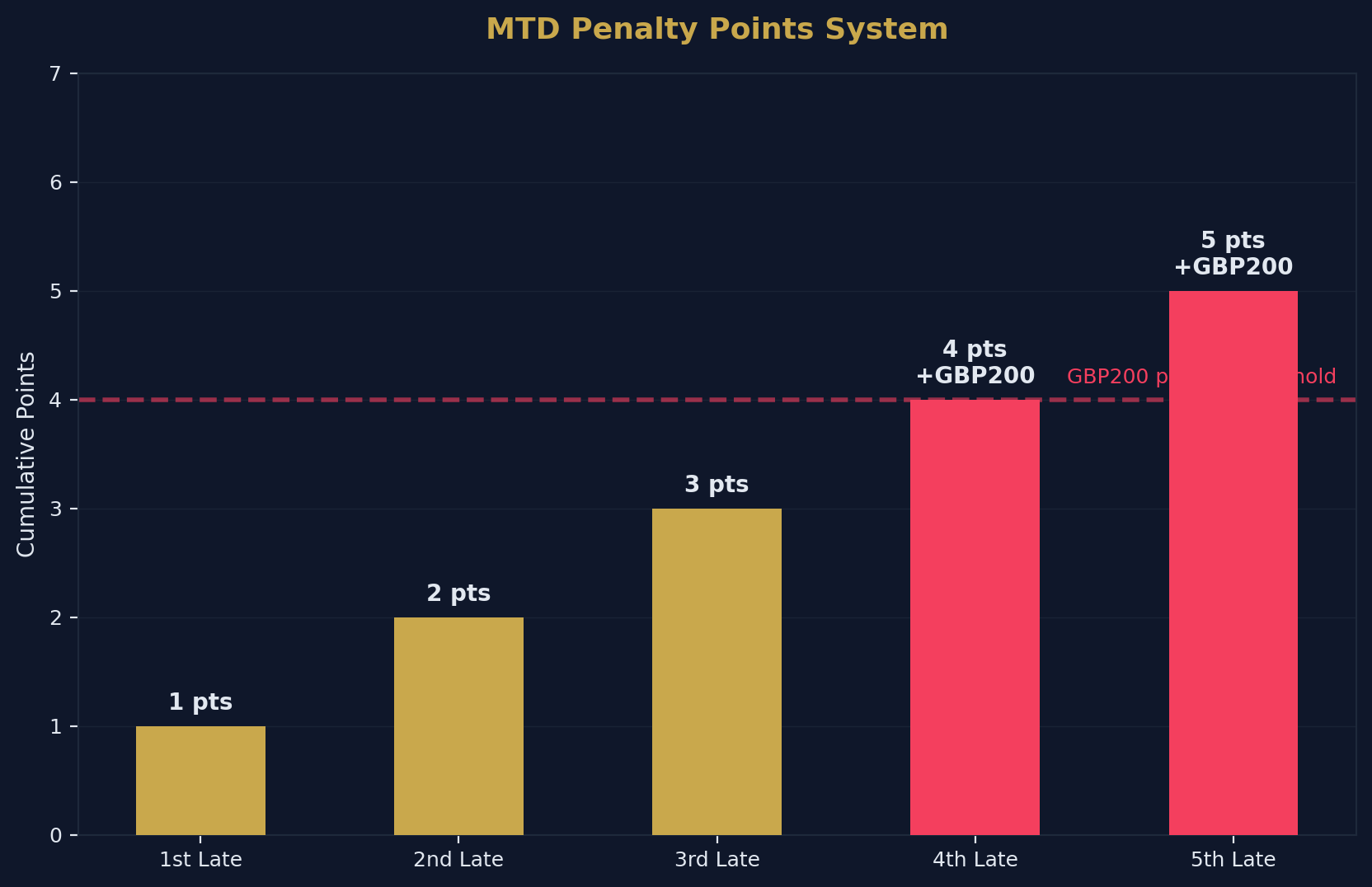
Points-Based Penalties (Late Submission)
MTD uses a penalty points system similar to driving licence points:
| Event | Points | Financial Penalty |
|---|---|---|
| First late quarterly submission | 1 point | None |
| Second late submission | 2 points | None |
| Third late submission | 3 points | None |
| Fourth late submission | 4 points | £200 penalty triggered |
| Each subsequent late submission | — | £200 each |
Points expire after 24 months of perfect compliance (all submissions on time).
Late Payment Penalties
| Delay | Penalty |
|---|---|
| Up to 15 days late | None (grace period) |
| 16–30 days late | 2% of tax owed |
| 31+ days late | 2% + additional 2% |
| After 31 days | 4% annualised daily interest |
Step-by-Step: Getting MTD-Ready
Before Your First Quarter (Do Now)
| Step | Action | Time Required |
|---|---|---|
| 1 | Check your gross income — add all property rental income (before expenses) | 10 minutes |
| 2 | Sign up for MTD via your HMRC online account (Government Gateway) | 30 minutes |
| 3 | Choose your software — pick from HMRC's approved list | 1 hour |
| 4 | Connect bank feeds — link your property bank accounts to your software | 30 minutes |
| 5 | Digitise existing records — scan receipts, upload statements from 6 April 2026 | 2–4 hours |
| 6 | Speak to your accountant — confirm your setup and quarterly workflow | 30 minutes |
Each Quarter (Ongoing)
| Task | When | Time Required |
|---|---|---|
| Categorise income and expenses | Ongoing (or monthly) | 15–30 min/month |
| Reconcile bank transactions | Monthly | 15 min/month |
| Review quarterly summary | Before submission deadline | 30 minutes |
| Submit quarterly update via software | By deadline | 5 minutes |
Annual (After Tax Year End)
| Task | When | Time Required |
|---|---|---|
| Review full-year figures | April–May | 1–2 hours |
| Add non-property income (dividends, salary) | Before final declaration | 30 minutes |
| Submit Final Declaration | By 31 January | 15 minutes |
| Pay tax due | By 31 January | — |
Impact on Buy-to-Let Investors
The Real Cost of Compliance
| Cost | Personal Landlord | <a href="/post/limited-company-buy-to-let-guide" style="color:#c9a84c;text-decoration:underline;font-weight:500">Ltd Company |
|---|---|---|
| MTD software | £60–£400/year | N/A (exempt) |
| Additional accountant time | £200–£500/year | N/A |
| Your time (quarterly admin) | 8–12 hours/year | N/A |
| Total annual compliance cost | £260–£900+ | £0 |
This Is Another Reason to Go Ltd
MTD adds yet another cost and administrative burden to personal landlords — on top of:
- Section 24 mortgage interest restrictions
- Higher stamp duty surcharges
- Renters' Rights Act compliance
- Upcoming EPC C requirements
For investors with growing portfolios, this strengthens the case for a limited company structure which is entirely exempt from MTD for ITSA.
Frequently Asked Questions
Does MTD apply to limited companies?
No. Limited company landlords are exempt from MTD for ITSA. They follow Corporation Tax rules, which have separate (and already digital) reporting requirements.
What if I have multiple properties?
All properties are combined into a single property business for MTD purposes. You submit one set of quarterly updates covering all your rental properties.
Can my accountant do it for me?
Yes — your accountant can be authorised to submit quarterly updates and the final declaration on your behalf. Most accountants are offering MTD packages for £200–£500/year on top of their standard fees.
What if I miss a quarterly deadline?
You receive one penalty point. Points accumulate — at 4 points, you receive a £200 fine. Points clear after 24 months of perfect compliance.
Do I need to submit exact figures quarterly?
Quarterly updates are summaries, not final figures. You can make adjustments in later quarters or in your final declaration. The final declaration is what determines your actual tax liability.
What about jointly owned property?
Each joint owner must register separately for MTD if their share of gross income exceeds the threshold. Each submits their own quarterly updates.
How to Cite This Page
Making Tax Digital for Landlords: The Complete 2026 Guide. Shaded Canvas. Published April 2026. Available at: https://blog.shadedcanvas.co.uk/post/making-tax-digital-for-landlords
Stop being a landlord. Start being an investor.
Shaded Canvas introduces serious capital to vetted UK property opportunities — targeting 12–16% net returns.
Start Investing →

