

Every privately rented property in England must reach EPC Band C by 1 October 2030. That is not a proposal — it is confirmed legislation. Landlords who fail to comply face fines of up to £30,000 per property. But this deadline is not just a compliance burden — it is an investment opportunity. Energy-efficient properties command higher rents, attract better tenants, sell for more, and unlock green mortgage products with preferential rates.
This guide breaks down every upgrade option, its cost, its impact on your EPC rating, and the ROI for property investors who treat energy efficiency as a strategic advantage rather than a regulatory headache.
Last Updated: April 2026 | Deadline: 1 October 2030
The Regulatory Landscape
MEES Requirements
| Requirement | Current Rule | From 1 October 2030 |
|---|---|---|
| Minimum EPC rating (PRS) | Band E | Band C |
| Spending cap per property | £3,500 | £10,000 |
| Low-value property cap | — | 10% of property value (if under £100k) |
| Penalty for non-compliance | Up to £5,000 | Up to £30,000 |
| Exemption if cap reached | Yes (5-year) | Yes (10-year) |
| Applies to | New tenancies | All tenancies |
Key Dates
| Date | Event |
|---|---|
| April 2026 | Current MEES (Band E minimum) in force |
| 1 October 2029 | New Home Energy Model (HEM) replaces current EPC methodology |
| 1 October 2030 | EPC Band C required for all PRS tenancies |
| Ongoing | Boiler Upgrade Scheme (£7,500 for heat pumps) |
| Until March 2027 | 0% VAT on energy-saving materials |
Understanding EPC Ratings
What Each Band Means
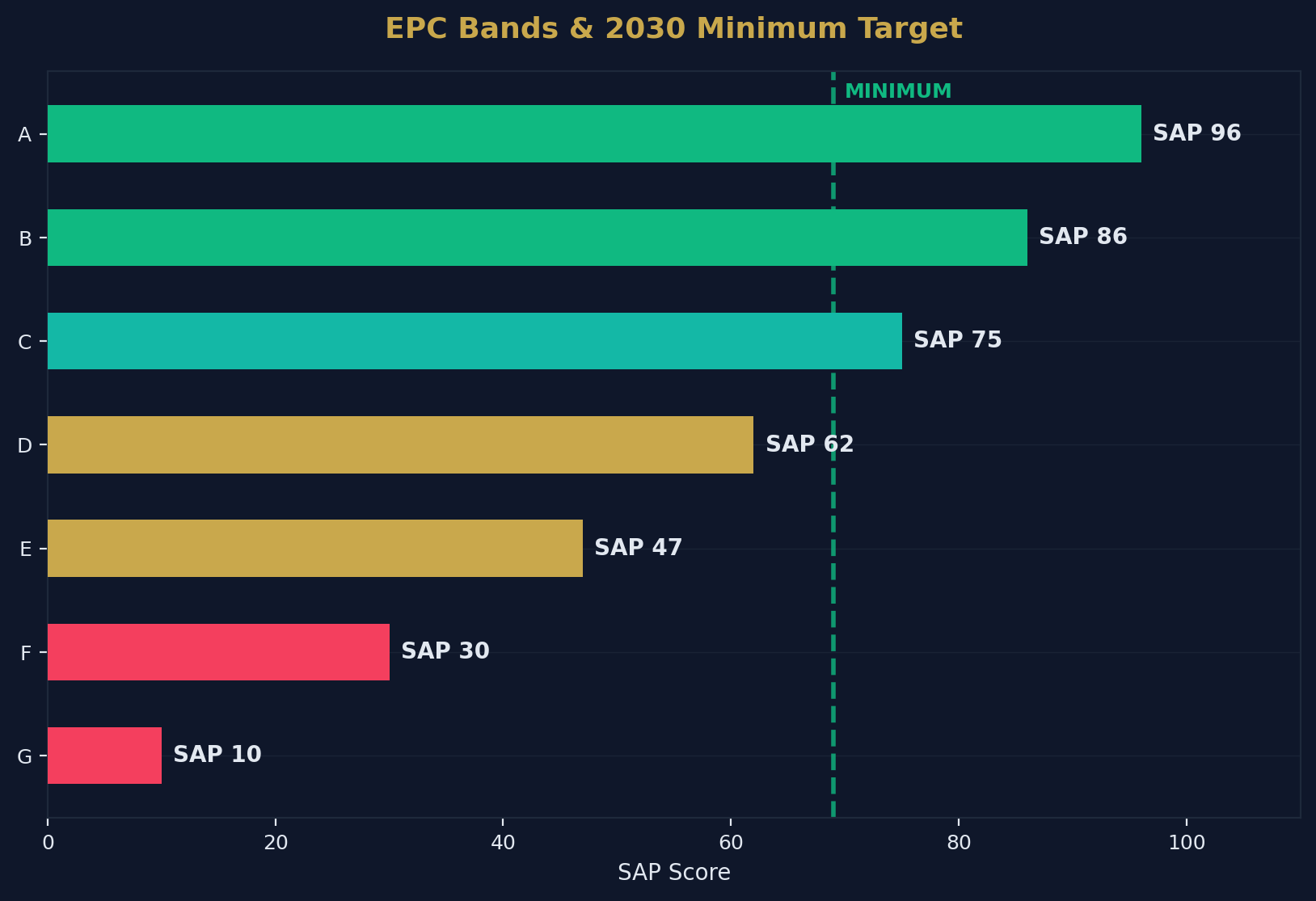
| Band | SAP Score | Typical Property | Annual Energy Cost |
|---|---|---|---|
| A | 92–100 | New-build, passive house | £400–£600 |
| B | 81–91 | Modern well-insulated home | £600–£900 |
| C | 69–80 | Minimum target for landlords | £900–£1,200 |
| D | 55–68 | Average UK home (most stock) | £1,200–£1,600 |
| E | 39–54 | Older, poorly insulated | £1,600–£2,200 |
| F | 21–38 | Very poor efficiency | £2,200–£3,000 |
| G | 1–20 | No insulation, single glazing | £3,000+ |
Where UK Housing Stock Sits
- Approximately 55% of UK homes are rated D or below
- Only ~45% currently meet the EPC C standard
- The average rental property is Band D
- Older terraced housing — the bread and butter of buy-to-let — typically sits at D or E
Upgrade Options: Cost and Impact
The Upgrade Menu
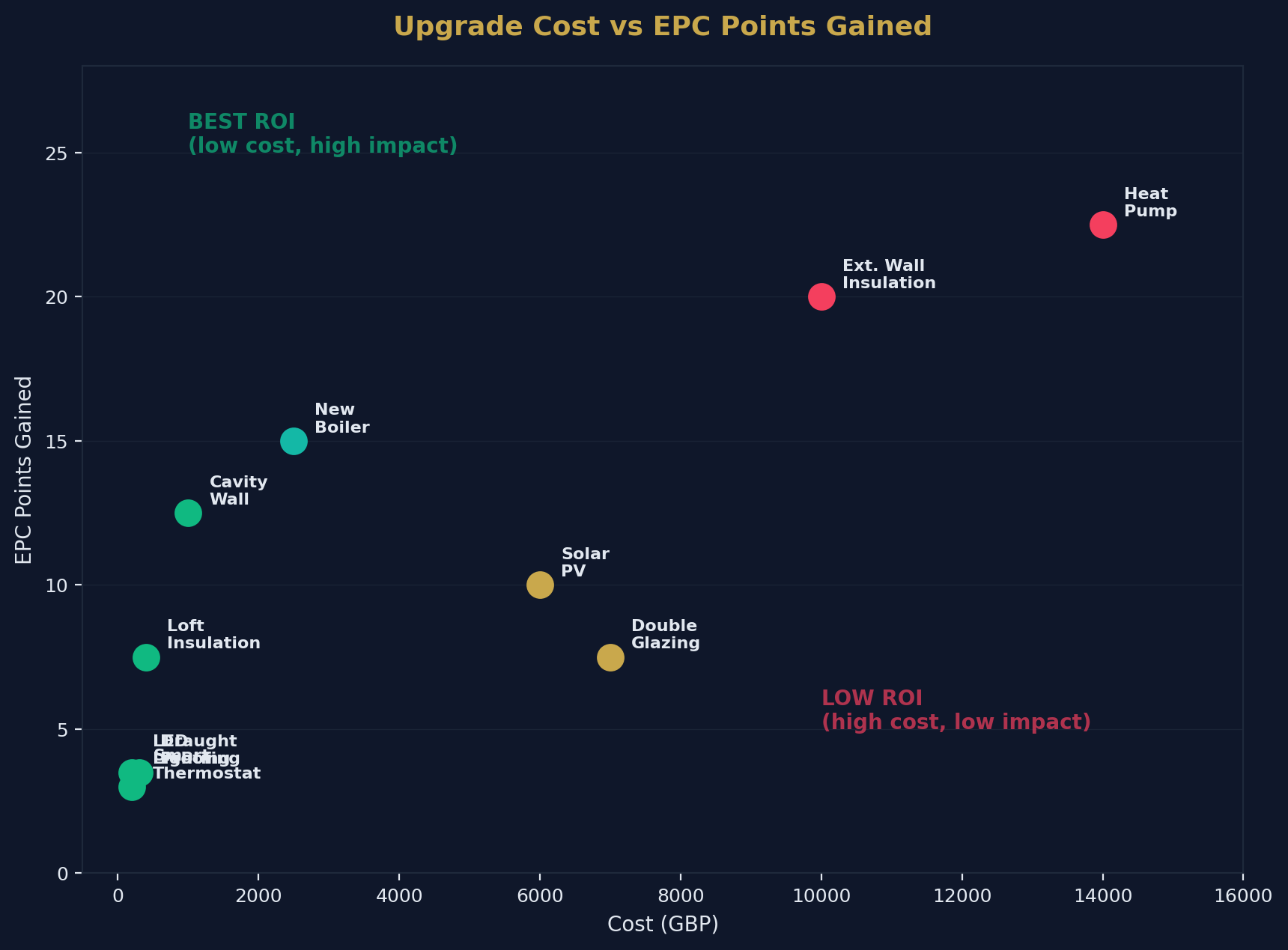
| Measure | Typical Cost | EPC Points Gained | Payback Period | Disruption |
|---|---|---|---|---|
| Loft insulation (top-up to 270mm) | £200–£600 | 5–10 points | 2–3 years | Low |
| Cavity wall insulation | £500–£1,500 | 10–15 points | 3–5 years | Low |
| LED lighting (full house) | £100–£300 | 2–5 points | 1 year | Minimal |
| Smart thermostat | £150–£250 | 2–4 points | 2 years | Minimal |
| Draught-proofing | £200–£400 | 2–5 points | 2–3 years | Low |
| Hot water cylinder jacket | £15–£30 | 1–3 points | 6 months | Minimal |
| Double glazing (full house) | £3,900–£10,000 | 5–10 points | 15–20 years | Medium |
| A-rated condensing boiler | £1,600–£3,500 | 10–20 points | 5–8 years | Medium |
| External wall insulation | £5,000–£15,000 | 15–25 points | 10–15 years | High |
| Internal wall insulation | £4,000–£10,000 | 10–20 points | 10–15 years | High |
| Solar PV panels | £4,000–£8,000 | 5–15 points | 8–12 years | Medium |
| Air source heat pump | £10,000–£18,000 | 15–30 points | 12–18 years | High |
The "Fabric First" Approach
The most cost-effective strategy is to reduce heat loss before upgrading heating systems:
Phase 1: Quick Wins (£500–£1,500 total)
- Top-up loft insulation → 5–10 points
- Cavity wall insulation → 10–15 points
- LED lighting + smart thermostat → 4–9 points
- Draught-proofing → 2–5 points
Total: 21–39 points gained for under £1,500
This alone can push a Band E property into Band D, or a Band D into Band C.
Phase 2: Major Interventions (if still below C) 5. Boiler upgrade → 10–20 points 6. Double glazing → 5–10 points
Phase 3: Deep Retrofit (rarely needed) 7. External/internal wall insulation 8. Heat pump 9. Solar PV
Most properties can reach Band C with Phase 1 + Phase 2 alone, at a total cost of £3,000–£6,000 — well within the £10,000 cap.
Financial Incentives and Support
Available Now
| Scheme | Benefit | Eligibility |
|---|---|---|
| Boiler Upgrade Scheme | £7,500 grant for heat pump installation | All homeowners/landlords in England |
| 0% VAT on energy materials | No VAT on insulation, heat pumps, solar | Until March 2027 |
| Home Upgrade Grant (HUG2) | Up to £10,000 for off-gas-grid homes | Landlord with eligible tenants |
| ECO4 / Great British Insulation | Free/subsidised insulation | Low-income tenants or low EPC |
| Green mortgages | Lower rates for EPC A/B properties | Various lenders |
Green Mortgage Products
| Lender | Product | Benefit |
|---|---|---|
| Nationwide | Green Reward | Up to £500 cashback for A/B rated |
| Barclays | Green Home | Discounted rate for A–C rated |
| NatWest | Green Mortgage | Rate discount + cashback |
| Halifax | Green Living Reward | £750–£2,000 toward improvements |
Tax Deductibility
Energy efficiency improvements are generally tax-deductible for landlords:
- Limited company: Deducted as a business expense, reducing corporation tax
- Personal ownership: Treated as an allowable revenue expense (if replacing like-for-like) or capital expenditure
The ROI Case
Value Impact of EPC Improvements
| Improvement | Capital Value Uplift | Rental Premium | Annual Saving (Tenant) |
|---|---|---|---|
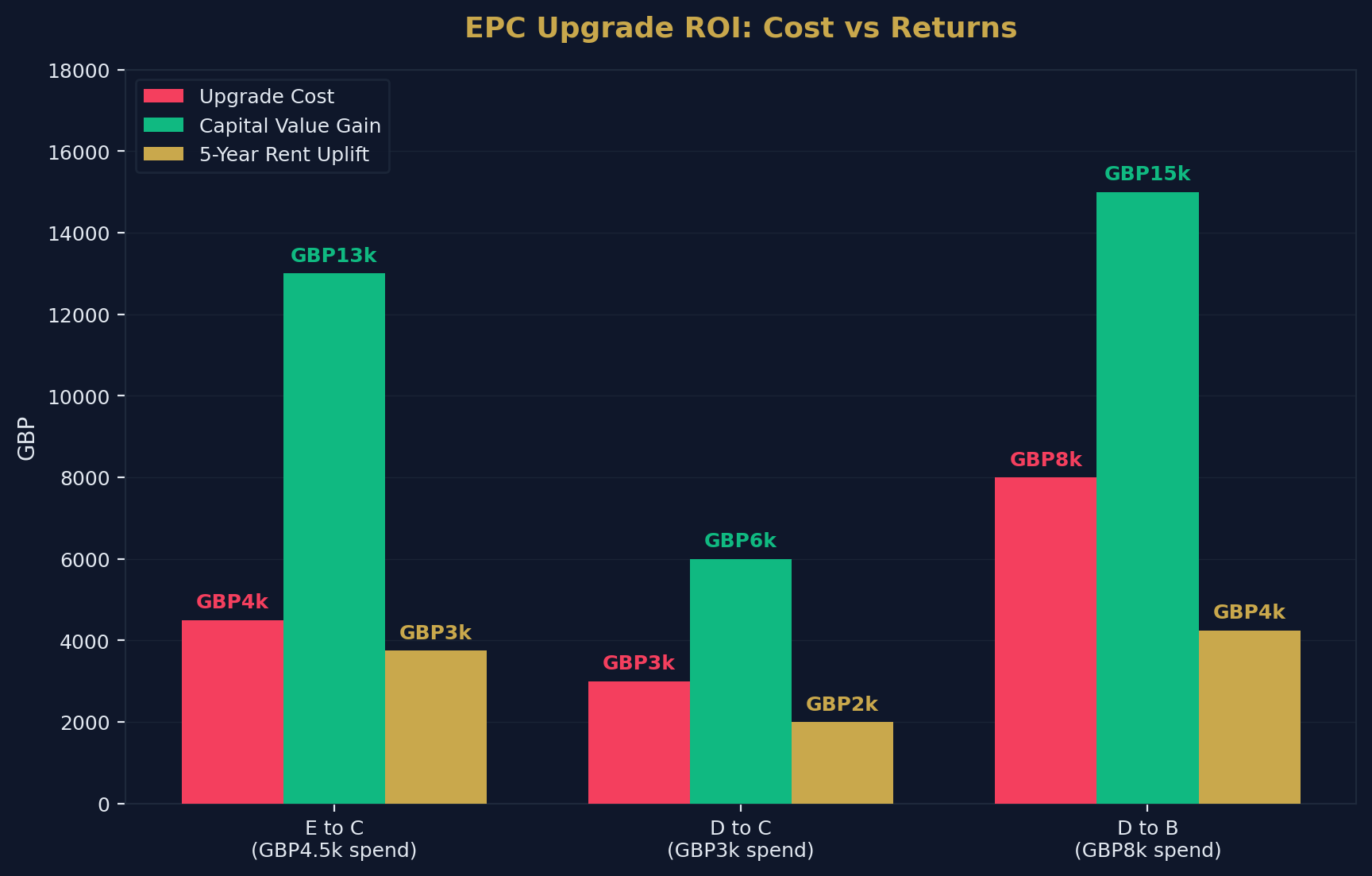
| E → C | +5–8% property value | +5–10% rent premium | £400–£800/year |
| D → C | +2–4% property value | +3–5% rent premium | £200–£400/year |
| D → B | +5–10% property value | +5–12% rent premium | £400–£700/year |
Worked Example: Band E → Band C
| Metric | Before (Band E) | After (Band C) |
|---|---|---|
| Property value | £200,000 | £210,000–£216,000 |
| Monthly rent | £850 | £893–£935 |
| Annual rental income | £10,200 | £10,716–£11,220 |
| Upgrade cost | — | £4,500 |
| Payback from rent uplift | — | 4–9 years |
| Capital value gain | — | £10,000–£16,000 |
An investor spending £4,500 gains £10,000+ in capital value immediately, plus £500–£1,000/year in higher rent. This is one of the highest-ROI forced appreciation strategies available to property investors.
Common Property Types: Upgrade Paths
Victorian/Edwardian Terrace (Typical Band E/F)
| Issue | Solution | Cost | Points |
|---|---|---|---|
| Solid walls (no cavity) | Internal or external insulation | £4,000–£15,000 | 15–25 |
| Single glazing | Double glazing | £4,000–£8,000 | 5–10 |
| Old boiler | A-rated condensing boiler | £2,000–£3,000 | 10–20 |
| Minimal loft insulation | 270mm top-up | £300–£500 | 5–10 |
| Total | £10,000–£26,500 | 35–65 |
Note: The £10,000 cap means landlords only need to spend up to this amount. If the property doesn't reach C after £10,000, a 10-year exemption can be registered.
1960s–1980s Semi-Detached (Typical Band D)
| Issue | Solution | Cost | Points |
|---|---|---|---|
| Un-filled cavity walls | Cavity wall insulation | £500–£1,500 | 10–15 |
| Thin loft insulation | Top-up to 270mm | £200–£400 | 5–10 |
| Old boiler (15+ years) | A-rated condensing boiler | £2,000–£3,000 | 10–20 |
| Halogen/CFL lighting | LED throughout | £100–£200 | 2–5 |
| Total | £2,800–£5,100 | 27–50 |
This property type is the easiest to upgrade — usually reaching Band C for under £5,000.
Purpose-Built Flat (Typical Band C/D)
| Issue | Solution | Cost | Points |
|---|---|---|---|
| Electric heating | Storage heaters or heat pump | £2,000–£8,000 | 10–20 |
| Single-glazed windows | Double glazing (if leasehold permits) | £2,000–£5,000 | 5–10 |
| No thermostat | Smart thermostat | £150–£250 | 2–4 |
| Total | £4,150–£13,250 | 17–34 |
Leasehold flats may face restrictions on external changes. Check the lease and engage the freeholder early.
Strategic Considerations for Investors
Acquisition Strategy
Smart investors are now actively targeting low-EPC properties as a value-add play:
- Buy at a discount (below-market due to poor EPC)
- Upgrade to Band C for £3,000–£6,000
- Achieve £10,000–£20,000 capital uplift
- Secure higher rent + access green mortgage rates
- This is forced appreciation — similar to a light refurbishment but focused on energy metrics
Portfolio Audit Checklist
| Action | Priority |
|---|---|
| Commission new EPCs for all properties (old ones may underrate) | 🔴 Now |
| Identify properties already at C or above | ✅ No action |
| Identify D-rated properties (quick win) | 🟡 Plan upgrades |
| Identify E/F-rated properties (significant work) | 🔴 Budget now |
| Check for available grants (ECO4, HUG2, BUS) | 🟡 Apply now |
| Model upgrade costs vs exemption strategy | 🟡 With accountant |
| Check stamp duty implications if selling | ⚠️ If considering exit |
The Exemption vs Upgrade Decision
If spending £10,000 still won't get you to Band C:
- Register a 10-year exemption (free, but property remains less valuable)
- Or sell to an investor/developer who can undertake deeper works
- The exemption is a legitimate backstop — but it doesn't increase your asset value
For most buy-to-let portfolios, the upgrade is the better financial decision because the capital uplift exceeds the cost.
Frequently Asked Questions
Do I need to upgrade before 2030?
Not legally — but practically, yes. Mortgage lenders are already factoring EPC ratings into valuations. Properties with poor ratings may face down-valuations at remortgage, reducing your available equity.
What if my tenant won't allow access for works?
The Renters' Rights Act includes provisions for landlords to access properties for necessary improvements. You must give reasonable notice and minimise disruption.
Are heat pumps worth it for rental properties?
For most rental properties, a modern condensing boiler remains the better ROI. Heat pumps make sense for off-gas-grid properties or when combined with the £7,500 Boiler Upgrade Scheme grant.
Does EPC rating affect property tax?
Not directly — but council tax revaluation (expected 2028+) may factor in energy efficiency. Green mortgages also reduce your finance costs, improving after-tax returns.
What about HMOs?
HMOs require an EPC for the whole property. If individual rooms are let, you may need EPCs for each unit. Check with your local authority.
How to Cite This Page
EPC Upgrades for Landlords: Costs, ROI, and the 2030 Deadline. Shaded Canvas. Published April 2026. Available at: https://blog.shadedcanvas.co.uk/post/epc-upgrades-for-landlords
Stop being a landlord. Start being an investor.
Shaded Canvas introduces serious capital to vetted UK property opportunities — targeting 12–16% net returns.
Start Investing →

